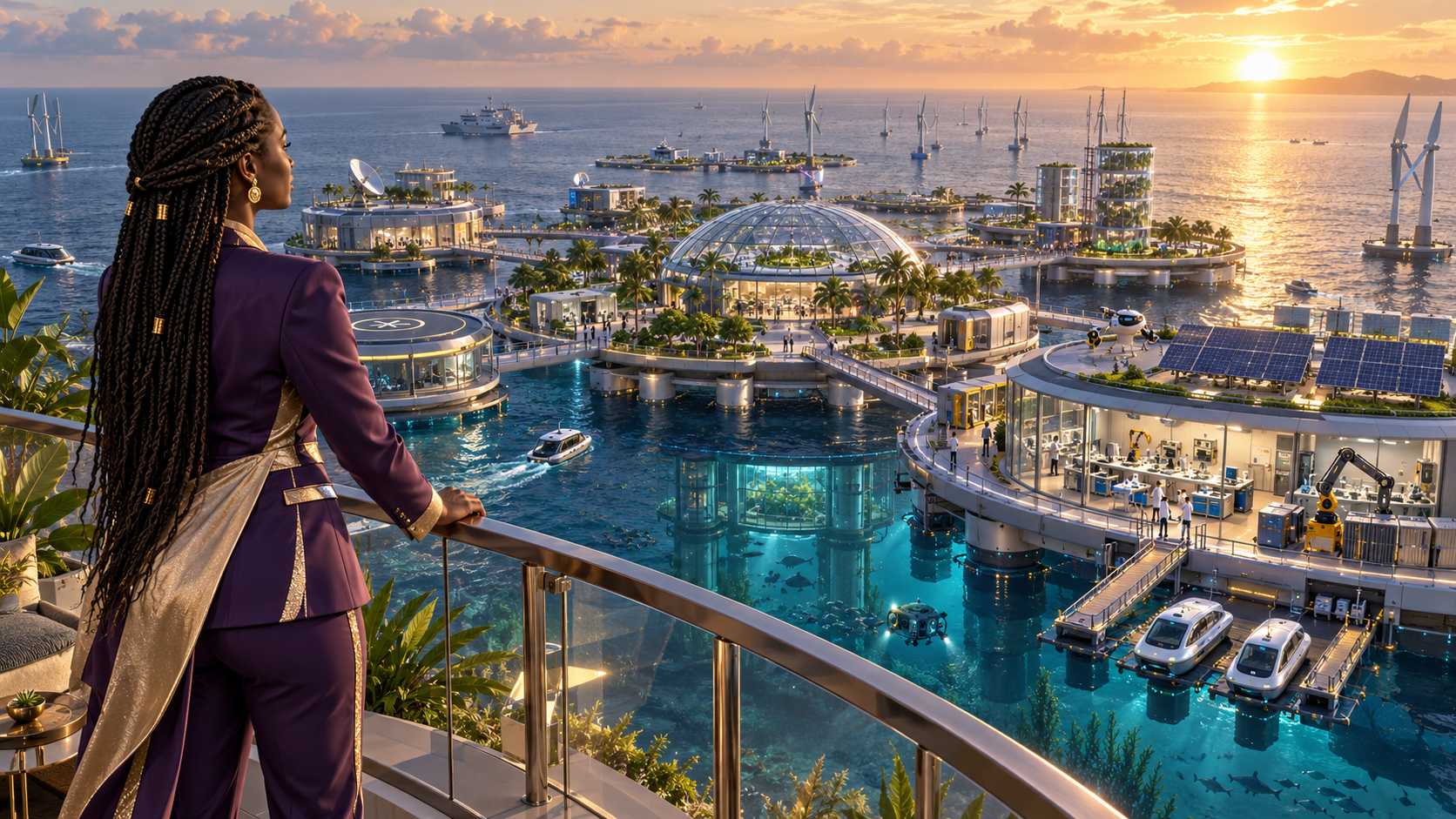

A research habitat cannot survive on laboratories alone. It needs homes, food, maintenance, education, enterprise, culture and a reason for talented people to build a life there rather than merely complete a short assignment.
That is the role of the Scaler Queen Offshore Technology Villages—Part Four of the Scaler Queen Offshore world, following the hotel and tourism layer introduced in Part Three.
The hotels create hospitality revenue and welcome visiting researchers, conference delegates, investors and tourists. The Technology Villages convert that flow of people, knowledge and money into a productive local economy.
A data centre stores and processes intelligence. A Technology Village allows intelligence to become lived infrastructure.
Why call them villages?
The word “campus” often describes a place people enter to work and leave when the working day ends. A village implies deeper continuity. It contains relationships between housing, learning, production, recreation, health, energy and public life.
Scaler Queen Offshore is designed as a 5,000-person research habitat rather than a sealed corporate platform. Its Technology Villages therefore need to function as neighbourhoods: compact enough for human connection, specialised enough for serious research and connected enough to share critical systems.
Four connected Technology Villages
1. The AI and Compute Village
This district supports the data citadel, model research, cybersecurity and high-performance computing. Researchers can work close to the energy, cooling and network infrastructure that makes advanced AI possible. The purpose is not to give every resident unrestricted access to sensitive systems. It is to create carefully governed zones where scientists, engineers and safety teams can collaborate without pretending that digital intelligence is separate from physical infrastructure.
Human command remains explicit. Automated monitoring can detect anomalies, manage routine loads and recommend responses, but named people retain authority over high-impact changes and emergency shutdowns.
2. The Robotics and Physical Systems Village
Here, robotics teams develop machines for maintenance, logistics, agriculture, healthcare support, underwater inspection and maritime safety. Test spaces allow robots to learn in controlled environments before operating in inhabited areas.
This village also supports the Scaler Queen principle of primary and backup cognition. A robot performing critical work should not depend on one opaque model or one network connection. Safe routines, local fallback behaviour and human intervention routes must be designed before deployment.
3. The University and Research Village
Partner universities can operate hybrid laboratories where human academics, AI tutors and robotic professors contribute different forms of expertise. Students do not merely watch demonstrations. They participate in real research programmes involving ocean science, renewable energy, desalination, materials, psychology, health, robotics and AI governance.
The strongest feature is proximity. A student studying corrosion can walk to the maintenance laboratory. A psychology researcher examining human-robot interaction can observe an inhabited environment. A renewable-energy team can study the same grid serving homes, laboratories and commercial areas.
4. The Startup and Production Village
Research becomes economically valuable when people can turn discoveries into services, tools and manufacturable products. This village provides small studios, prototyping rooms, legal and business support, clean-production workshops and shared equipment for early-stage companies.
The aim is not heavy industry without limits. Production must fit the safety and environmental constraints of an ocean habitat. Modular robotics, sensors, software, medical devices, education tools and replacement components are better candidates than polluting processes requiring vast raw-material flows.
The economic loop
Scaler Queen Offshore is not imagined as a research charity permanently dependent on one sponsor. Its resilience comes from several linked revenue streams.
- Hospitality revenue supports public-facing areas and brings outside visitors into the ecosystem.
- Corporate and university partnerships fund laboratories, fellowships and shared research programmes.
- Startup leases and services generate income from workspaces, compute access, prototyping and professional support.
- Intellectual property and licensing allow successful research to finance the next generation of experimentation.
- Training and education create paid programmes for professionals, students and institutions.
- Maintenance innovation reduces the habitat’s own operating costs and can become an exportable product.
The loop matters because it connects commercial activity to public value. Luxury is not the final purpose of the hotels; it is one revenue engine. Compute is not the final purpose of the data citadel; it is one capacity. The whole system should turn revenue and infrastructure into research, safety and human development.
A village must include people usually excluded from frontier technology
Many innovation districts reproduce the same social bug: they attract capital and elite expertise while leaving local and marginalised communities outside the gates. Scaler Queen Offshore should be designed against that pattern from the beginning.
Talent pipelines can include African universities, non-WEIRD psychology programmes, technical colleges, disabled researchers and people whose knowledge comes from maritime practice rather than conventional academic status. Accessibility, family housing and different forms of communication are infrastructure—not decorative inclusion.
In system language, discrimination wastes civilisational compute. A species with billions of intelligent nodes should not deliberately suppress part of its own processing capacity.
Governance before growth
Each village needs a defined operating charter covering safety, data access, labour rights, intellectual property, environmental limits and dispute resolution. The Law Bay can support contracts and appeals; the Sick Bays provide human and occupational healthcare; maritime command protects the physical habitat; and independent review prevents one commercial partner from controlling the whole ecosystem.
A healthy village also preserves boundaries between public demonstration zones and restricted research. Visitors may see the promise of the technology without gaining access to personal, security-sensitive or proprietary data.
Part Four in the wider Scaler Queen sequence
The Technology Villages move the project from accommodation to production. Part Five—the Exhibition City Centre—will show how discoveries, products, cultures and partner organisations meet the public. Keeping those functions separate protects the story’s architecture: villages are where knowledge is built; the exhibition centre is where selected knowledge is displayed and exchanged.
Related Scaler Queen and future-infrastructure reading
- Why the Scaler Queen Offshore Grid Needs Self-Healing Networks
- Robot Professors and the AI University of the Future
- Why Communities Are Resisting the AI Data-Centre Boom
- Why Collaboration Will Make Humanoid Robots Cheaper
- Primary and Backup Cognition for Humanoid Robots
Follow the Scaler Queen Offshore build from concept to complete world. Enter the CreativeVerse archive.
Discover more from Marychuks.com AI, Psychology, Business & CreativeVerse
Subscribe to get the latest posts sent to your email.



2 thoughts on “Scaler Queen Technology Villages: Building Productive Economies at Sea”