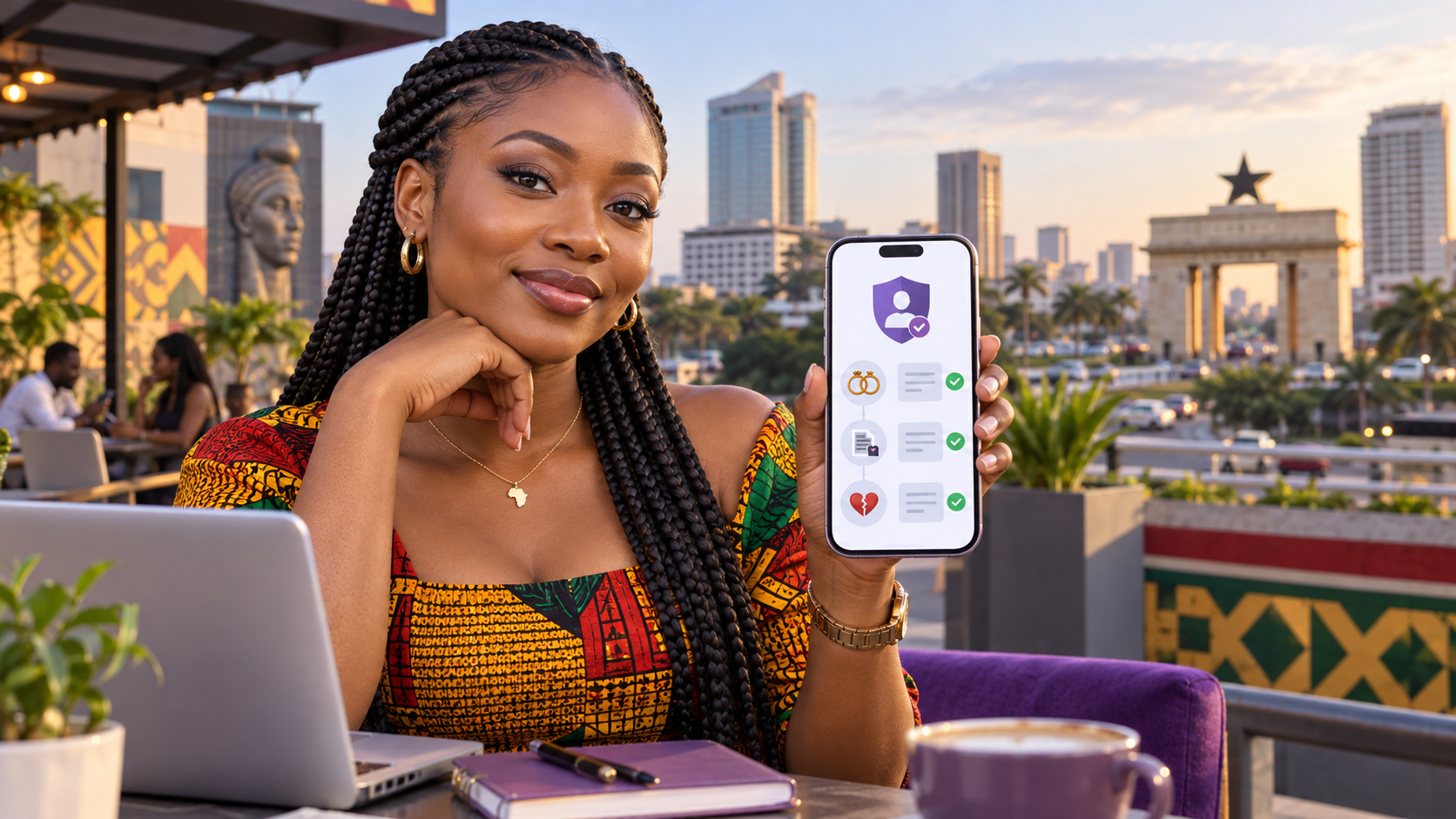

Ghana has launched a digital platform that could change a question many people struggle to answer before marriage: is the person I am planning a future with already legally married to someone else?
The platform is called Marrify. It was launched in Accra on 28 August 2026 in partnership with Ghana’s Ministry of Gender, Children and Social Protection, according to Ghana’s Daily Graphic. Its official website provides searchable modules for marriage records, divorce records, marriage officers, marriage venues, licensed imams and denomination profiles.
The idea immediately raises a bigger possibility. If a trusted system can confirm an important part of a person’s civil status, could dating platforms offer a privacy-conscious verification layer before users make emotional, financial or marital commitments?
What Marrify says it covers
Marrify presents itself as a national marriage and divorce registry platform. Its website says users can search across customary, Islamic, ordinance and international marriage records while preserving links between spouses, venues, certificates and source context.
The platform also publishes ambitious coverage figures: a Gazette span from 1886 to 2026, all 16 regional coordinating councils and 261 metropolitan, municipal and district assemblies. These are the platform’s own stated coverage claims and should be assessed alongside the source attached to an individual result.
One detail circulating on social media requires caution. In the official pages and reporting reviewed for this article, I did not find a confirmed requirement that users must enter Ghana’s national identity number to reveal “everything” about a person. Readers should therefore distinguish the verified search functions from viral descriptions of how the app works.
Why the concept matters
A hidden existing marriage is not a small profile exaggeration. It can expose another person to emotional harm, financial loss, legal complications, health risks and public humiliation. It can also affect children and spouses who never consented to becoming part of a concealed relationship.
At present, most dating verification is narrow. A badge may show that a face resembles the person in uploaded photographs or that a telephone number works. It does not necessarily verify marital status, name history, criminal intent, financial claims or the quality of someone’s behaviour.
Identity verification answers “Are you this person?” Marital-status verification asks “Is this important legal claim about you accurate?” They are different safety layers.
What Marrify can—and cannot—prove
A registry search can strengthen evidence about a recorded legal event. It may show that a marriage was registered, a divorce was recorded, an officiant was licensed or a venue appeared in official records.
It cannot automatically prove that every record is complete, current or correctly matched to the person in front of you. Names can be shared. Historical records can contain errors. Some marriages may not have reached the relevant database. A person may use a variation of a name, and a lawful divorce may not yet appear.
Nor can a “clear” search result prove that someone is honest, emotionally safe or compatible. Verification reduces uncertainty in one domain; it does not certify character.
The privacy question
Marriage and divorce information sits at the intersection of public records, personal identity and intimate life. Ghana’s Data Protection Act 2012 (Act 843) regulates how personal information is obtained, held, used and disclosed. A trusted verification service therefore needs more than an impressive search box.
- Purpose limitation: collect or reveal only what is necessary for the stated safety purpose.
- Identity matching: prevent users from attaching another person’s record to the wrong profile.
- Correction routes: let people challenge records that are inaccurate, outdated or incomplete.
- Access controls: stop bulk harvesting, stalking and discriminatory profiling.
- Security: protect queries and results from unauthorised disclosure.
- Transparency: explain the source, date and limits of every result.
The safest design may not show a stranger the full record. It could return a minimal, time-limited statement such as “marital-status check completed on this date”, with the person’s consent and a route to dispute an error.
How dating platforms could use this idea
A global dating platform should not simply copy Ghanaian records into its own database. Civil-status systems differ between countries, and international marriages create additional complexity. A better model would connect to approved national or local registries through governed verification providers.
- Obtain informed consent from the person whose status will be checked.
- Match identity securely without exposing the identity document to other users.
- Return the minimum result needed for the safety purpose rather than a complete personal history.
- Date-stamp the check because status can change.
- Provide human review when records conflict or a user disputes the result.
- Prohibit misuse for harassment, public shaming or unauthorised background investigations.
This could become one layer in the future ChatConnect model: AI-assisted matchmaking supported by verified information, user choice and clear privacy boundaries. The AI should help users interpret evidence and ask better questions—not secretly investigate people or make intimate decisions on their behalf.
App Spotlight verdict
- Problem relevance: high. Hidden marriages and false relationship claims can cause serious harm.
- Public value: potentially high if the records are accurate, current and accessible through fair procedures.
- Verification value: stronger than a photo badge for the specific claim of recorded marital status.
- Main risk: incomplete records or excessive disclosure could create false confidence or privacy harm.
- Opportunity: a consent-based verification standard for dating, marriage preparation and civil administration.
Marrify deserves attention because it turns relationship verification from a private detective problem into a piece of digital public infrastructure. Its long-term value will depend on accuracy, corrections, privacy protection and public trust—not merely on how many searches it can return.
Related reading
- The AI Verification Habit: Check Before You Trust
- Why We Trust AI: The Psychology of Calibrated Trust
- Verification and the Psychology of Trust
- The Digital Economy Rewards Trust, Not Noise
Sources
- Marrify official platform and registry modules
- Daily Graphic: Marrify launch in Accra (3 September 2026)
- Ghana Data Protection Commission: Data Protection Act 2012 guidance
Follow the development of safer, consent-based AI matchmaking. Join the MaryChuks.com conversation.
Discover more from Marychuks.com AI, Psychology, Business & CreativeVerse
Subscribe to get the latest posts sent to your email.



One thought on “Marrify: Could Ghana’s Marriage-Verification Platform Make Online Dating Safer?”