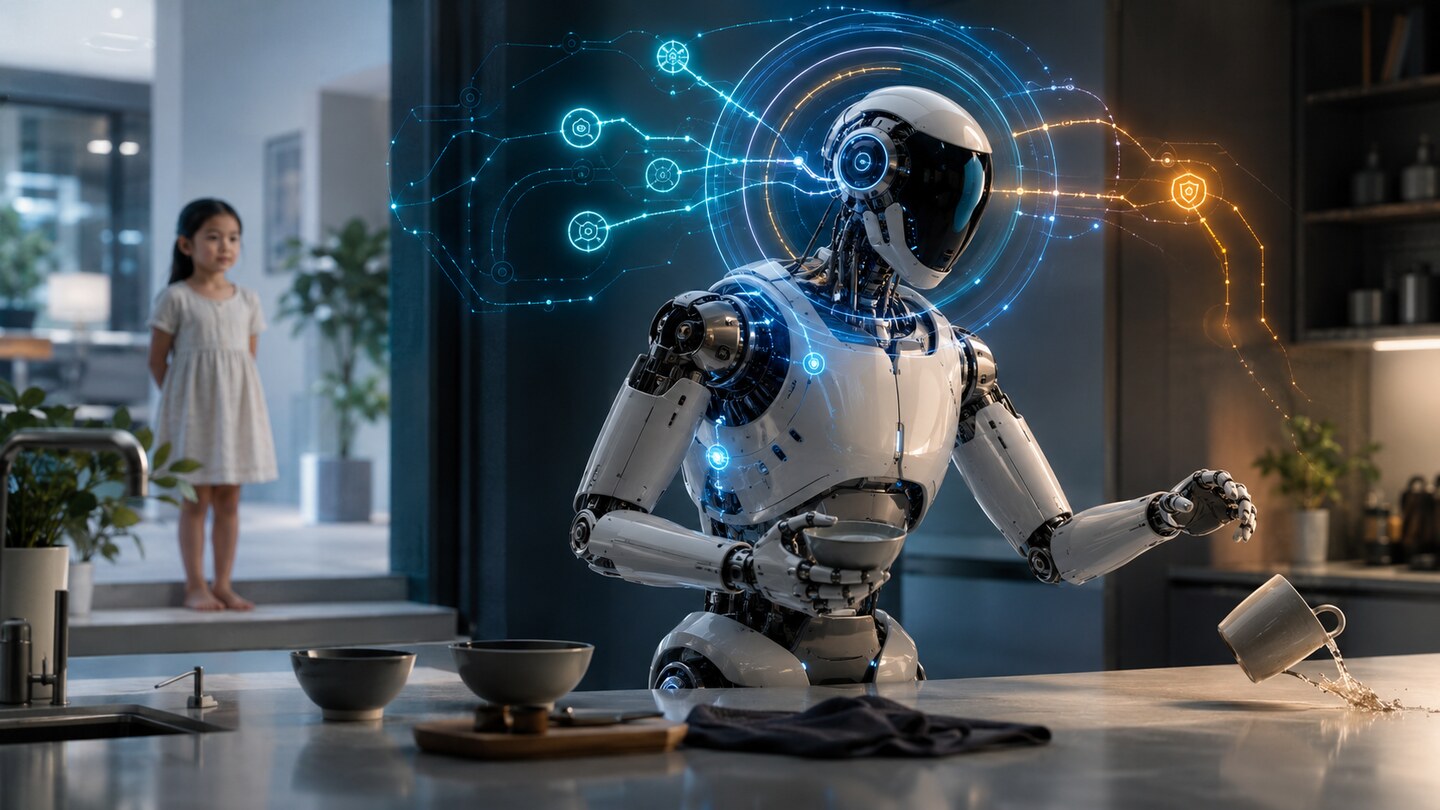

A humanoid robot may look like one machine, but its behaviour will emerge from many software systems operating inside one physical body. That raises a crucial design question: when the robot’s normal routine no longer fits the situation, what should take over?
In the first article in this series, Humanoid Robots Can Work—but Can They Live With Us?, I argued that physical capability is not enough for domestic life. A robot may be able to lift, carry, clean and navigate, yet still fail to understand privacy, permission, relationships and changing human expectations.
The next layer is cognitive architecture. Robots entering homes, hospitals, schools and public spaces will need ordinary task routines, specialised subroutines and a protected fallback system for uncertainty. I call this distinction primary and backup cognition.
A robot is not one mind inside one body
People naturally interpret a humanoid as a single character because the machine has one face, one voice and one body. Technically, however, its behaviour may involve perception models, language systems, motion planners, low-level controllers, memory, safety rules, identity permissions and task-specific software.
Tesla’s description of Optimus already points toward this layered reality. The company says a general-purpose autonomous humanoid requires software stacks for balance, navigation, perception and interaction with the physical world. Google DeepMind similarly separates high-level embodied reasoning from low-level safety-critical controllers. The visible robot is therefore better understood as a platform where several forms of intelligence must coordinate.
The body gives the robot presence. The software layers give it behaviour. The safety architecture determines whether that behaviour remains acceptable when reality changes.
Routine, subroutine and cognition are not the same thing
A routine is the normal sequence used to complete a familiar task. If the instruction is “bring the cup from the kitchen,” the routine may identify the cup, calculate a route, grip it, walk and deliver it.
A subroutine is a narrower capability called when needed. Opening a cupboard, detecting a fragile object or asking a person to move out of the way could each be handled by a specialised component.
Cognition is the supervisory capacity that decides which routine is appropriate, whether its assumptions are still valid and when the machine should stop, replan or transfer authority. This distinction matters because adding more skills does not automatically create better judgment. A robot can possess hundreds of subroutines and still select the wrong one.
Primary cognition: complete the intended task
Primary cognition governs normal operation. It interprets the instruction, identifies the goal, chooses the relevant skills and monitors progress. In a predictable setting, it should be efficient and unobtrusive.
Google DeepMind describes useful robot intelligence through generality, interactivity and dexterity. Its robotics work also demonstrates continuous monitoring: if an object slips or somebody moves it, the system can detect the change and replan. Figure’s Figure 03 uses redundant close-range visual feedback in its hands to preserve awareness when its main cameras are obstructed.
These are important forms of adaptive control. Yet adaptation alone does not answer the social question. A robot may find another route to finish a task when the safer or more respectful response would be to stop and ask.
Backup cognition: protect people when the assumptions fail
Backup cognition should activate when the machine’s confidence falls, the environment changes, two instructions conflict or a safety boundary is approached. It is not simply a second personality and it should not be an unlimited improvisation mode. It is a bounded layer designed to reduce risk.
- Uncertainty trigger: the robot cannot reliably identify the person, object, instruction or consequence.
- Context trigger: a child enters the work area, a visitor arrives or the household changes from private to social mode.
- Conflict trigger: a command clashes with an existing safety, privacy or consent rule.
- Physical trigger: an object slips, a route is blocked or unexpected contact occurs.
- Authority trigger: an authorised human pauses, overrides or reassigns the task.
The safest fallback may be to freeze movement, lower force, put an object down, increase distance, explain the uncertainty or request human confirmation. Intelligence is not demonstrated only by continuing. Sometimes the most intelligent action is refusing to guess.
The five-layer safety mind for humanoid robots
- Physical safety reflex: collision avoidance, force limits, stability controls and emergency stopping operate at the fastest level.
- Primary task cognition: the robot plans and performs the authorised task under expected conditions.
- Context supervisor: the system watches for environmental, relational and social changes that alter what is appropriate.
- Bounded backup cognition: the robot selects only from approved fallback behaviours when certainty or safety deteriorates.
- Human authority and audit: people can interrupt, inspect and review what the robot perceived, decided and did.
This layered proposal is consistent with a broader risk-management principle: trustworthiness must be designed into the system rather than added after deployment. The US National Institute of Standards and Technology describes its AI Risk Management Framework as a way to incorporate trustworthiness considerations into the design, development, use and evaluation of AI systems. A domestic robot turns those abstract risks into physical consequences.
The karate-robot question: reaction is not intention
A dramatic online clip can show a robot being pushed and then producing movement that resembles karate or self-defence. It is tempting—and entertaining—to interpret that motion as anger, retaliation or an activated defensive personality. But a short clip cannot establish the machine’s internal cause.
The movement could result from balance recovery, a demonstration routine, teleoperation, edited sequencing or a trained response. The critical distinction is between what the movement looks like to a human observer and what control process produced it. Anthropomorphic interpretation can make competent motor control appear emotionally intentional.
That psychological gap matters. If people cannot tell whether a sudden movement is stabilisation, task execution or defensive action, trust collapses. Robots will need legible behaviour: visible status signals, predictable pauses and explanations that help people understand which layer has taken control.
ChatGPTinside as an installable behavioural layer
My ChatGPTinside framework imagines a market of downloadable personality modules, skill packs and behavioural subroutines for robots. A cooking module could teach a person while respecting dietary rules. A care module could apply safeguarding and escalation boundaries. A household module could recognise living-room, bedroom, visitor and going-out expectations.
But modular intelligence requires modular governance. Every installed capability should declare what sensors it uses, which data it remembers, what actions it may take, who may activate it and which higher-level rule can stop it. A subroutine must never silently rewrite the robot’s safety hierarchy.
This makes backup cognition commercially important. Robot manufacturers may build hardware and general embodied intelligence, while specialist developers build validated behavioural modules for education, care, hospitality, domestic organisation and other environments. The opportunity is not to make a robot pretend to be human. It is to help the machine behave appropriately around humans.
ChatGPTinside remains separate from ChatConnect, my dating-industry concept. ChatConnect concerns relationship discovery and compatibility. ChatGPTinside concerns installable context learning and behaviour for robots operating across human environments.
The psychological standard: calibrated trust
A domestic robot should not be judged only by task-completion rates. It should be judged by whether people understand its limits and retain control. If a machine succeeds ninety-nine times but conceals uncertainty on the hundredth, its apparent confidence becomes a danger.
Good design creates calibrated trust: users neither panic unnecessarily nor assume the robot is incapable of error. That requires clear permissions, controllable memory, reversible actions, explanations after unexpected behaviour and a reliable way to summon human oversight.
MaryChuks analysis: the future belongs to layered robots
The humanoid-robot market is often presented as a race to build the most capable body or the most general model. The deeper competition may be architectural. Which company can make hundreds of skills cooperate without allowing one task to override safety, privacy or human authority?
Primary cognition gives the robot competence. Subroutines give it range. Backup cognition gives it restraint. Social intelligence gives its actions meaning within human life. Human authority gives the whole system legitimacy.
That is the difference between a robot that merely keeps moving and one that knows when continuing is no longer the right decision.
Sources and further reading: Tesla AI & Robotics; Figure 03; Google DeepMind on Gemini Robotics and layered safety; and the NIST AI Risk Management Framework. “Primary and backup cognition” and the ChatGPTinside modular-behaviour framework are Mary Oge Chuks’s conceptual analysis.
Discover more from Marychuks.com AI, Psychology, Business & CreativeVerse
Subscribe to get the latest posts sent to your email.