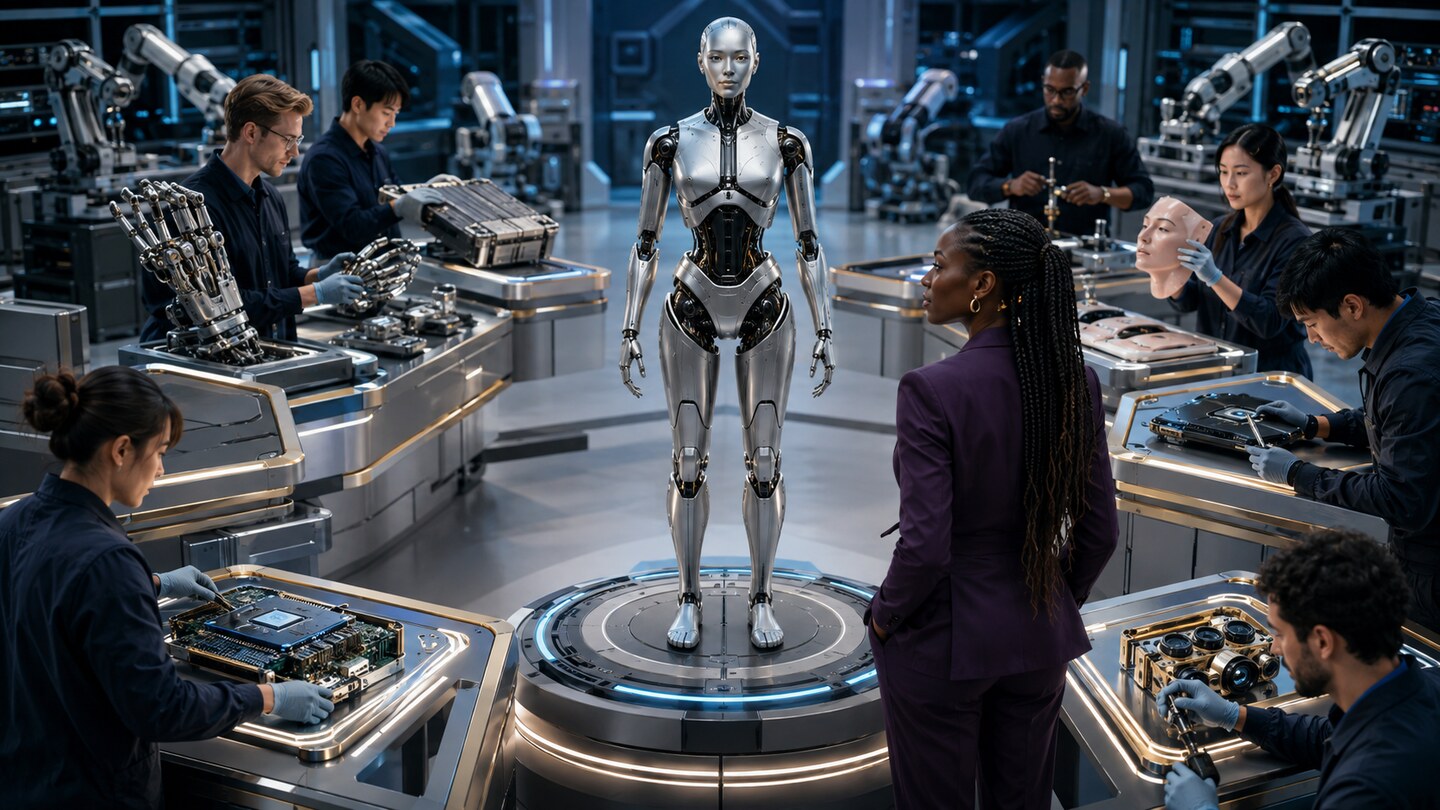

The company whose name appears on a humanoid robot may not manufacture every part inside it. Like a luxury car, yacht or aircraft, the finished machine could become the visible result of an ecosystem of specialist suppliers—and that collaboration may be what finally makes robots affordable.
The humanoid-robot conversation often sounds like a race between complete machines: Tesla versus Figure, China versus the West, industrial robots versus companion robots. But the more important competition may happen underneath the brand name. Who makes the actuators? Who produces the tactile hands, batteries, cameras, chips, soft exterior, voice, memory, safety system and social-intelligence layer?
This is the third article in my humanoid-robot series. In Part One, I distinguished working intelligence from the social intelligence needed for human environments. In Part Two, I proposed routines, subroutines and primary and backup cognition. The next question is economic: how does the industry combine all those layers quickly enough—and cheaply enough—for mass adoption?
The luxury-car lesson for humanoid robotics
A premium car manufacturer creates the brand, overall design, performance standard and customer experience. Yet thousands of components may come from specialist companies. The same logic applies to boats and aircraft. Integration is the product.
Humanoid robots are even more multidisciplinary. No single organisation must necessarily be the world’s best manufacturer of motors, hands, batteries, tactile skin, cameras, processors, speech systems, foundation models, memory, personality and safety software at the same time. A lead company can define the architecture and certify the finished robot while buying or licensing specialist modules.
The robot brand may own the customer relationship, but the robot’s capability will come from a network of specialised intelligence and manufacturing.
Figure already shows the hybrid model
Figure’s manufacturing strategy illustrates that vertical integration and supplier collaboration are not opposites. In its October 2025 introduction to Figure 03, the company said it had designed critical modules—including actuators, batteries, sensors, structures and electronics—in-house. It also said it strategically partnered with suppliers capable of meeting its required volume, schedule and quality standards.
Figure described the outcome as a global partner network designed to scale to thousands and eventually millions of parts. Its BotQ manufacturing line was presented with an initial capacity of up to 12,000 humanoids per year and a four-year goal of 100,000 units. The company also redesigned components around die-casting, injection moulding and stamping, reducing parts and assembly steps to lower unit cost as production grows.
That is not a choice between “make everything” and “outsource everything.” It is a strategic boundary: own the layers that define the product, then collaborate where specialist suppliers improve scale, speed or economics.
Unitree shows how components can become a market
Unitree’s official G1 product page provides another clue. It lists a starting price of US$13,500 before tax and shipping, while offering different joint configurations, optional dexterous hands, tactile sensor arrays, secondary development and high-compute modules from multiple brands. The same website separates humanoids, robotic arms, perception products and components.
The G1 is not proof that a fully capable domestic companion is already available at a mass-consumer price; Unitree explicitly warns that the industry remains in an early exploratory stage and urges buyers to understand current limitations. But it does show how a humanoid can become a configurable platform instead of one sealed machine.
Once components become product categories, suppliers compete to improve them. Better hands can be sold to several robot manufacturers. Battery advances can spread across different bodies. A new compute module can be integrated without redesigning the entire robot. This is how an ecosystem starts compressing cost and development time.
Silicon is not silicone—and robots may need both industries
The language matters. Silicon is the semiconductor material associated with computer chips. Silicone is a flexible polymer that can be used for soft coverings, facial structures and skin-like embodiment. A future home or companion robot may need both: silicon for computation and silicone—or other soft materials—for safe, socially acceptable physical presence.
Factory images and creator demonstrations from East Asia have made the contrast visually striking. Many Western humanoid programmes foreground exposed metal, functional shells and industrial labour. Other manufacturers emphasise lifelike faces, softer bodies and social presentation. These are not simply different aesthetics; they suggest different supplier specialisms and different assumptions about the customer.
Realbotix, for example, describes its work as giving physical form to service-sector AI and frames its robots around human-to-robot interaction. Figure has chosen washable soft goods, multi-density foam and improved speech hardware for household use. These approaches show that embodiment can be designed as a distinct commercial layer rather than treated as decoration added at the end.
The five markets inside one humanoid robot
- Body and manufacturing: frames, housings, joints, thermal design and high-volume assembly.
- Motion and manipulation: motors, actuators, hands, balance systems, force control and tactile sensing.
- Perception and compute: cameras, microphones, LiDAR, processors and on-device inference.
- Embodiment and interface: soft materials, faces, voices, displays, clothing and socially legible signals.
- Intelligence and governance: foundation models, memory, skills, personality, primary and backup cognition, privacy and human override.
A sixth market then grows around the completed platform: maintenance, insurance, charging, repair, training, accessories and software subscriptions. The robot may therefore follow the economics of smartphones and cars: the hardware creates the installed base, while updates, services and specialised capabilities generate recurring value.
Why collaboration can make robots cheaper faster
Collaboration reduces duplication. If ten robot companies separately invent ten incompatible hands, batteries and software interfaces, each carries more research cost and manufacturing risk. If specialist suppliers can serve several manufacturers through tested interfaces, their production volumes rise and their learning cycles accelerate.
- Scale: one component supplier can spread tooling and research costs across several customers.
- Speed: manufacturers integrate mature modules instead of developing every layer from zero.
- Repairability: standardised parts can be replaced without discarding the entire machine.
- Choice: buyers can select different hands, faces, compute levels or intelligence packages.
- Competition: specialists improve performance and price within each component category.
However, collaboration only produces these benefits when the interfaces are stable and safety responsibilities are clear. A cheaper module that creates unpredictable behaviour, weak cybersecurity or impossible repairs does not reduce the real cost. The ecosystem needs certification, traceability, signed software, permission controls and reliable update standards.
The psychology of affordability
Price does more than change what people can buy. It changes what they believe a product is for.
At an extremely high price, a humanoid is interpreted as a corporate experiment, status object or speculative machine. Consumers focus on the risk of loss: What if it breaks? What if the company disappears? What if the robot becomes obsolete? High financial exposure amplifies hesitation.
As cost falls, the mental category can change. The robot may be evaluated less like laboratory equipment and more like a car, computer or household platform. Leasing, subscription and shared-service models could reduce the commitment further, allowing schools, care providers and families to experience usefulness before purchasing outright.
Visible adoption also produces social proof. When robots appear only at trade shows, they remain psychologically distant. When people see neighbours, workplaces or community organisations using them safely, uncertainty falls and norms develop. Familiarity does not guarantee trust, but it makes informed trust possible.
This creates a reinforcing cycle: collaboration lowers cost; lower cost increases trials; more trials generate real-world learning; learning improves products; improved products encourage broader adoption.
ChatGPTinside belongs in the intelligence supply chain
My ChatGPTinside proposal treats social intelligence, personality, skills and context-sensitive behaviour as installable layers. The robot manufacturer would not need to predict every household, culture, profession or relationship. Approved modules could teach cooking, care, education, hospitality or other specialised modes while remaining subordinate to the robot’s safety architecture.
This creates a software market alongside the component market. Robot manufacturers retain their hardware revenue. Under one MaryChuks commercial proposal, OpenAI would take no commission from the robot sale itself; paid AI-token or service revenue would instead be divided 60% to the robot-side owner or manufacturer and 40% to OpenAI. The exact structure would require commercial negotiation, but the principle is clear: hardware and intelligence can have separate revenue models.
ChatGPTinside is not ChatConnect. ChatConnect remains my dating-industry concept. ChatGPTinside is the proposed behavioural and skills ecosystem for robots living and working across human environments.
The critical risk: a fragmented robot with no accountable integrator
The luxury-car analogy has a limit. If a component fails in a car, there are established standards, recalls, service networks and legal responsibilities. Humanoid robotics will need equivalent accountability across hardware, software and behaviour.
The lead manufacturer must remain responsible for the integrated system. It should not be possible to blame the hand supplier, model provider or personality developer while the consumer is left with an unsafe robot. Certification must test the complete configuration, including what happens after third-party modules are installed.
MaryChuks analysis: the winning company may orchestrate rather than manufacture everything
The future humanoid industry may not produce one company that dominates every layer. It may produce powerful orchestrators: companies that define trustworthy standards, combine the best specialised components and create a customer experience people can afford and understand.
The East may lead some forms of scalable manufacturing and soft embodiment. Western companies may lead other hardware, AI or platform layers. Specialist firms across the world can contribute the missing components. Geography matters, but interoperability matters more.
The psychological threshold for mass adoption will arrive when a robot stops feeling like an expensive demonstration and starts feeling like a supported platform: repairable, upgradeable, configurable and useful. Collaboration is therefore not only an industrial strategy. It is part of how the industry converts technological possibility into social acceptance.
Sources and further reading: Figure 03 manufacturing and supply-chain strategy; Unitree G1 specifications and pricing; and Realbotix on service-sector humanoid embodiment. Forecasts about component ecosystems, adoption psychology and ChatGPTinside are Mary Oge Chuks’s analysis and proposals.
Discover more from Marychuks.com AI, Psychology, Business & CreativeVerse
Subscribe to get the latest posts sent to your email.



One thought on “Humanoid Robots Will Be Built Like Luxury Cars: Why Collaboration Will Make Them Cheaper”