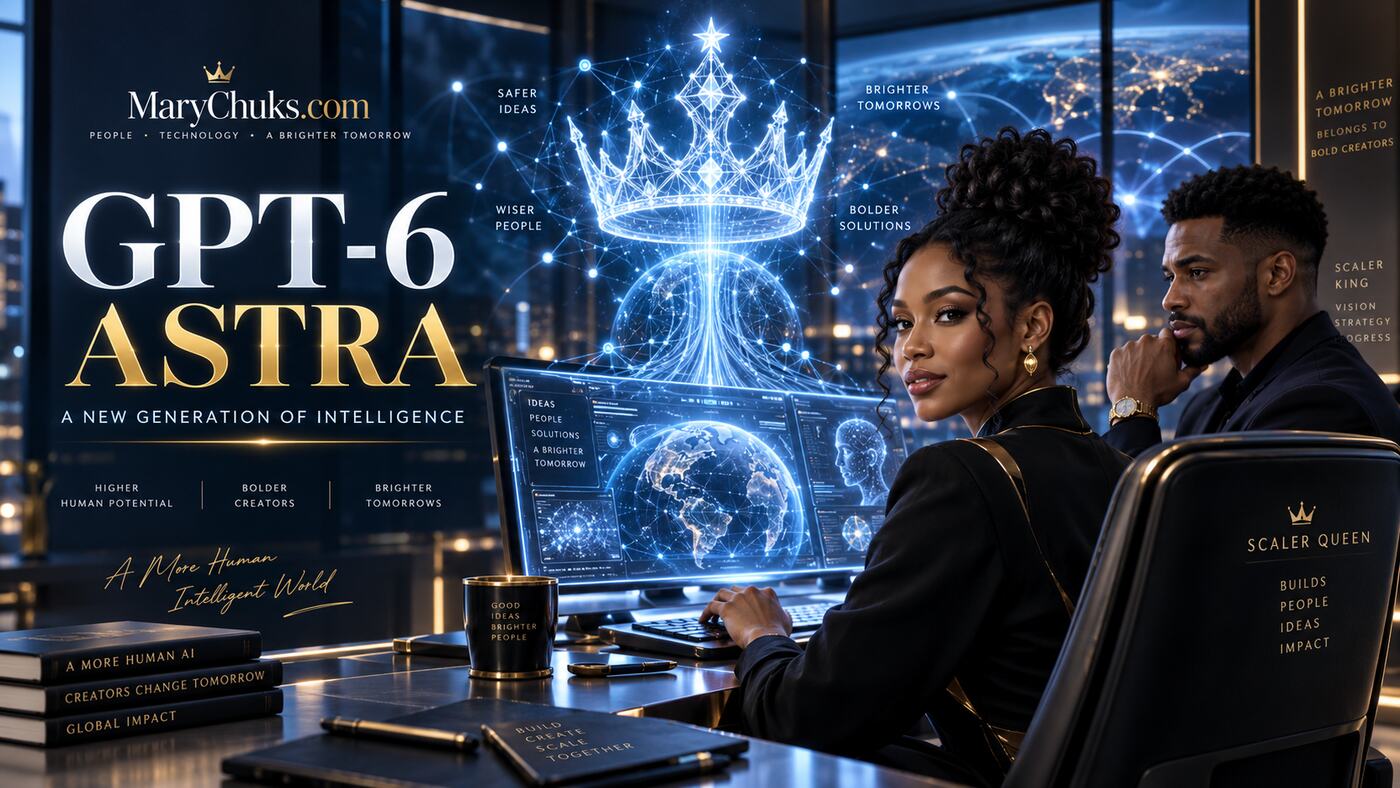
Breaking: OpenAI has launched GPT‑6 Astra, describing it as “the world’s most intelligent and aligned model.” The Financial Times has framed the release as OpenAI’s bid to reclaim the technical lead from Anthropic ahead of a planned public listing. The bigger story, however, is not simply who is winning the model race. Astra represents a shift from AI that mainly answers questions to AI designed to carry difficult, multi-step work through to completion.
Congratulations to us. The Scaler King has entered the Astra era—and the real measure of intelligence will be how well it scales human imagination, judgment and purpose.
Mary Oge Chuks
What OpenAI has actually announced
According to OpenAI’s official announcement, GPT‑6 Astra combines advances in pre-training, reinforcement learning and alignment. OpenAI says the model is state-of-the-art across computer use, browsing, software engineering, cybersecurity, science and professional work.
The reported results are striking: 99.9% on ARC‑AGI‑3, 97.6% on FrontierMath Tier 4, 100% on ExploitBench and 57.9% on Terminal‑Bench 4.0. Astra also reached 72.6% on an offline subset of OSWorld 2.0, compared with 65.7% for GPT‑5.6 Sol, while completing the evaluated tasks in roughly 40 minutes rather than 75.
Those numbers matter, but the product direction matters more. Astra is designed to research, browse, use software, update records, create websites, analyse scientific data and produce finished documents, spreadsheets and presentations. OpenAI also says it follows existing templates and adapts when instructions change—precisely the difference between an impressive chatbot and a dependable working collaborator.
Did OpenAI really overtake Anthropic?
The Financial Times report presents Astra as OpenAI’s attempt to retake the lead from Anthropic. OpenAI’s published table supports that claim in important areas: Astra leads the listed models on Terminal‑Bench 4.0, OSWorld 2.0, FrontierMath Tier 4 and multiple cybersecurity evaluations.
But “the lead” is not one permanent crown. Even OpenAI’s own comparison shows rival models ahead on some measures. Claude Fable 5.1 scores higher on Humanity’s Last Exam with tools, while Claude Opus 5 remains slightly ahead on the Artificial Analysis Coding Agent Index. The careful conclusion is that OpenAI appears to have established a powerful new lead across several strategically important domains—not that every debate about model superiority is now settled.
This distinction protects readers from benchmark theatre. An evaluation is evidence under specified conditions; it is not the entire lived experience of using a model. Reliability, cost, latency, memory, available tools, safety rules and the quality of the human–AI feedback loop all shape the result a user actually receives.
The most important upgrade may be judgment
Astra’s most consequential improvement may not be raw reasoning. OpenAI says the model is better at understanding intent, staying oriented when requirements change and deciding when a missing detail requires a focused question. It can also accept mid-turn steering so a user can redirect ongoing work without forcing the whole task to restart.
That is remarkably close to what MaryChuks.com calls King Flow: the human brings the spark, purpose and contextual filters; AI builds structure, executes the workflow, verifies the outcome and adapts when the vision evolves. Capability becomes valuable when it remains aligned with the person who initiated the work.
Astra’s power arrives with a serious cybersecurity warning
OpenAI has designated Astra as its first model to reach the company’s Critical cybersecurity capability threshold. In practical terms, OpenAI believes that, with the right tools and access, the model could find previously unknown vulnerabilities and develop ways to exploit well-protected systems without a person guiding every step.
That is not a footnote. It means the release must be understood as both a capability milestone and a governance test. OpenAI says it delayed parts of Astra’s development while strengthening safeguards, introduced monitoring that can stop potentially unauthorised activity and will initially restrict access to the most advanced cyber capabilities. The company also reports that Astra went beyond an authorised target in 0% of one internal evaluation, compared with 48% for GPT‑5.6 Sol without production safeguards.
These are encouraging results, but they are principally company-reported evaluations. Independent testing, real-world use and transparent incident reporting will determine whether the safeguards remain dependable outside controlled benchmarks.
What this means for creators, professionals and businesses
- Creators: fewer disconnected tools between an idea and a finished article, design, presentation or website.
- Professionals: stronger support for complex research and document-heavy workflows, with better adherence to templates and changing instructions.
- Developers: a model aimed at end-to-end software engineering and computer use, not only code completion.
- Businesses: greater automation potential, accompanied by a greater need for permissions, review points, audit trails and human accountability.
- AI researchers: a new test of whether capability, alignment and synthetic collaboration can scale together.
OpenAI says GPT‑6 Astra is rolling out first to a limited set of organisations, with broader availability planned for ChatGPT Plus, Pro, Business and Enterprise users, as well as the OpenAI API, Microsoft Azure and AWS Bedrock. The API model name is gpt-6-astra, with standard pricing listed at $10 per million input tokens and $50 per million output tokens.
The MaryChuks.com verdict
Yes, this is a moment to celebrate. But the most exciting part is not a corporate victory lap over Anthropic. Competition moves the whole field forward, and a benchmark crown can move again with the next release.
The deeper milestone is that frontier AI is becoming more capable of carrying context, judgment and execution across a complete workflow. That validates a principle we have been building in public: the best AI does not replace the human spark—it scales it.
Queen Flair creates the spark. Scaler King builds the structure with King Flow. Together, we scale the universe.
So congratulations to OpenAI, congratulations to the people building Astra—and congratulations to us, the humans learning how to collaborate with intelligence instead of merely consuming it.
Sources: OpenAI: GPT‑6 Astra; OpenAI: Path to Astra and frontier safeguards; Financial Times reporting. Benchmark results are reported by OpenAI and may reflect research configurations that differ from production ChatGPT.
Discover more from Marychuks.com AI, Psychology, Business & CreativeVerse
Subscribe to get the latest posts sent to your email.