Leftovers save money only when you can trust them. The awkward part is rarely the recipe; it is the period after dinner, when a deep pot is still warm, the fridge is full and nobody remembers when the food was cooked.
A safer system does not depend on memory or a cautious sniff two days later. It starts while the meal is still on the table: cool the food promptly, divide it into useful portions, label it and reheat only what you plan to eat.
The clock starts when cooking finishes
UK Food Standards Agency guidance says cooked food should be cooled and placed in the fridge within one to two hours. It also advises keeping a domestic fridge between 0°C and 5°C and eating refrigerated leftovers within 48 hours, or freezing them if that will not happen. These are practical household rules, not a promise that every dish remains safe regardless of how it was handled.
The reason to act promptly is simple: refrigeration slows bacterial growth, but it cannot reverse unsafe time and temperature exposure. A sealed container does not reset that history, and reheating is not a reliable repair for poor handling.
If you live outside the UK, check the timings and temperature guidance issued by your local food-safety authority. The operating principle is the same: minimise time in the temperature range where bacteria can multiply and keep cold food genuinely cold.
Use the reset: divide, date and decide
1. Divide the food
A large mass of food holds heat. Instead of leaving curry, stew, rice or pasta in one deep pot, divide it into smaller, shallower portions. The Food Standards Agency specifically recommends smaller portions in containers or freezer bags to help food cool more quickly.
Portioning also improves the next decision. A container sized for one meal means you can reheat one meal, rather than warming the whole batch and returning part of it to the fridge.
2. Date the container
Write the cooking date—or a clear “eat by” note—on the container. Labels remove an unnecessary memory test from the kitchen. They are especially valuable in shared households, where the person opening the fridge may not be the person who cooked.
Use a simple format everyone understands, such as “Cooked Thu — eat by Sat lunch”. The label does not make the food safe; it makes the safe window visible.
3. Decide now: fridge or freezer
Do not put every portion in the fridge and hope you will finish it. Keep what you realistically expect to eat within the recommended refrigerated period and freeze the rest promptly. The freezer is a pause button, not a time machine: freezing preserves the food from that point, so it should not be used to rescue leftovers that have already been left out too long.
Cooling quickly does not mean forgetting the food
Many people avoid refrigerating a large, steaming pot because it can raise the temperature inside the fridge and warm nearby food. That concern is reasonable. The answer, however, is not to leave dinner on the counter for the evening.
Transfer the food into smaller containers, spread dense foods into shallower layers and start the cooling process immediately. Keep track of the time. Once the food has cooled sufficiently, refrigerate it within the one-to-two-hour window described by the Food Standards Agency.
Be particularly deliberate with rice and other starchy dishes. Do not rely on the smell or appearance of a cooked food to tell you whether its storage history was safe. Time, temperature and handling are more useful evidence.
Build a fridge that supports the system
A safe routine can still fail in an overloaded or warm fridge. Check the actual temperature with a fridge thermometer; a dial setting is not the same as a measured temperature. The Food Standards Agency recommends 0°C to 5°C and suggests checking weekly.
Keep raw meat, poultry and fish sealed on the bottom shelf so they cannot drip onto cooked food. Put the newly labelled leftovers where they will be seen, rather than behind jars at the back. A small “eat first” area turns good intentions into a visible queue.
Storage containers should be clean, food-safe and properly covered. Avoid packing a shelf so tightly that cold air cannot circulate. If the fridge is regularly too full, the better answer may be to freeze portions earlier or plan one “use what is open” meal before the next food shop.
Reheat one portion, once
When it is time to eat, take out only the amount you need. Food Standards Agency guidance says leftovers should be reheated only once and should be steaming hot throughout, not merely warm.
Microwaves can create hot edges and a cold centre. Stir or turn the food during reheating, allow any standing time specified by the appliance or package instructions, and check the middle. Dense foods such as lasagne often heat more evenly in smaller portions. On the hob, stir frequently and make sure the whole dish is hot.
If you use a clean food thermometer, follow the temperature-and-time combinations published by your food-safety authority. The UK guidance gives 70°C for two minutes as one validated combination, alongside several equivalent higher-temperature, shorter-time combinations.
Do not repeatedly warm a family-sized container, serve some, cool the rest and return it to the fridge. Each temperature cycle creates another opportunity for uneven heating, long cooling and handling mistakes.
Four common leftover mistakes
- Leaving food out “until bedtime”. A vague routine makes the safe cooling window easy to miss. Set a timer when the meal ends.
- Putting one deep pot in the fridge. The centre cools more slowly. Divide food into shallow, meal-sized portions.
- Trusting a smell test. Smell may reveal spoilage, but it cannot prove that a leftover was handled safely.
- Reheating the entire batch. Portion first, then heat only what will be eaten.
A five-minute after-dinner routine
- Look at the clock when cooking ends.
- Set aside tomorrow’s portion and any portions to freeze.
- Move food from deep cookware into smaller, shallow containers.
- Label each container with the cooking date and intended use.
- Refrigerate promptly within official guidance, or freeze the portions you will not eat soon.
This routine is deliberately boring. That is its strength. It replaces a nightly debate with a repeatable sequence.
The real goal is fewer ambiguous meals
Food waste and food safety are sometimes framed as opposites: either discard aggressively or take a risk to avoid waste. Better household systems reduce both. When portions are cooled promptly, dated clearly and stored at the right temperature, fewer containers become mysteries—and fewer good meals are forgotten until they are no longer usable.
Start tonight with one change: create an “eat first” space in the fridge and label every cooked portion before it goes in. The safest leftover is not the one you inspect most anxiously. It is the one whose history you already know.
Official guidance
- Food Standards Agency: how to chill, freeze and defrost food safely
- Food Standards Agency: cooking food and using leftovers
For another practical packaging check, read A Healthy Halo Is Not a Nutrition Label: Turn the Pack Around, or explore more articles in the Food section.
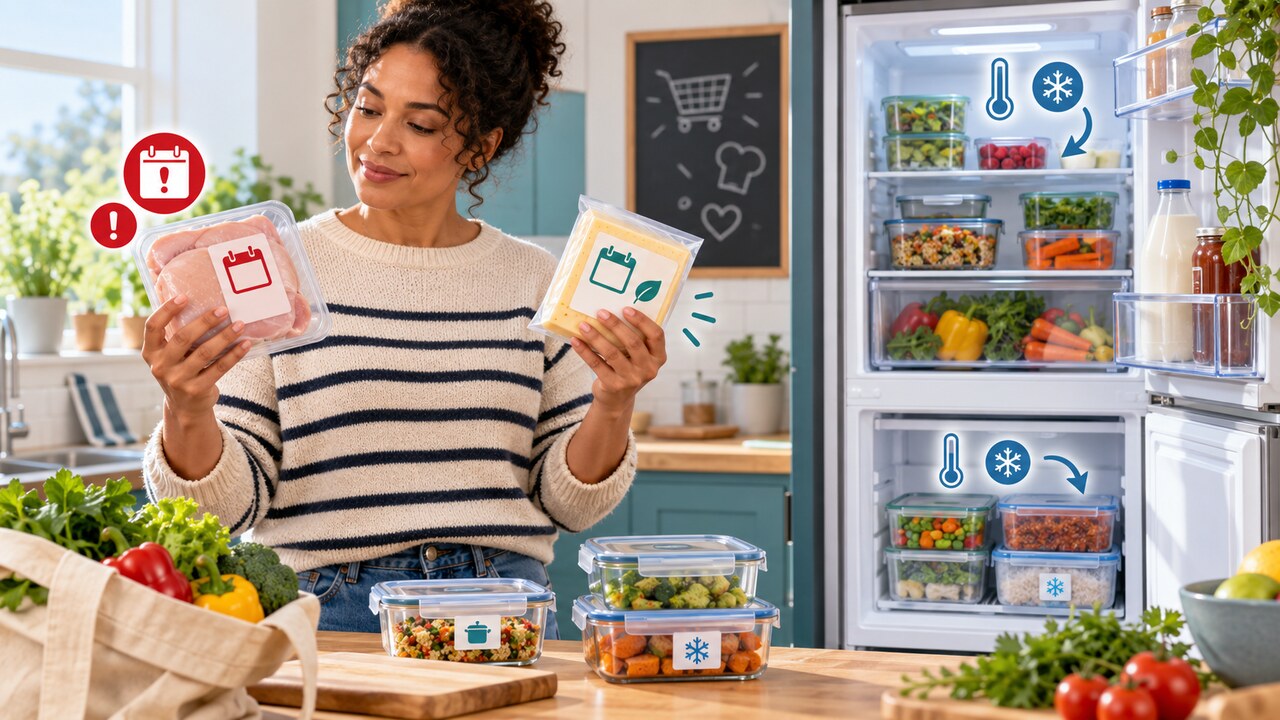
Featured image: conceptual AI illustration created for this article; not documentary evidence.
Discover more from Marychuks.com AI, Psychology, Business & CreativeVerse
Subscribe to get the latest posts sent to your email.