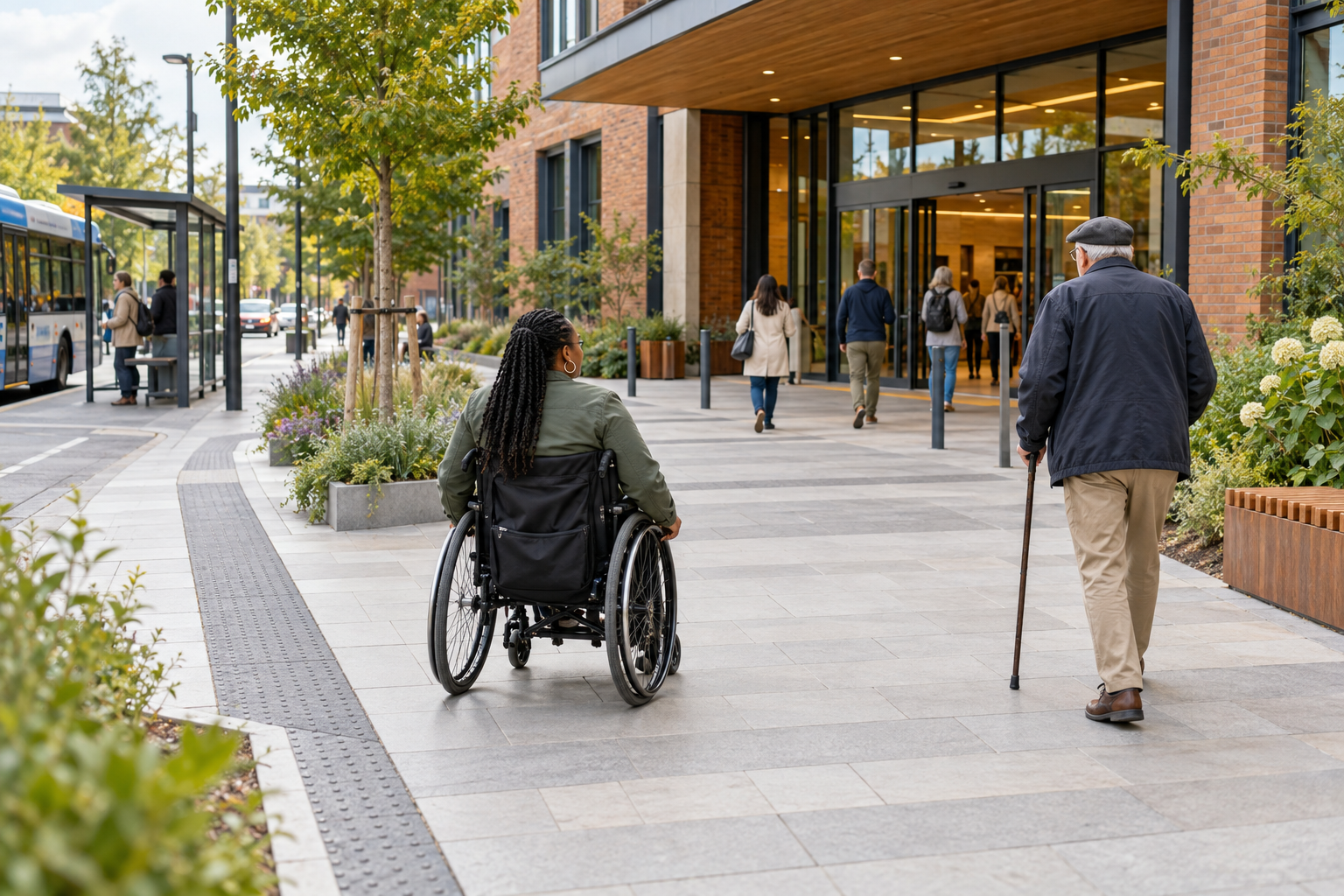
An address can be correct while the arrival is impossible. A venue may advertise a step-free doorway, yet the route to it includes a broken kerb, a narrow gap between bins, an unmarked vehicle crossing or a “temporary” sign that blocks the only usable path.
That is why accessibility must be tested as a journey, not a feature. The last 50 metres—from the pavement, bus stop, parking space or passenger drop-off to the reception point—often determines whether someone can enter independently, safely and with dignity.
Treat access as an unbroken chain
A ramp does not make a building accessible if nobody can reach it. The useful unit of analysis is the complete route from an arrival point to the service a visitor came to use.
The United States Access Board’s official guide makes this connection explicit: accessible routes should link relevant arrival points—including accessible parking, passenger loading zones, public streets, pavements and public transport stops—to accessible entrances. The UK Department for Transport similarly frames inclusive mobility around both accessible transport and a barrier-free pedestrian environment.
For a small business, clinic, school, office or community venue, this means inspecting five connected stages:
- arrival from the street, transport stop, parking space or drop-off;
- movement across the site boundary;
- the external path and any crossing points;
- the doorway, threshold and entrance controls;
- the route to reception or the first point of service.
If one link fails, the visitor does not experience the other four as accessible.
Start at every realistic arrival point
Do not begin the audit at the front door. Begin where different visitors actually arrive. Walk or roll the route from the nearest public transport stop, the public pavement, an accessible parking space, a taxi or community-transport drop-off, and any entrance promoted on your website.
At each starting point, ask:
- Can a person identify the correct building without asking a stranger?
- Is there a continuous pedestrian route, or must someone share space with moving vehicles?
- Can a wheelchair or mobility-scooter user get from the drop-off area onto the path?
- Is there somewhere safe to pause without blocking other people?
- Would the route still make sense after dark, in rain or when the area is busy?
A route that works only for someone who already knows the hidden side entrance is not genuinely easy to use.
Inspect the path, not just its dimensions
Measurements matter, but so do maintenance and behaviour. A wide path can become narrow when delivery cages, café furniture, parked bicycles, bins or promotional boards occupy it. A smooth surface can become hazardous when drainage fails or tree roots lift a slab.
Check the route for:
- steps, steep changes in level and abrupt kerbs;
- loose gravel, broken paving, deep joints and slippery surfaces;
- cross-slopes that pull a wheelchair or walking frame sideways;
- low branches, projecting objects and street furniture in the travel line;
- gaps too narrow for comfortable passage and turning;
- poor drainage, puddles, ice or wet leaves;
- insufficient lighting and shadows that conceal level changes.
Test the route during normal operations, not immediately after staff have tidied it for inspection. Accessibility is a performance condition: it must survive deliveries, queues, waste collection, weather and everyday improvisation.
Map every conflict with vehicles and cycles
Many final approaches cross a car park entrance, loading bay, service road or cycle lane. The danger is not solved simply because the crossing is short.
Observe whether drivers and riders can see someone approaching at seated height, whether vehicles reverse across the route, whether markings create a clear priority, and whether a person with limited hearing or vision has enough information to cross safely. Check what happens when a delivery van occupies the intended drop-off point or sight line.
Record the conflict, the time it occurs and who controls the space. A landlord, local authority, transport operator, neighbouring business and tenant may each own a different part of the problem. Naming the responsible party turns a vague complaint into an infrastructure task.
Make the accessible entrance easy to find
An alternative entrance is not useful when the sign appears only after a visitor reaches the steps. Wayfinding should begin before the route divides.
Useful directions describe the journey rather than offering a label. “Step-free entrance beside the pharmacy, 25 metres to the left” is more actionable than an accessibility symbol with no arrow or distance. Online information should identify the correct arrival point, surface, gradient or lift dependence, door arrangement and what assistance is available.
Keep instructions consistent across the website, map listing, appointment email, telephone script and on-site signs. Conflicting directions create cognitive load and can turn a manageable route into an anxious search.
Audit the doorway as a sequence
The doorway includes more than the door leaf. Examine the approach space, level landing, threshold, handle or automatic control, opening force, closing speed, weather mat and the space immediately inside.
Ask a practical question at each point: can someone approach, reach, operate, pass through and recover position without assistance? A button may be present but blocked by a planter. A lightweight door may be usable until wind pressure changes. A level threshold may be undermined by a loose mat that catches small wheels or a walking aid.
In England, Approved Document M provides a regulatory baseline for access to and use of buildings. A baseline is not the same as a complete user experience, especially where an older building, later furniture or changing operations introduce new barriers. Confirm applicable requirements with a qualified local professional rather than assuming a visual check proves compliance.
Include the human service layer
Some environments require staff assistance, but the assistance must be dependable. A bell that cannot be reached, a telephone number answered only inside the venue or a portable ramp stored behind stock is not a reliable access system.
Where assistance is part of the route, test:
- whether the request point can be found and reached;
- how long someone waits and where they can wait safely;
- whether staff know the procedure and have authority to act;
- whether the equipment is available, maintained and suitable;
- what happens during breaks, shift changes and busy periods.
The goal is not to eliminate every human interaction. It is to prevent access from depending on luck, confidence or a particular employee being present.
Run three passes instead of one inspection
Pass one: the physical route
Move from each arrival point to the first service point. Photograph barriers, note surfaces and level changes, and record where the route becomes unclear or unsafe. Do not photograph identifiable visitors without consent.
Pass two: the information route
Start with the information a first-time visitor receives online or by phone. Try to reach the right entrance using only those instructions. Note missing landmarks, outdated images, inaccessible contact methods and contradictions.
Pass three: the operating route
Repeat the journey during a delivery, at closing time or in poor weather. Check whether temporary objects, locked gates, queues or staffing changes break the route. This pass often reveals why a technically compliant design fails in practice.
Test with people, not imagined averages
No single simulation can represent disability. Wheelchairs, walking aids, vision, hearing, pain, fatigue, dexterity, balance and information-processing needs vary widely. Pushing an empty wheelchair around the route can reveal some physical obstacles, but it does not replace the knowledge of disabled people who use the space.
Invite paid participation from people with different access needs. Give them a real task—arrive, find the entrance and reach the service point—then ask where effort, uncertainty or dependence increased. Treat their findings as operational evidence, not inspiration.
Prioritise fixes by impact and control
Sort findings into four action groups:
- Remove now: movable signs, bins, cables, furniture and other avoidable obstructions.
- Maintain: lighting, drainage, vegetation, markings, mats, door controls and call systems.
- Explain honestly: publish accurate arrival guidance while a physical barrier is being resolved.
- Redesign: commission competent advice for kerbs, gradients, surfaces, crossings, doors and structural changes.
Give every item an owner and completion date. “Facilities issue” is not an owner. A named role with authority, budget and a review date is.
Use accurate public language
Avoid one-word claims such as “accessible” when you can describe the route. State what has been verified: step-free route from a named arrival point, type of door, availability of seating, location of assistance and any known limitation.
This gives visitors information they can use and helps the organisation notice when conditions change. It also prevents the accessible entrance from becoming a marketing badge detached from the physical journey.
A 30-minute last-50-metres check
- Choose one public transport stop, one pavement approach and one drop-off or parking point.
- Follow each route to the first service point without taking shortcuts.
- Record every obstruction, conflict, unclear direction and assistance dependency.
- Repeat the weakest route under normal operating conditions.
- Fix movable barriers immediately and assign owners to the rest.
- Update public arrival information with specific, verified details.
- Schedule a recheck after the next delivery cycle, weather change or site alteration.
A building becomes meaningfully accessible when the route works as one continuous system. The last 50 metres may be outside the room where your service is delivered, but it is still part of the service.
Official guidance consulted
- UK Department for Transport: Inclusive Mobility
- GOV.UK: Approved Document M
- United States Access Board: Accessible Routes
Discover more from Marychuks.com AI, Psychology, Business & CreativeVerse
Subscribe to get the latest posts sent to your email.