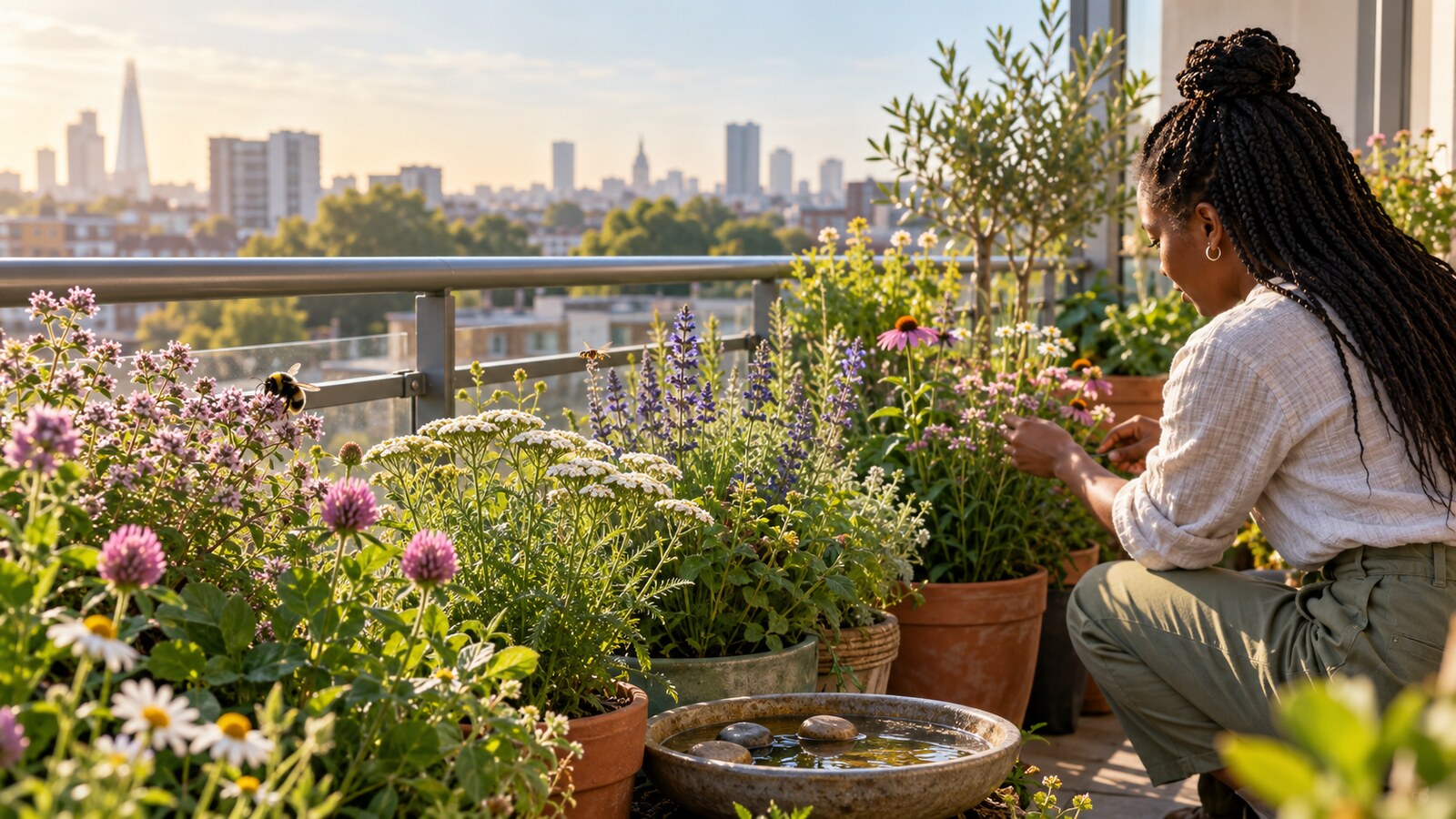
A balcony may be too small to recreate a meadow, but it is not too small to offer food, water and temporary shelter to visiting insects. The useful question is not whether a few pots can “save the bees”. It is whether a small urban space can become a dependable stop between larger habitats.
That distinction matters. Grand claims create disappointment; a well-designed stopover creates something observable. You can provide flowers across more of the year, reduce unnecessary pesticide use, notice which insects actually visit and adjust the planting from evidence rather than aesthetics alone.
Start with the conditions, not a shopping list
Before buying plants, spend several days mapping the space. Record when direct sun reaches it, how quickly pots dry, where wind is strongest and whether rain reaches the containers. A south-facing glass balcony can become hot and dry; a courtyard between buildings may remain shaded; an exposed upper floor may need heavier containers and lower planting.
- Sun: count hours of direct light rather than relying on “sunny” or “shady”.
- Water: check drainage and decide how watering will work during travel or hot weather.
- Wind: avoid tall, top-heavy pots where gusts could make them unsafe.
- Weight: respect the balcony’s load limits and ask the building manager when uncertain.
- Neighbour impact: prevent runoff, loose soil and unsecured objects from falling below.
The best plant is one that fits the site and remains healthy enough to flower. A fashionable “pollinator plant” that repeatedly dries out offers less than a modest, suitable plant that blooms reliably.
Build a flowering calendar rather than one spectacular week
The Royal Horticultural Society’s research-led guidance recommends an abundant mixture of flowering plants, with more British and northern-hemisphere plants than southern-hemisphere species, while recognising that selected exotics can help extend the flowering season. Its central practical message is simple: origin matters, but the amount and continuity of flowers matter too.
Choose a small set of plants that flower in sequence. The exact species should depend on your country, climate and balcony conditions. In Britain, options for containers can include crocus for early forage, foxglove for a larger part-shaded pot, yarrow for open flower heads, wild marjoram for a sunny herb pot, red clover for compact planting and ivy where a safely supported late-flowering climber is suitable. Check toxicity before planting where children or pets use the space.
| Design question | Practical response |
|---|---|
| Is something flowering in early spring? | Add an early bulb or locally appropriate early-flowering plant. |
| Does everything peak at once? | Replace one duplicate with a plant that flowers earlier or later. |
| Can insects reach the flower? | Include simple, open or flat-topped flowers alongside tubular forms. |
| Will the plant survive the site? | Match it to the actual light, moisture, wind and container depth. |
Choose variety without turning the balcony into a catalogue
A useful small-space design provides different flower shapes, heights and bloom times. It does not require twenty unrelated species. Repetition helps insects find a resource and makes watering simpler. Three generous containers can work better than twelve tiny pots that overheat and dry out.
The RHS’s work on plants and plant-dwelling invertebrates also shows why foliage and density matter. Leaves and stems support herbivores, predators, detritivores and omnivores—not only the adult insects photographed on flowers. A few nibbled leaves can therefore be evidence of a functioning food chain rather than automatic proof that the garden has failed.
Add water safely
A shallow dish with clean water and stones or rough surfaces can provide landing points. Keep it stable, refresh it regularly and avoid creating deep open water where small insects may drown. Empty and clean standing-water containers often enough to prevent stagnation and follow local mosquito guidance, especially in warmer regions.
Water the soil, not visiting insects. Early morning watering reduces heat stress and gives you a chance to check whether pots are draining properly. Grouping containers can slow drying, but leaves still need airflow.
Stop treating every insect as a pest
A pollinator stopover cannot function as a sterile display. Avoid routine pesticide use, including “just in case” spraying. First identify the problem, examine the scale of damage and try physical or cultural controls such as removing a badly affected leaf, improving airflow or washing a small aphid cluster away with water. Read every product label and consider the risk to non-target insects.
The goal is not zero damage. It is a healthy enough plant community that can support visitors without collapsing. Predatory insects also need prey; removing every aphid can remove part of their food supply.
Use observation as your feedback system
For ten minutes once a week, record the date, time, weather, flowering plants and visible visitors. Photograph from a respectful distance. Note behaviours—feeding, resting, sheltering—rather than guessing species from one blurred image.
- Which plant receives repeated visits?
- Which months have no flowers?
- Which pots dry first?
- Are visits concentrated at one time of day?
- What survived the season with manageable care?
The answers guide next season’s purchases. The RHS advises gardeners to observe which plants attract pollinators locally and grow more of them. That is a better decision rule than buying another plant because its label carries a bee icon.
Where AI can help—and where it can mislead
AI can turn your notes into a flowering calendar, remind you to water according to observed conditions and organise photographs by date. Image-recognition tools may suggest an insect or plant identity, but a suggestion is not a verified record. Similar species, immature stages, poor angles and regional differences can produce confident mistakes.
Use AI to narrow the possibilities, then check a reputable regional field guide or expert recording scheme before making ecological claims. Never handle an unfamiliar insect merely to obtain a better photograph.
The Business + Psychology + AI view
Business: A small, resilient planting plan reduces waste from unsuitable impulse purchases. Nurseries, property managers and hospitality businesses can also use honest, observable habitat features instead of vague “green” decoration claims.
Psychology: Visible weekly changes make care rewarding. The routine becomes easier when success means noticing one new visitor or closing one flowering gap, rather than achieving an impossible perfect ecosystem.
AI: Scheduling, note organisation and tentative identification can reduce friction, while human observation and external verification protect the quality of the record.
A seven-day starter plan
- Map sun, shade, wind and rain exposure.
- Check safety, weight and drainage constraints.
- Choose three containers large enough for stable moisture.
- Select locally appropriate plants with overlapping bloom times.
- Add a shallow, stable water source with landing stones.
- Create a ten-minute weekly observation note.
- Review the first month and replace what does not suit the site.
Small habitat, honest ambition
Your balcony will not replace lost countryside or repair biodiversity decline on its own. It can still become one reliable point in a wider urban network: a place where a bee finds nectar, a hoverfly pauses, a moth feeds at dusk and a resident learns to notice the living city.
Begin with one flowering gap, one safe water dish and one observation habit. A small space becomes useful through continuity, not spectacle.
Sources and practical references
- Royal Horticultural Society: native and non-native plants for pollinators
- Royal Horticultural Society: plants for plant-dwelling invertebrates
- Royal Horticultural Society: wildflowers for urban pollinators
- Royal Horticultural Society: encouraging wildlife in gardens
Discover more from Marychuks.com AI, Psychology, Business & CreativeVerse
Subscribe to get the latest posts sent to your email.



One thought on “Your Balcony Is Not Too Small for Biodiversity: Build a Pollinator Stopover”