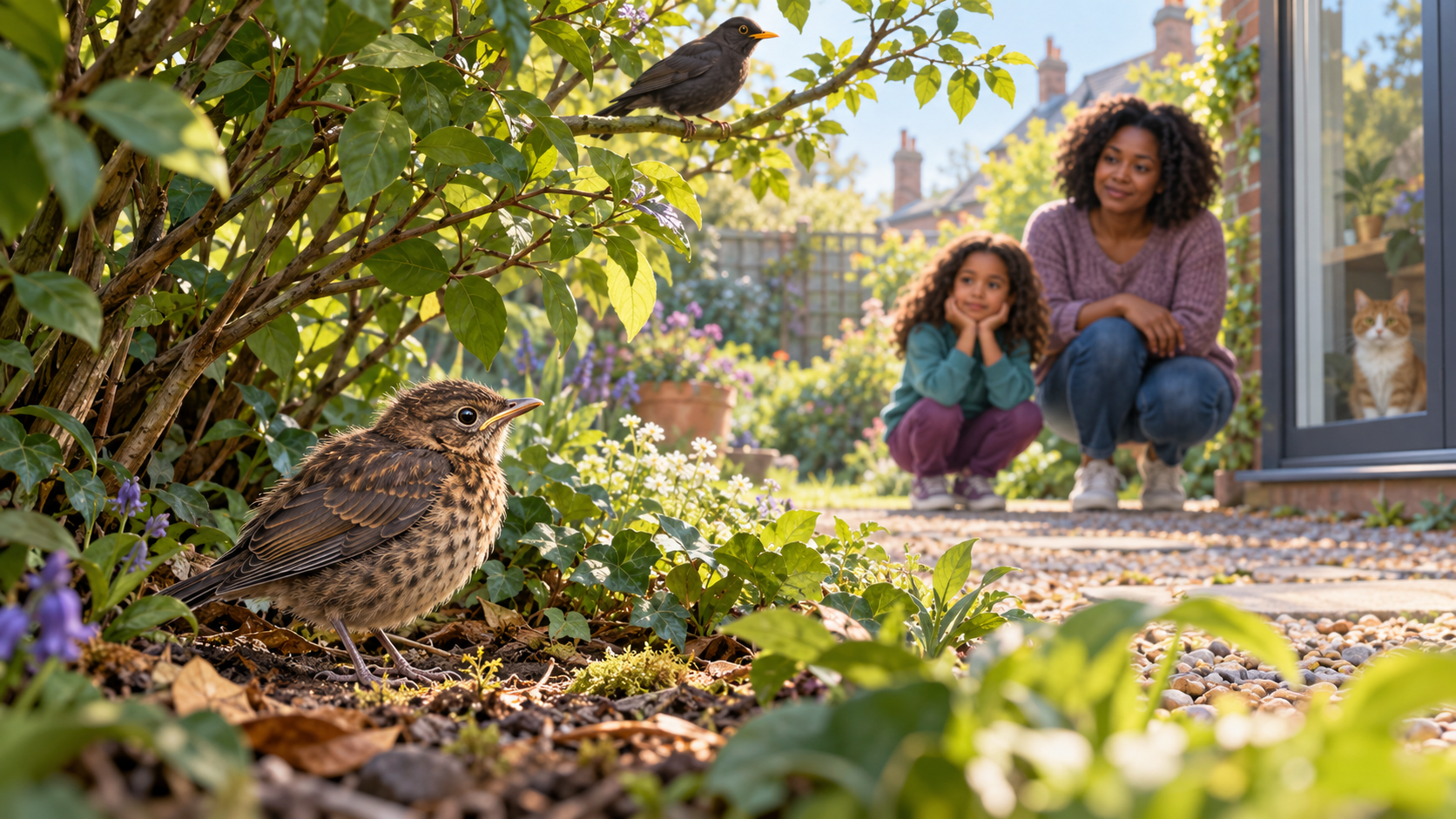
A young bird is sitting on the pavement or beneath a hedge. It does not fly away when you approach. Your instinct says: rescue it immediately.
Sometimes intervention saves a life. Sometimes the “rescue” separates a healthy fledgling from parents that are still feeding it. The useful question is not simply, “Is this bird on the ground?” It is, “What stage is the bird at, is it injured, and is there an immediate danger?”
This five-minute triage helps you make that distinction. It is written with Great Britain in mind, but the biological principles are broadly useful. Wildlife laws, disease alerts and rescue arrangements differ by country, so readers elsewhere should also check their local wildlife authority.
First: look before you touch
Pause several metres away. Keep children, dogs and cats back. Observe the bird’s feathers, posture, movement and surroundings without standing over it.
Your presence can stop parent birds from approaching. The RSPB explains that feathered fledglings may spend several days on or near the ground while their flight feathers develop. Their parents can still be nearby, collecting food or waiting for people to leave.
Step 1: Is it a fledgling or a nestling?
A fledgling is mostly feathered
A fledgling usually has most or all of its feathers. It may have a short tail, a slightly fluffy appearance or visible edges around the beak. It may hop, grip a branch, flutter or call, even if it cannot yet fly confidently.
For an alert, uninjured fledgling, the default response is usually to leave it alone, secure pets and watch from a distance. Being grounded is not automatically an emergency.
A nestling is bare or only partly feathered
A nestling has no feathers or only sparse developing feathers. It is not ready to live outside the nest and is more vulnerable to cold, dehydration and predators.
If you can identify the original nest and reach it safely without damaging or disturbing it, the RSPCA advises re-nesting the bird. If the nest has fallen or cannot be used, the RSPCA describes placing a simple replacement nest securely in the nearest suitable tree so the parents can continue caring for the young.
Do not undertake dangerous climbing, cut branches, dismantle a roof or move an active nest to a new area. In Britain, active wild-bird nests and eggs are legally protected. The government’s wild-bird guidance explains the relevant protections and the additional safeguards for certain species.
Step 2: Check for immediate danger
A healthy fledgling may need protection from a preventable hazard even when it does not need to be taken into captivity.
- Road or busy path: if safe and necessary, move the bird only a very short distance into nearby shelter where its parents can still locate it.
- Cat or dog: bring the pet indoors and keep it away. Do not assume the danger has passed because the bird looks calm.
- Exposed heat or weather: seek advice rather than relocating the bird far away. The correct response depends on species, age and condition.
- Crowd of people: create distance. Parent birds are more likely to return when observers withdraw.
If movement is unavoidable, the RSPCA recommends gloves and a move of no more than a few metres to sheltered safety. The purpose is hazard reduction, not adoption.
Step 3: Look for injury or illness
Contact a wildlife rehabilitator or vet promptly if the young bird has an obvious wound, a drooping or oddly positioned wing, difficulty standing, severe weakness, breathing distress, blood, a collision injury or evidence of an animal attack.
A bird that has been in a cat’s mouth needs expert advice even when you cannot see a puncture. Do not wait for visible deterioration before calling.
Also seek specialist guidance for species with very different development patterns. Ducklings, goslings, swifts, swallows, martins, birds of prey and seabirds may not fit a simple garden-songbird checklist. Use a reputable local rescue directory or veterinary practice rather than guessing from an image search.
Step 4: Give the parents a fair chance to return
If the bird is a healthy fledgling and the site is safe, leave the immediate area and observe discreetly. Parent birds may avoid approaching while a person is close.
The RSPCA recommends captivity only as a last resort: when the bird is sick or injured, the parents are known to be dead, or continuous monitoring from a distance for more than two hours shows that the parents have not returned.
“Continuous” matters. Looking once, going indoors and returning much later does not tell you whether a quick feeding visit occurred. If watching safely is impractical, telephone a wildlife professional and describe exactly what you can see.
Step 5: If professional help is needed, contain—do not treat
Follow the rehabilitator’s or vet’s instructions. They may ask you to transport the bird. A common short-term approach is a ventilated cardboard box lined with a towel or plain paper, kept dark, quiet and away from children and pets. However, the precise handling method should come from the professional receiving the bird.
Do not attempt home treatment while waiting:
- Do not pour water into the beak.
- Do not offer bread, milk or improvised food.
- Do not repeatedly handle the bird for photographs.
- Do not keep it as a pet.
- Do not release an injured bird somewhere different without expert advice.
Young birds have species-specific diets and delicate airways. A well-meant drink or meal can cause harm, delay correct treatment or make assessment harder.
Current bird-flu caution in Great Britain
As of 7 October 2026, this issue requires extra care. The Animal and Plant Health Agency’s wild-bird surveillance page was updated on 5 October 2026 with week-40 data, confirming that monitoring remains active. The RSPCA currently warns people not to touch or handle sick or dead birds because of avian-influenza precautions.
If a bird is sick or dead rather than a normally behaving fledgling, keep people and pets away and check the latest official reporting guidance. GOV.UK explains when the public should report dead wild birds and avian-influenza concerns. Advice may change with outbreaks, so use the dated official page rather than an old social-media graphic.
The five-minute decision table
| What you see | Likely situation | Safest next step |
|---|---|---|
| Mostly feathered, alert, hopping or gripping | Healthy fledgling | Secure pets, step away and monitor |
| Mostly feathered but in immediate traffic or predator danger | Fledgling in a hazardous position | Move only a few metres to nearby shelter if safe |
| Bare or sparsely feathered | Nestling | Re-nest if safely possible; otherwise seek rescue advice |
| Bleeding, weak, unable to stand or with an abnormal wing | Injured or ill bird | Contact a wildlife rehabilitator or vet promptly |
| Known cat or dog contact | Possible hidden injury | Seek professional advice urgently |
| Sick or dead bird during bird-flu precautions | Potential disease concern | Do not handle casually; follow current official reporting advice |
Why “doing less” can be responsible care
Humans often equate care with taking control: picking up, feeding, warming and bringing indoors. Wildlife care requires a different psychology. The animal’s best caregiver may already be present but hidden. Our job can be to remove the cat, reduce the crowd and allow the parent bird to return.
This is not an argument for ignoring obvious suffering. It is a discipline of matching intervention to evidence. Observe first. Act quickly when injury or abandonment is credible. Involve specialists when the bird’s condition, species or disease risk makes the situation uncertain.
A practical takeaway
Remember the sequence: feathers, danger, injury, parents, professional help.
- Check whether the bird is a feathered fledgling or an unfeathered nestling.
- Remove immediate hazards, especially pets and crowds.
- Look for injury, illness or animal contact.
- Observe from a distance long enough to give the parents a chance.
- Call a wildlife rehabilitator or vet when rescue is genuinely needed.
The kindest outcome is not always a bird in a box. Often it is a fledgling under a hedge, a cat safely indoors and a parent bird returning once the humans step away.
Explore more nature guidance
For another practical way to support urban wildlife without over-managing it, read Your Balcony Is Not Too Small for Biodiversity: Build a Pollinator Stopover.
Sources and scope
- RSPCA: Found a baby bird out of a nest.
- RSPB: advice on fledglings and fallen nests.
- Animal and Plant Health Agency: avian influenza in wild birds, updated 5 October 2026.
- GOV.UK: wild-bird protection and licences.
This article provides general public guidance, not veterinary diagnosis. Follow current instructions from a qualified wildlife rehabilitator, veterinary professional or local authority. The featured image is a conceptual AI illustration, not documentary evidence and not a depiction of a real rescue.
Discover more from Marychuks.com AI, Psychology, Business & CreativeVerse
Subscribe to get the latest posts sent to your email.