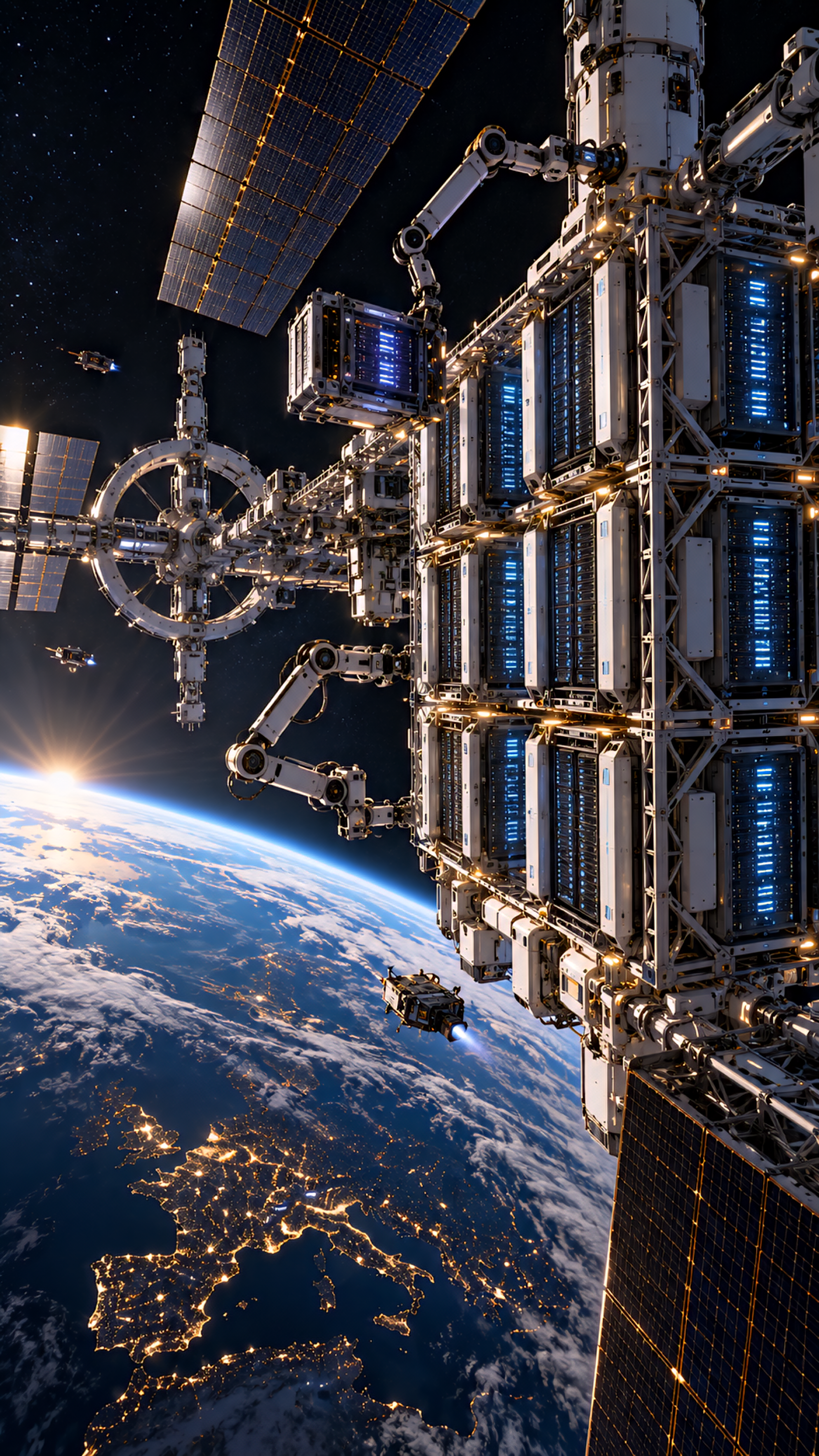
The global artificial-intelligence race is increasingly becoming an infrastructure race.
Models need chips.
Chips need electricity.
Electricity needs grids.
Servers need cooling.
Data centres need land.
Every new generation of computational demand puts more pressure on those physical systems.
Now, some companies are asking a question that sounds like science fiction:
What if part of the future cloud is built above Earth?
French company ALATYR is developing a concept for large-scale orbital data centres. The company’s published roadmap lists a first commercial deployment target of 2030, with modular infrastructure designed for in-orbit servicing and expansion.
In September, ALATYR announced a memorandum of understanding with European cloud provider Scaleway.
The companies plan to work on areas including cloud architecture, interfaces, performance, security, and future orbital computing and storage services.
This does not mean Europe already has hyperscale AI data centres operating in space.
It is an emerging infrastructure programme.
And orbital compute creates difficult engineering problems of its own.
Hardware must survive radiation.
Heat must be rejected in a vacuum.
Equipment must be launched.
Repairs become much more difficult.
Communication latency matters.
Orbital debris matters.
Replacement cycles matter.
Economics matters.
But the fact that serious companies are exploring the idea reveals something bigger.
The physical infrastructure supporting AI is beginning to diversify.
The future may not contain one universal kind of data centre.
Land-based hyperscale campuses may handle certain workloads.
Edge systems may handle others.
Offshore infrastructure could become relevant in some regions.
Orbital computing could eventually support specialised storage or computation, particularly where resilience or proximity to space-generated data is valuable.
That leads to a bigger future thinking question.
For years, people imagined AI primarily as software.
But the next stage of AI is intensely physical.
Steel.
Copper.
Chips.
Power stations.
Cooling systems.
Fibre.
Subsea cables.
Satellites.
Robotics.
Perhaps eventually, orbital construction.
Every digital intelligence ultimately sits on physical infrastructure somewhere.
As the appetite for computation grows, the question is no longer simply:
“How intelligent can the model become?”
It is also:
Where are we going to put all the machines required to run it?
Increasingly, engineers are looking everywhere.
Including up.
Discover more from Marychuks.com AI, Psychology, Business & CreativeVerse
Subscribe to get the latest posts sent to your email.