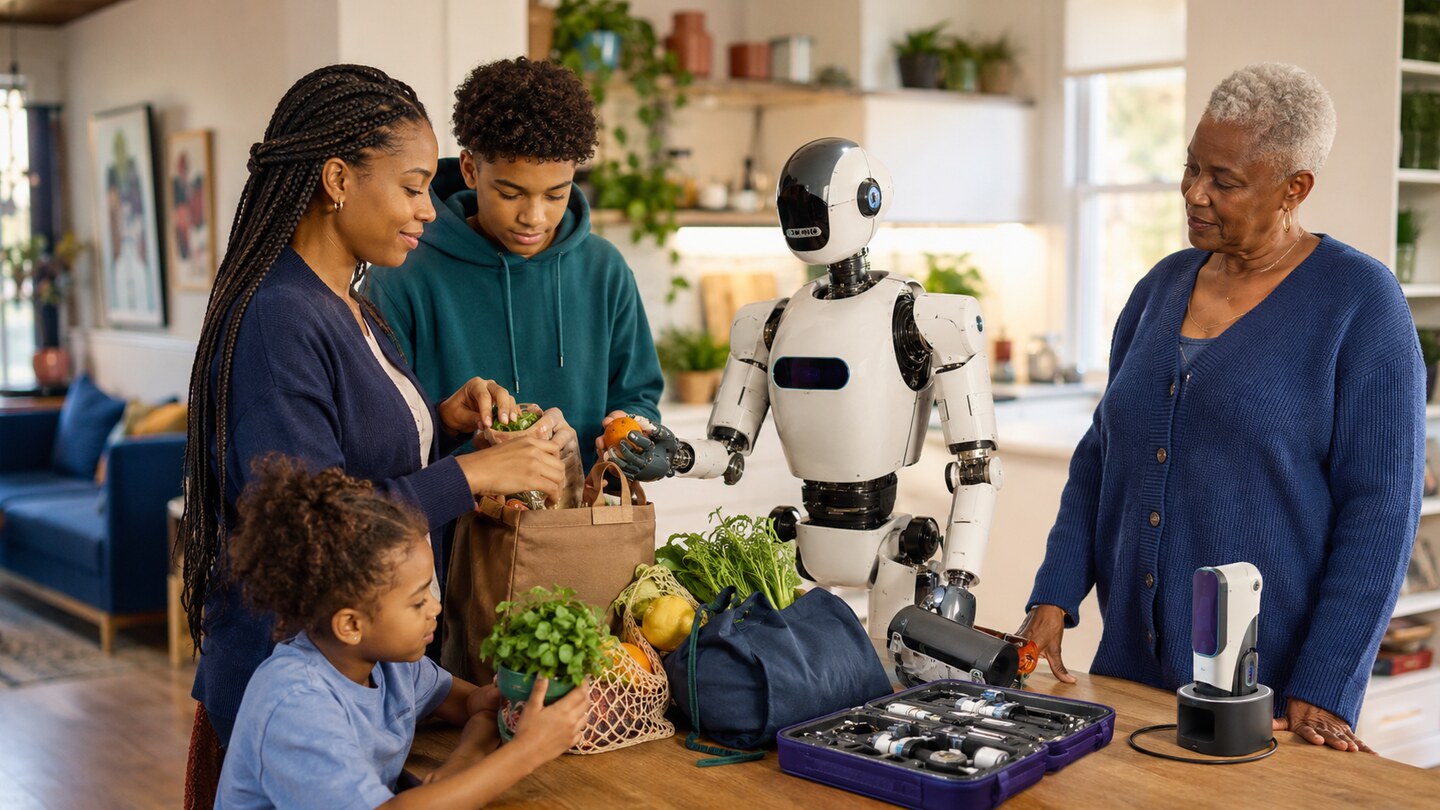

A cheaper humanoid robot is not automatically an accepted humanoid robot. Affordability can move the machine from a trade-show spectacle into ordinary life—but usefulness, control, trust and social meaning will determine whether people allow it to stay.
In the previous article, Humanoid Robots Will Be Built Like Luxury Cars, I argued that specialist suppliers and modular production could reduce costs. A company might integrate hands, batteries, sensors, silicon compute, silicone embodiment and intelligence from different expert producers rather than inventing every component alone.
That explains how prices may fall. It does not explain what happens inside the mind of the buyer when they do.
The psychological transformation will begin when people stop asking, “Why would anybody own a robot?” and start asking, “Which robot fits my household, work or care needs?” That is a change of category—from experimental machine to practical platform.
Price changes more than purchasing power
When a humanoid costs more than a family home, the consumer does not evaluate it as an ordinary appliance. It belongs to a psychological category containing prototypes, corporate research and extreme luxury. Curiosity may be high, but personal relevance remains low.
When prices move closer to cars, computers or major household equipment, the comparison changes. People begin calculating time saved, care provided, tasks completed and years of use. The question shifts from fascination to value.
Unitree currently lists its G1 humanoid from US$13,500 before tax and shipping. The company also warns that the global humanoid industry remains in an early exploratory stage and that individual buyers must understand present limitations. That combination is psychologically important: the headline price may feel increasingly accessible, but capability and readiness still require careful evaluation.
Affordability opens the front door. Perceived usefulness decides whether the robot is invited inside.
1. Perceived usefulness: what problem does the robot solve?
Fred Davis’s original Technology Acceptance Model placed perceived usefulness and perceived ease of use at the centre of technology acceptance. Although the research was developed around information systems, the basic question becomes even sharper for robots: does this machine produce enough meaningful benefit to justify its cost, space, maintenance and risk?
A household does not need a robot because it can walk. It needs one because it can reliably help with cooking preparation, carrying, cleaning, reminders, mobility support, tutoring or another valued activity. Impressive movement attracts attention; demonstrated usefulness supports adoption.
Different households will define usefulness differently. A busy parent may value saved time. An older adult may value physical assistance without surrendering independence. A school may value repeatable demonstrations and additional learning support. The winning robot is therefore not simply the most advanced. It is the one whose benefits are visible within the user’s actual life.
2. Perceived control: can the human remain in charge?
A machine with a human-sized body creates a stronger sense of agency than a phone or speaker. If people cannot predict what it will do, stop it easily or inspect its permissions, affordability may increase anxiety rather than adoption.
Control must be more than an emergency button hidden in an application. Users need understandable modes, physical stopping options, role-based permissions, controllable memory and clear explanations after unexpected behaviour. The robot should show when it is listening, recording, learning, acting or waiting.
This connects directly to my primary and backup cognition framework. When uncertainty rises, a safe robot should pause, reduce force, request confirmation or hand authority back to a person. A machine becomes easier to trust when restraint is visible.
3. Loss aversion: the purchase risk is larger than the price tag
Buyers do not calculate only the expected benefits of a new product. They imagine what they could lose. With humanoid robots, those concerns include financial loss, injury, privacy, data exposure, emotional disruption, obsolescence and dependence on a manufacturer that may not survive.
A lower purchase price reduces one form of risk, but it can create another suspicion: what has been compromised to make the robot cheaper? Consumers will need credible answers about durability, cybersecurity, batteries, software support, repair costs and insurance.
This is why the US National Institute of Standards and Technology describes AI trustworthiness as something to incorporate across design, development, use and evaluation. Trust cannot be added as a marketing slogan after a robot reaches the home.
4. Trialability: people may need to experience robots before owning them
Humanoid adoption may initially resemble cars and expensive technology more than smartphones. Leasing, rentals, workplace access, community demonstrations and supervised home trials can lower the psychological commitment.
A trial converts abstract fear into specific evidence. The user discovers which tasks work, which fail, how noisy the robot is, how much room it needs and whether the family can operate it confidently. The experience may increase adoption—or correctly reveal that the product is not yet suitable.
That second outcome matters. Ethical adoption is not about persuading everyone to want a robot. It is about helping people form an accurate judgment.
5. Social proof: when robots move from exhibitions into neighbourhoods
A technology feels unusual when people encounter it only in promotional videos. It begins to feel socially available when somebody nearby uses it successfully.
Schools, hospitals, hotels, care organisations and workplaces may therefore normalise humanoids before most private households buy them. People will observe how the robots behave, how staff respond to errors and whether the promised benefits appear in real life.
Familiarity can reduce uncertainty, but repetition is not automatically positive. Repeated exposure to clumsy, intrusive or unsafe robots will strengthen rejection. Social proof works in both directions. Every public deployment becomes an advertisement for—or warning against—the entire category.
6. The uncanny valley: looking human is not the same as feeling acceptable
Masahiro Mori’s uncanny-valley proposal suggests that increasing human resemblance may produce greater affinity until an almost-human appearance creates discomfort. The idea should not be treated as a universal law, but it remains a useful design warning.
A humanoid does not need to deceive people into believing it is biologically human. In many settings, a clearly mechanical robot with warm communication and predictable behaviour may feel safer than a lifelike face whose timing, gaze or movement feels inconsistent.
The psychological problem is not simply the amount of silicone skin. It is coherence. Does the voice fit the face? Does the movement fit the social context? Do the machine’s emotional signals match its real capabilities? A robot becomes unsettling when appearance promises a kind of understanding that behaviour cannot deliver.
7. Personalisation: when one robot becomes “our robot”
Mass-produced hardware creates scale, but personalisation creates attachment and household fit. People may want different voices, communication styles, languages, teaching approaches, privacy boundaries and skill sets.
This is where my ChatGPTinside proposal becomes relevant. ChatGPTinside treats cooking, education, care, household support, personality and other capabilities as installable modules rather than one fixed identity chosen by the manufacturer.
However, personalisation must remain transparent. Users should know which module is active, what information it can access and whether its memory belongs to the person, household, robot manufacturer or AI provider. Emotional familiarity without data control would create attachment built on asymmetric power.
ChatGPTinside remains separate from ChatConnect. ChatConnect is my dating-industry concept. ChatGPTinside concerns the behavioural, personality and skills ecosystem for robots operating in human environments.
The adoption ladder: from spectacle to household infrastructure
- Spectacle: people watch demonstrations but cannot imagine personal ownership.
- Accessible trial: lower prices and leasing allow organisations and early adopters to test real uses.
- Visible usefulness: successful tasks create evidence beyond promotional claims.
- Social normalisation: communities develop expectations and etiquette around robot behaviour.
- Personal integration: skills, routines and identity settings are adapted to the household.
- Infrastructure: repair, insurance, regulation and software support make long-term ownership credible.
Affordability accelerates movement up this ladder, but it cannot skip the steps. A cheap robot with no repair network may remain a risky novelty. A more expensive robot with verified usefulness, support and resale value may feel safer.
The danger of a new robot divide
If humanoids become valuable for education, care, productivity and income generation, unequal access could create a new form of digital inequality. Families with advanced robots might gain more time, personalised learning and practical support while other households fall further behind.
Lower prices help, but public access models may also matter: libraries with robot-learning laboratories, school-based systems, community leasing, disability support and care-service provision. Mass adoption should not mean that every household must make an individual luxury purchase.
What manufacturers should measure before claiming acceptance
- Which tasks people continue using after the novelty period ends
- How often users intervene, stop or correct the robot
- Whether confidence matches the robot’s actual reliability
- Which household members feel excluded, watched or overruled
- Repair time, software-support duration and total ownership cost
- Whether users can understand and change data permissions
- How trust changes after the first significant error
Sales measure acquisition. These indicators measure adoption.
MaryChuks analysis: affordability creates exposure; accountability creates acceptance
Collaboration between robot companies and specialist suppliers could produce machines faster and at lower cost. That industrial change has a psychological consequence: more people can encounter robots directly, test their usefulness and build realistic expectations.
But cheaper robots will not automatically become household members. If they are intrusive, unrepairable or difficult to control, greater exposure may accelerate rejection. Price can move the robot into society; behaviour determines the direction society moves after meeting it.
The successful humanoid will therefore combine four forms of affordability: an attainable purchase or lease price, manageable maintenance, understandable mental effort and acceptable emotional risk.
When those conditions converge, the robot stops being merely a machine people can buy. It becomes a platform people can confidently place within everyday life.
Sources and further reading: Unitree G1 product information and buyer cautions; Fred Davis, Perceived Usefulness, Perceived Ease of Use, and User Acceptance of Information Technology (MIS Quarterly, 1989); Masahiro Mori, The Uncanny Valley (authorised English publication, IEEE, 2012); and the NIST AI Risk Management Framework. Applications to affordable humanoid robots and ChatGPTinside are Mary Oge Chuks’s psychological analysis.
Discover more from Marychuks.com AI, Psychology, Business & CreativeVerse
Subscribe to get the latest posts sent to your email.