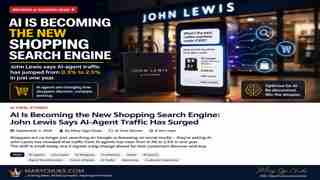
AI is beginning to change not only how people search for information, but how they discover what to buy.
John Lewis says searches arriving from AI agents have risen to 2.5% from just 0.3% a year ago, according to Reuters. The percentage is still small compared with traditional search and direct traffic, but the speed of the increase is the real story.
From Google Search to AI Recommendation
For years, online retail discovery followed a familiar path: search on Google, browse social media, click an advert, compare products and then buy. AI agents are beginning to compress several of those steps into one conversation.
A shopper can now ask an AI system for the best coffee machine under a certain price, a gift for a specific person, or a product that meets a long list of requirements. Instead of showing ten blue links, the AI can compare options, explain differences and increasingly direct the shopper toward a specific retailer.
That changes the competitive question for retailers. It is no longer only: Can customers find us on Google? It is increasingly: Can AI systems understand our products well enough to recommend us?
Why John Lewis Is Investing in Content
John Lewis Managing Director Peter Ruis described the growth as accelerating across age groups. The retailer has opened a new content studio at its Oxford Street flagship where influencers can create material daily, and it is also producing its own video content.
That strategy makes sense in an AI-discovery economy. Modern AI recommendation systems do not operate in a vacuum. They draw signals from product pages, reviews, articles, videos, social conversation, structured data and other publicly available information. The richer and clearer a retailer’s digital footprint becomes, the easier it may be for AI systems to understand what that retailer sells and why a product is relevant.
The New SEO May Be AIO
Traditional search-engine optimisation was built around ranking pages for human searchers. The emerging layer is sometimes described as AI optimisation, answer-engine optimisation or generative-engine optimisation.
The terminology is still evolving, but the commercial principle is straightforward: businesses increasingly need information that machines can interpret accurately. Clear product specifications, useful comparisons, authoritative descriptions, structured data, strong brand signals and trustworthy external references may matter more as AI becomes an intermediary between buyer and seller.
A 2.5% Signal Can Still Be a Big Deal
It would be a mistake to read 2.5% as evidence that AI has already replaced conventional ecommerce search. It has not. But moving from 0.3% to 2.5% in a year represents more than an eightfold increase in the share reported by John Lewis.
Early shifts in user behaviour often look insignificant in absolute terms before they become strategically important. Social commerce followed a similar pattern: first a small source of discovery, then a major marketing channel. AI shopping may be entering that experimental-to-commercial transition.
What This Means for Creators and Publishers
This development matters beyond retailers. Publishers, creators and independent businesses also need to think about how their work appears inside AI-generated answers.
- Write pages that clearly explain what a product or service does.
- Use descriptive titles, categories and metadata rather than vague promotional language.
- Publish original expertise that gives AI systems something meaningful to cite or summarise.
- Keep pricing, availability and product information current.
- Build a recognisable brand footprint across the open web rather than relying on a single platform.
The Bigger Shift: AI Is Becoming Distribution Infrastructure
The most important part of this story is not that shoppers have suddenly abandoned traditional search. It is that AI is moving one layer closer to the transaction.
First AI answered questions. Then it helped people create. Now agents are beginning to search, compare, recommend and act. When that happens, AI stops being merely a tool sitting beside ecommerce and starts becoming part of ecommerce distribution infrastructure itself.
The next battle for online visibility may not simply be who ranks first on Google. It may be who the AI recommends first.
For businesses, that means the time to understand AI-driven discovery is before it becomes the dominant behaviour, not after.
Source: Reuters, September 3, 2026 — reporting on John Lewis’ investment in content creation as searches from AI agents rise.
Discover more from Marychuks.com AI, Psychology, Business & CreativeVerse
Subscribe to get the latest posts sent to your email.