A place of worship can be open-hearted without being operationally unguarded. Hospitality is a value; safety is the system that helps people practise it without leaving children, adults at risk, volunteers or visitors dependent on improvisation.
The strongest plan does not treat every risk as the same. A safeguarding disclosure is not handled like a fire alarm. A medical emergency is not managed like an aggressive intruder. A lost child is not a counter-terrorism incident. When these situations are collapsed into one vague “security policy”, volunteers may remember none of it when pressure arrives.
A better model has three connected layers: safeguarding people from abuse or mistreatment; managing everyday emergencies; and preparing for serious hostile incidents. Each needs a clear route for recognising, responding, recording and escalating concerns.
Layer one: safeguarding is about power, not only strangers
Faith communities often rely on trust, volunteering and close relationships. Those strengths can also make it difficult to question a respected leader, report uncomfortable behaviour or admit that a familiar person may pose a risk. Safeguarding therefore has to cover internal relationships as carefully as external threats.
The Charity Commission’s safeguarding guidance for England and Wales says protecting people must be a governance priority. Trustees are expected to take reasonable steps to protect beneficiaries, staff, volunteers and anybody else who comes into contact with the charity. That includes suitable policies, role checks, trained people, a clear reporting system and prompt referral to the appropriate agencies.
A practical safeguarding system should answer:
- Who is the named safeguarding lead, and who acts if that person is implicated or unavailable?
- How can a child, adult, volunteer or visitor report a concern privately?
- Which roles require safer recruitment, references, training or criminal-record checks where legally eligible?
- What are the rules for one-to-one meetings, transport, home visits, changing areas and digital contact?
- Where are concerns recorded, who can access them and how are records protected?
- When must police, social care, a designated safeguarding authority or the Charity Commission be contacted?
The spiritual status of a person must never replace accountability. “They are respected”, “they have served for years” or “they are like family” are descriptions of social trust, not evidence that a concern is false. A healthy religious culture makes it possible to raise concerns without being accused of disloyalty to the faith.
Layer two: ordinary emergencies need visible roles
Most emergency planning is unglamorous. It concerns exits, fire alarms, first aid, accessibility, crowd flow, severe weather, a person becoming unwell, a missing child or a lift failing while a disabled visitor is upstairs. These events are easier to manage when roles are allocated before a service or gathering begins.
- Welcome lead: watches the entrance without turning hospitality into surveillance.
- Safeguarding lead: receives welfare concerns and follows the reporting procedure.
- Emergency caller: knows the full address, postcode and best access point for responders.
- Evacuation lead: checks routes and coordinates movement without assuming everybody can use stairs or hear instructions.
- First-aid lead: checks supplies and knows the location of any automated external defibrillator.
- Family-contact lead: manages reunification and prevents unverified collection of children.
Small communities can combine roles, but should still name the functions. “Everyone knows what to do” often means no one knows who has called 999, checked the accessible exit or met the ambulance.
Layer three: prepare for hostile incidents without militarising worship
Security preparation should reduce fear rather than make fear the organising principle of communal life. The aim is not to treat unfamiliar worshippers as suspects. It is to ensure that volunteers can notice concerning behaviour, communicate quickly and move people away from danger.
ProtectUK’s free faith-security training provides tailored learning for Christian, Hindu, Jewish, Muslim, Sikh and multi-faith settings. Its purpose is to strengthen preparedness and reduce risks from hate crime and other serious incidents. A mixed volunteer team should complete appropriate training, then translate the learning into the building’s actual layout and community needs.
Useful planning questions include:
- Can the main entrance be observed and controlled without blocking a safe exit?
- Who can lock or unlock doors, and could that action trap people?
- Where can people move if danger is outside and evacuation would increase exposure?
- How will instructions reach Deaf people, those with limited English, people using hearing protection, children and anyone in a quiet room?
- Which volunteer contacts police, and what exact location information will they give?
- How will leaders account for groups using side rooms without delaying escape?
- Who communicates verified information to families and the wider community after an incident?
Martyn’s Law: what is law, and what is not yet in force
The Terrorism (Protection of Premises) Act 2025—widely called Martyn’s Law—received Royal Assent on 3 April 2025. The Home Office published statutory guidance on 15 April 2026 and last updated the collection on 25 August 2026.
Places of worship are among the categories potentially within scope. The government’s 24 July 2026 premises factsheet says premises generally meet the attendance threshold when at least 200 people, including staff, can reasonably be expected at the same time from time to time. Places of worship receive special treatment: where they qualify, they remain in the standard tier even if expected attendance reaches 800 or more.
However, the same factsheet states that the requirements have not yet been commenced. As of 26 September 2026, they are not yet in force. Communities should use the current official material to prepare, but must not describe future statutory duties as though compliance is already legally required.
When commenced, ProtectUK’s standard-tier guidance describes four public-protection procedures: evacuation, invacuation, lockdown and communication. It emphasises proportionate, reasonably practicable measures and warns that a written plan is insufficient if people cannot implement it rapidly.
Design welcome and boundaries together
A safer welcome desk does not need to resemble a checkpoint. Volunteers can greet newcomers, explain where facilities are, notice when somebody appears distressed and direct private conversations to a visible but appropriate space. Name badges can show who is authorised to lead children’s activities or receive safeguarding concerns.
Boundaries should be applied consistently. Side doors should not be propped open for convenience if the plan relies on controlled access. Private counselling should not take place in unobservable locked rooms. A volunteer should not publish photographs of children merely because a service was public. Emergency contact lists should not become general directories available to every helper.
Accessibility is part of safety, not an optional courtesy. An evacuation plan that assumes everybody can run, read small signs, understand spoken English or tolerate a loud crowded route is incomplete. Include disabled worshippers in planning and drills; do not design on their behalf without them.
Build a one-page response card
A short role card is more useful during pressure than a policy folder no volunteer has opened. It should contain:
- the full venue address, postcode and emergency entrance;
- the names or roles of the safeguarding and service leads;
- the location of first-aid equipment, fire controls and any AED;
- the primary and accessible evacuation routes;
- the safer internal location for invacuation where appropriate;
- the agreed lockdown authority and method, without creating entrapment;
- the communication method and a backup if power or mobile service fails;
- the reporting route for safeguarding concerns and serious incidents;
- a reminder not to post unverified information or identifiable casualties online.
Keep sensitive operational details out of public handouts and open social-media posts. The public needs clear safety information; it does not need every access-control weakness, private contact number or internal decision trigger.
Rehearse decisions, not theatre
A drill should test the plan rather than perform competence. Use short scenarios: smoke blocks the usual exit; a child cannot be located after a class; a worshipper discloses harm by a respected volunteer; danger is reported outside the entrance; a wheelchair user is in a room served only by a lift.
After each exercise, ask what information arrived first, who made the decision, which route failed and whether people understood the instruction. Record one owner and deadline for every correction. Do not simulate graphic violence or surprise participants in ways that may retraumatise them. Psychological safety matters during preparedness work too.
Evidence, interpretation and uncertainty
Evidence: charity trustees must take reasonable safeguarding steps; current official security guidance supports preparation and training; and Martyn’s Law has received Royal Assent but its duties are not yet commenced.
Interpretation: separating safeguarding, ordinary emergencies and hostile incidents makes each response easier to teach and reduces the risk that a generic security policy obscures abuse by trusted insiders.
Uncertainty: no template can determine the correct procedures for every building, faith tradition or congregation. Attendance, architecture, local threats, legal structure and the needs of worshippers differ. Responsible leaders should use current official guidance and seek competent local advice where necessary.
A warm welcome is not weakened by boundaries. It becomes more credible. People can worship, volunteer and seek support with greater confidence when kindness is backed by clear roles, accountable leadership and a plan that works beyond the page.
Legal and safety note: This article offers general UK information, with charity-law references applying to England and Wales. It is not legal advice, a safeguarding investigation or a venue-specific security assessment. In an emergency, call 999.
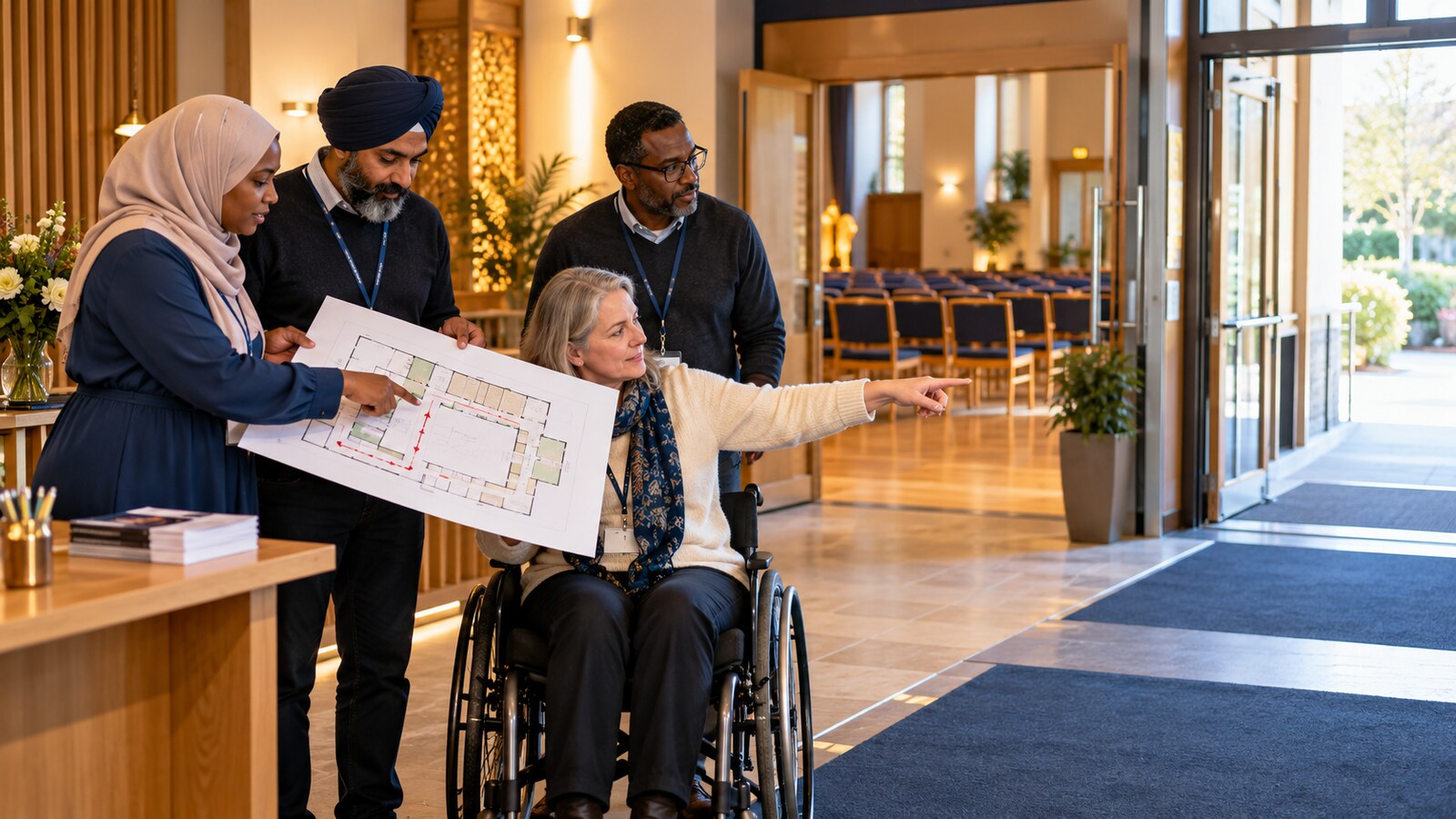
Image note: The featured image is an original conceptual AI-generated illustration of a planning exercise. It does not depict a real place of worship, congregation, threat or incident.
Discover more from Marychuks.com AI, Psychology, Business & CreativeVerse
Subscribe to get the latest posts sent to your email.