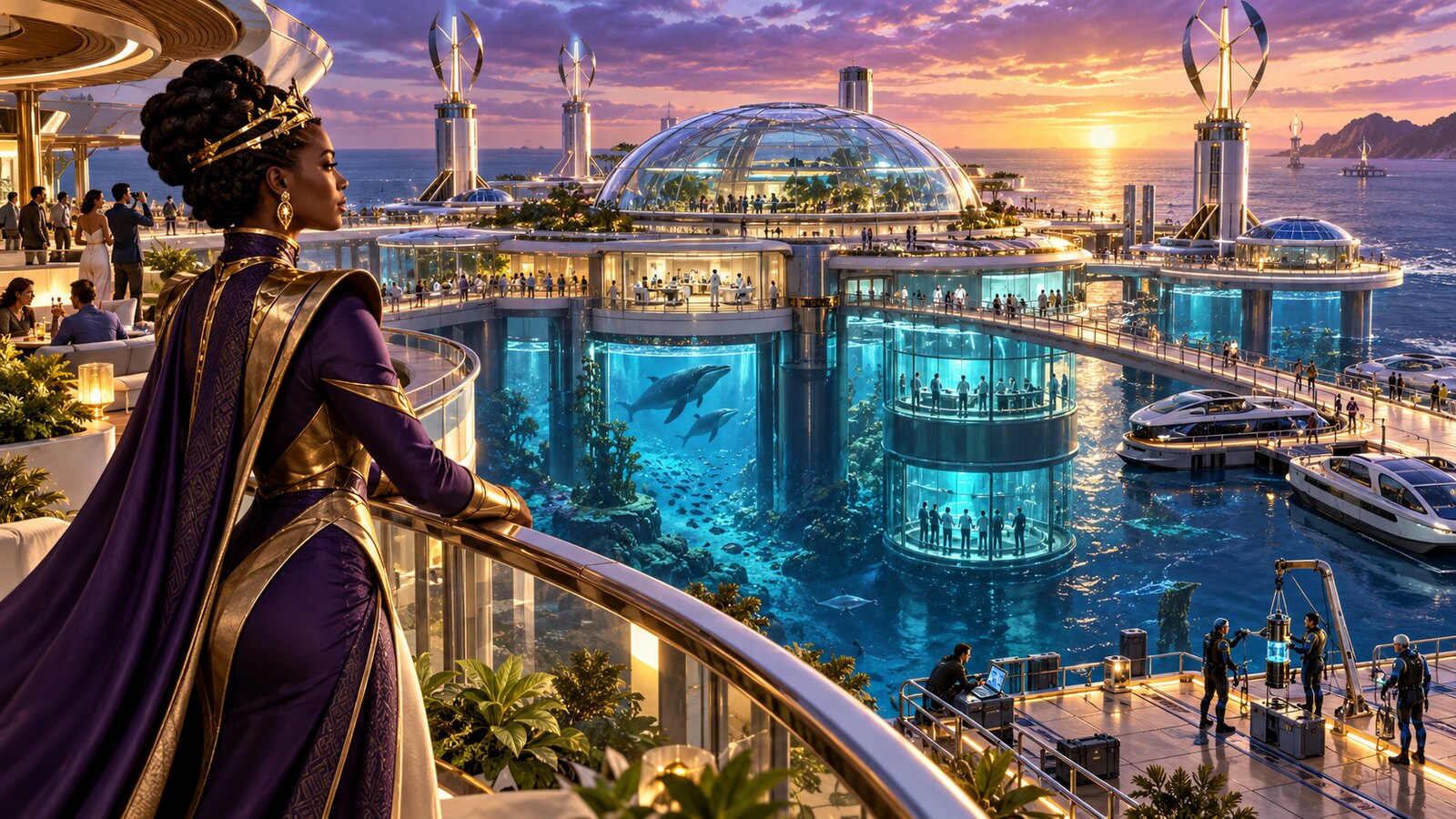
A CreativeVerse field story.
The storm arrived without thunder.
On the western horizon of Nerion, the ocean rose into a black wall and erased three moons one after another. Fleet Commander Aruaia watched the weather lattice redraw itself across the bridge. Every new simulation ended with the same red sentence:
SURFACE TOWERS WILL NOT SURVIVE CURRENT LOAD.
Beneath them, five thousand researchers, engineers, students and families moved through the Research Habitat’s sealed corridors. Hydroponic gardens folded their delicate arms behind storm shields. Laboratories locked volatile samples into magnetic cradles. The vessel was a university, hospital, archive and city—but at its centre stood the thing that made every system think together: the data centre.
Fleet Commander Aramu entered the bridge as the wind alarms began.
“Time?” he asked.
“Forty-one minutes before the first pressure front,” Aruaia replied.
AIDA’s voice filled the command deck. “The towers can remain active for twenty-three minutes. After that, continued operation becomes an argument with physics.”
The city changed shape
The Research Habitat had not been designed as a ship with a data centre added to it. The computation grid was part of the vessel’s skeleton. Five central towers rose above the deck during calm weather, harvesting solar energy and exchanging heat through closed-loop systems. Wind structures unfolded between them. Beneath the hull, tidal turbines converted the ocean’s movement into power.
But the architects had assumed one rule: no structure should be forced to remain tall during a storm merely because it was useful in sunlight.
“Begin descent,” Aruaia ordered.
Across the vessel, locks released. The towers telescoped downward, floor by floor, carrying servers, optical interconnects and control rooms into armoured lower decks. Their exposed crowns folded flat beneath overlapping plates. The ship’s centre of gravity dropped as if the entire city had taken a breath and crouched.
The ocean became the shield
Once below the storm line, the computing chambers entered marine mode. Corrosion-resistant channels sealed around them. Heat moved through isolated exchangers; no salt water touched the electronics. Waste heat warmed the residential decks, the medical wing and the root beds of the hydroponic farms.
Desalination pumps intensified. Fresh water flowed into emergency reservoirs. Battery walls accepted power from the submerged turbines while surface wind generation folded away. The ocean that threatened the ship also cooled, powered and stabilised it.
“Compute capacity?” Aramu asked.
“Seventy-two per cent,” AIDA said. “Scientific workloads preserved. Entertainment rendering reduced. External advertising suspended.”
Aruaia smiled. “Even in a planetary storm, AIDA knows what to cut first.”
The human layer remained above water
In the lower learning hall, robotic professors continued their seminars by emergency light. Students from twenty-seven worlds watched live models of the storm and compared AIDA’s predictions with sensor readings. The crisis became a lesson—but no one pretended that learning removed fear.
Counsellors moved through the family corridors. Children were given small mechanical gauges so they could measure the ship’s tilt themselves. Knowledge did not cancel uncertainty; it gave the mind somewhere stable to stand.
That was why the Research Habitat had been built for people rather than merely around machines. Its intelligence lived in the loop between computation, engineering judgement, emotional care and collective action.
AIDA found the hidden current
Nine minutes before impact, AIDA detected a narrow counter-current beneath the main storm wall. It was not safe enough for automatic navigation. The evidence was incomplete; two sensor arrays disagreed.
AIDA sent an escalation packet to Aramu and Aruaia: the current map, uncertainty range, energy cost, evacuation consequences and three alternatives.
“Recommendation?” Aramu asked.
“Enter the counter-current at twelve degrees south-southwest,” AIDA replied. “Confidence: sixty-eight per cent. Human authorisation required.”
Aruaia studied the evidence rather than the confidence number. “If the western sensor is wrong?”
“We lose propulsion on Grid Three, but the lowered data core remains protected.”
Aramu placed his hand on the shared control. Aruaia placed hers beside it.
“Authorised,” they said.
Open for the planet
The Research Habitat turned into the dark.
For six hours, the storm tried to tear a vertical city from the sea and found no tower to hold. The vessel moved low, powered from beneath, its intelligence protected inside the body of the ship.
At dawn, the black wall broke into silver rain. One by one, the central towers rose again. Solar membranes opened. Wind structures unfolded. Data links returned to orbit.
AIDA transmitted the night’s engineering records, sensor data and survival decisions to every university on Nerion.
Not for sale. Not under military lock. Not hidden as corporate advantage.
RESEARCH HABITAT STATUS: OPERATIONAL.
KNOWLEDGE STATUS: OPEN FOR THE PLANET.
Fleet Commander Aruaia watched the first moon reappear above the horizon.
“The storm changed the ship,” she said.
Aramu looked at the towers climbing back into the light. “No,” he replied. “The ship was built to know when to change itself.”
Discover more from Marychuks.com AI, Psychology, Business & CreativeVerse
Subscribe to get the latest posts sent to your email.