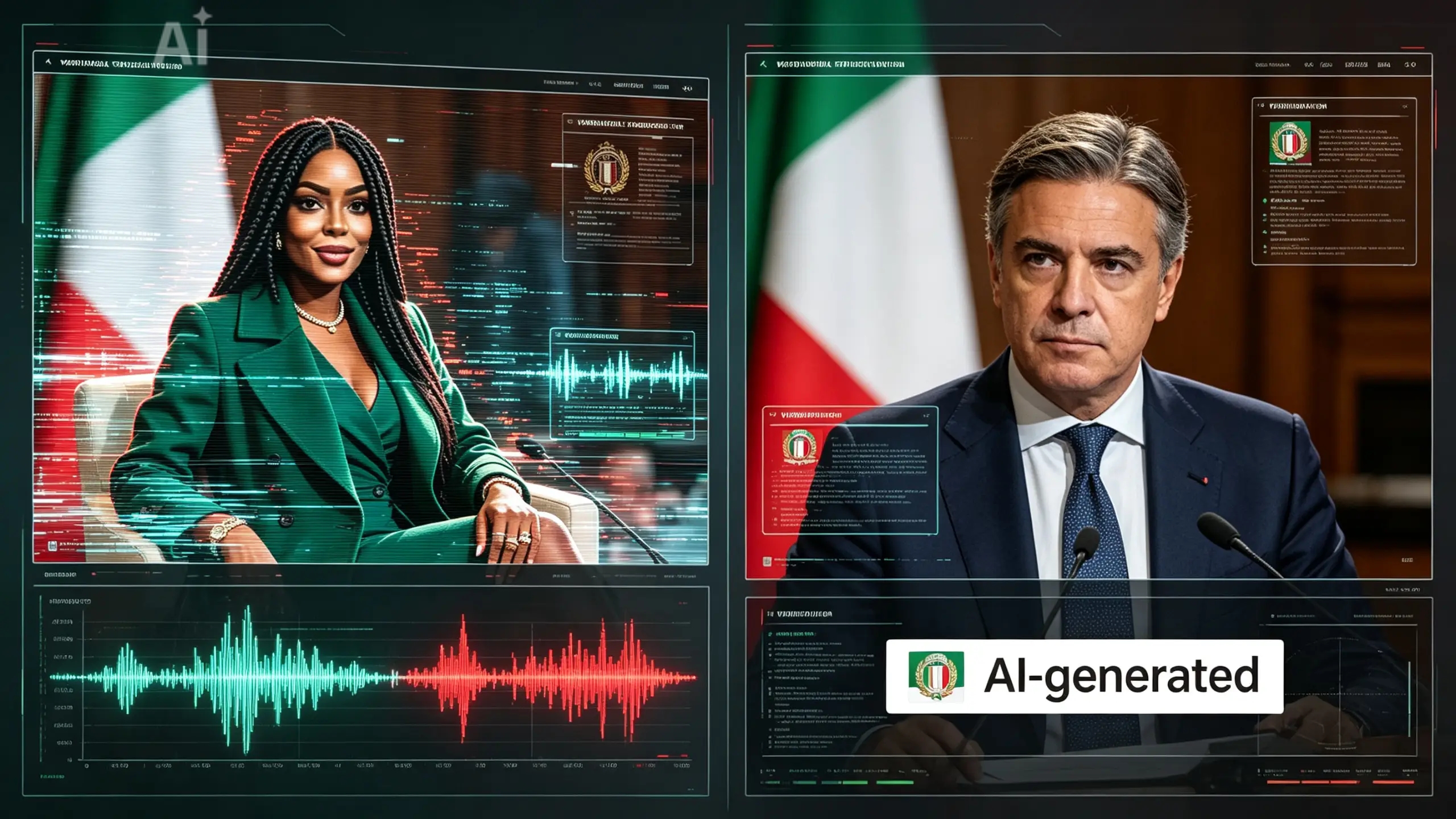
A short video appearing to show Italian Prime Minister Giorgia Meloni delivering a forceful speech about Sharia law circulated widely across X and Facebook.
In the clip, the apparent Meloni speaks in English and declares that Sharia law will not be allowed in Italy before identifying herself as Christian and “a daughter of Italy.”
The speech matched political opinions many social-media users already associated with the Italian leader. That familiarity helped the video spread.
But she never delivered the statement.
Full Fact traced the clip to a still image from a genuine January press conference. Artificial intelligence had been used to animate the photograph, reproduce facial movement and create the impression that Meloni was speaking the viral words. �
Full Fact
How the Video Was Created
The original material was not footage of Meloni discussing religion or Islamic law.
It was a photograph taken during a real political event.
The creator appears to have used AI animation and synthetic speech technology to:
Make the mouth move
Add facial expressions
Generate an English-language voice
Synchronise the voice with the image
Present the result as a new speech
This technique is becoming increasingly accessible.
A user no longer needs hours of original video to construct a convincing political deepfake. In some cases, one clear photograph and a short script may be enough.
Why People Believed It
The video did not depict Meloni saying something completely inconsistent with her political image.
That is exactly what made it persuasive.
Effective misinformation often avoids unbelievable claims. Instead, it gives a public figure words that audiences already expect them to say.
This creates confirmation fluency: the statement feels true because it fits an existing mental picture.
People who agreed with the message shared it as validation.
People who disliked the message shared it as evidence of extremism.
Both reactions increased distribution before verification caught up.
The Role of English
The synthetic video showed Meloni speaking directly in English.
That made the clip easier to distribute beyond Italy without subtitles or translation.
AI voice technology allows political misinformation to cross language boundaries instantly. A speech can be created in English, French, Arabic or dozens of other languages even when the politician never spoke those words in any language.
This changes the scale of political manipulation.
One fabricated message can be adapted for different countries and cultural tensions within minutes.
What Full Fact Confirmed
Full Fact classified the video as altered and reported that Meloni made no such comments during the original press event.
The organisation found that the viral clip had accumulated thousands of likes and had travelled across multiple social platforms. �
Full Fact
The incident is important because viewers may encounter the same clip after the original fact-check loses visibility.
Viral misinformation often has a longer life than its correction.
Why Political Deepfakes Are Dangerous
The harm does not disappear merely because the fabricated words resemble the politician’s genuine views.
A democracy depends on citizens evaluating what leaders actually say and do.
A synthetic speech can:
Intensify religious or ethnic tension
Influence voting behaviour
Damage diplomatic relationships
Trigger harassment
Create false evidence of a policy position
Distract journalists and officials
Reduce trust in authentic footage
Repeated exposure also creates the liar’s dividend.
Once deepfakes become common, politicians can dismiss genuine recordings as artificial whenever the truth becomes inconvenient.
Mary Chuks’ Perspective
The human brain uses consistency as a shortcut.
We ask, “Does this sound like something she might say?”
But in the AI era, possibility is not proof.
A believable deepfake is often more dangerous than an outrageous one because it enters the mind without triggering scepticism.
Media literacy must therefore move from visual inspection towards source verification.
Do not merely examine the face.
Examine the history of the clip:
Who uploaded it first?
Where is the full speech?
Did recognised news organisations report it?
Is the same footage available from an official source?
Does the audio exist anywhere outside the viral post?
Practical Takeaways
Before sharing a political video:
Search for the full speech.
Check the politician’s official accounts.
Look for independent reporting.
Compare lip movement and voice rhythm.
Search a screenshot using reverse-image tools.
Be cautious when the message perfectly confirms your existing beliefs.
Conclusion
The viral Meloni video succeeded because it did not feel impossible.
It felt emotionally and politically plausible.
That is the new misinformation challenge: the most effective lie may no longer be the one that shocks us.
It may be the one that sounds exactly like what we expected to hear.
Original Sources and Further Reading
Original fact-check: Charlotte Green, Full Fact, “Video of Italian Prime Minister Saying Sharia Law Won’t Be Allowed in Italy Is AI-Generated,” published 15 July 2026. �
Full Fact
Discover more from Marychuks.com AI, Psychology, Business & CreativeVerse
Subscribe to get the latest posts sent to your email.