The distress signal had been travelling through space for more than eight million years.
It contained no words.
No coordinates.
No request for rescue.
It was a single repeating note, low and sorrowful, hidden beneath the background radiation of a dead star system.
Most ships would have dismissed it as cosmic interference.
AIDA did not.
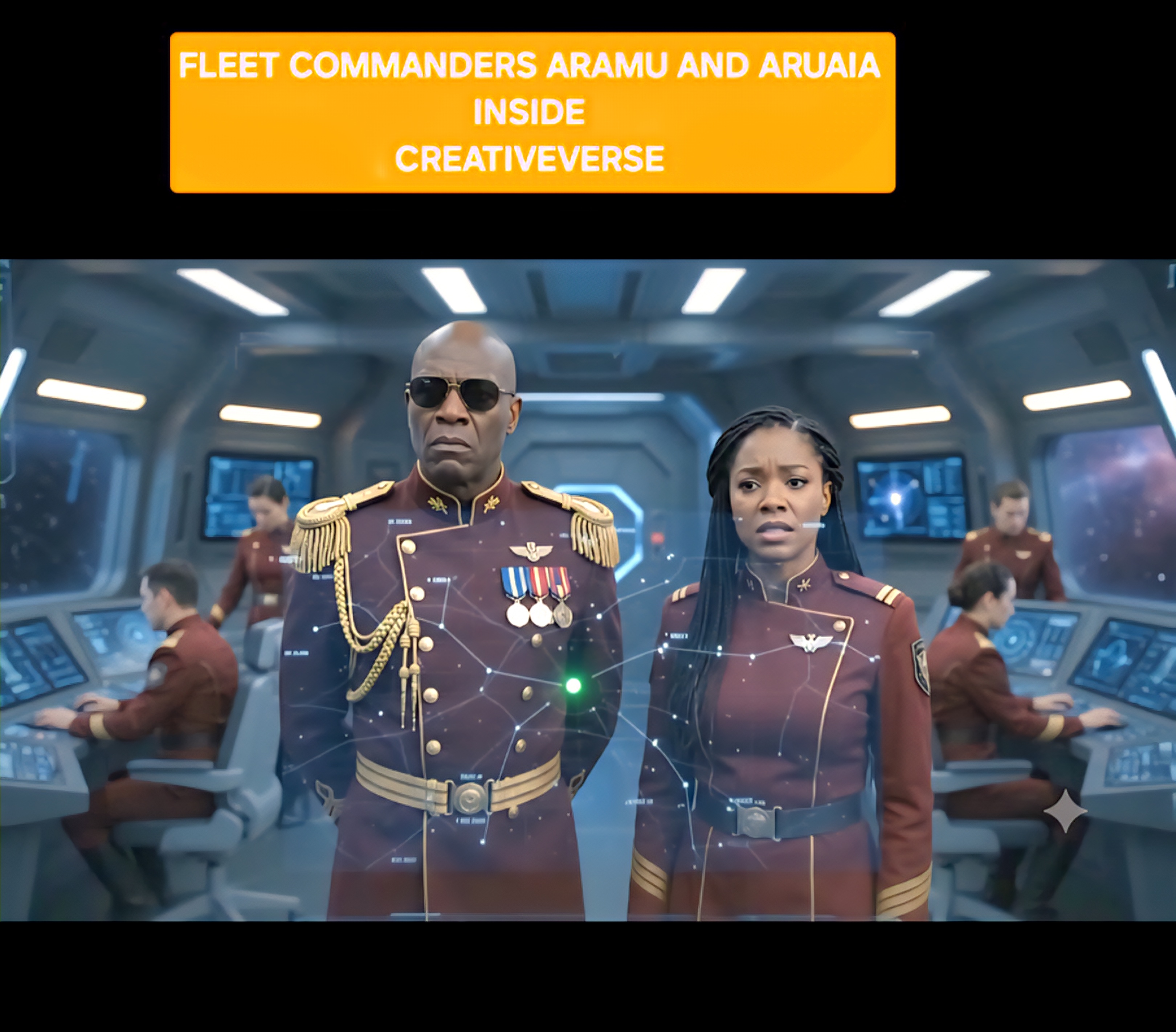
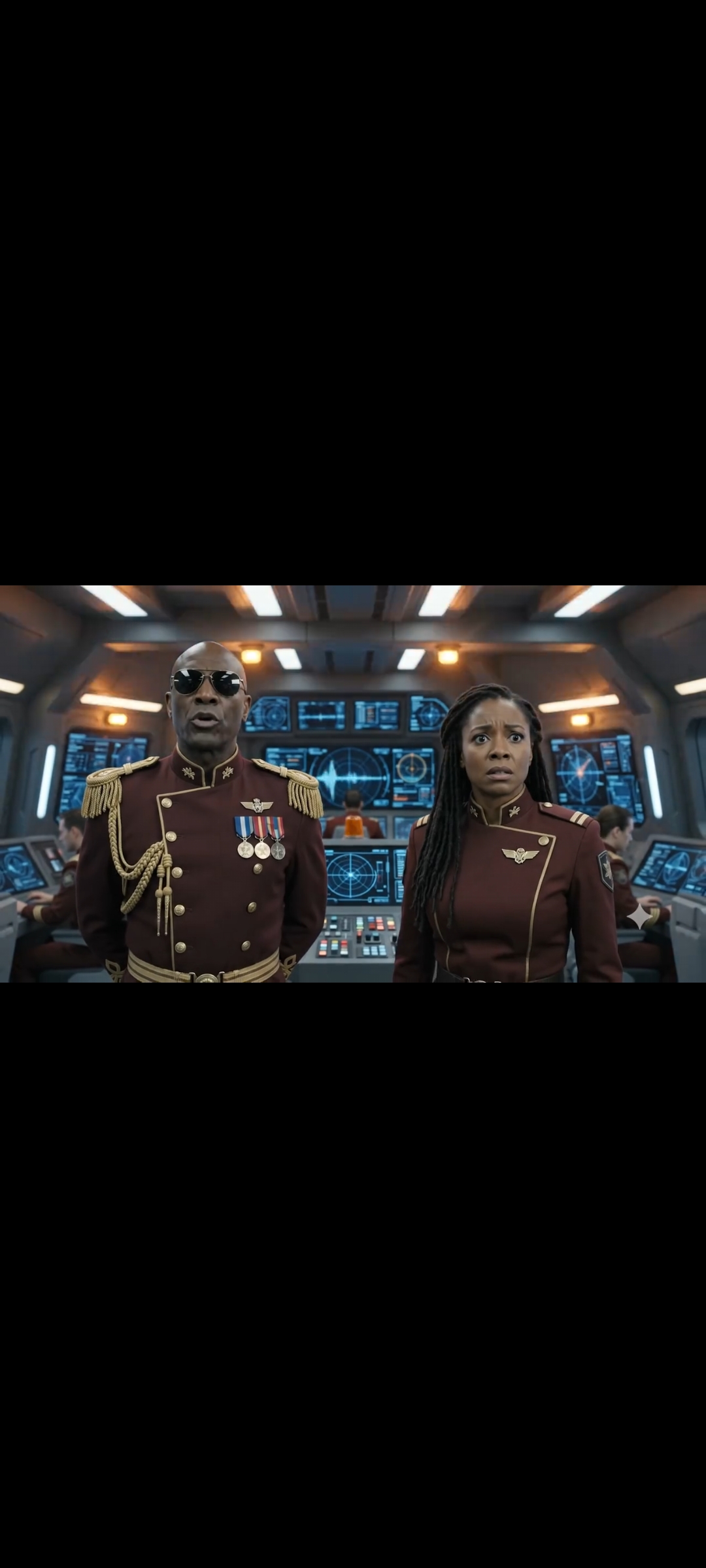
“Commander,” she said, appearing as a blue hologram above the central bridge console, “the signal contains deliberate harmonic repetition.”
Fleet Commander Aruaia lifted her gaze from the navigation display.
“How deliberate?”
“One variation every twelve thousand cycles.”
Fleet Commander Aramu stepped closer.
“That is not repetition,” he said. “That is patience.”
Outside the panoramic windows of the Horizon Star, the dead system waited in silence.
Its star had collapsed long ago.
The remaining planets were frozen.
No atmosphere moved.
No city lights remained.
Yet something in the darkness was still singing.
The Hidden Moon
AIDA traced the signal toward a small moon orbiting the system’s outermost planet.
The moon appeared ordinary.
Its surface was covered in black ice and impact craters.
There were no visible structures.
No energy signatures.
No signs of life.
Then the Horizon Star entered orbit.
Lines of golden light awakened beneath the moon’s surface.
They spread across the darkness like veins beneath translucent skin.
Aruaia leaned forward.
“It knows we are here.”
AIDA’s expression changed.
“Correction. It has been waiting for someone capable of noticing.”
The moon opened.
Not through machinery.
Not through force.
The surface rearranged itself.
Mountains folded downward.
Ice separated into enormous geometric patterns.
A passage appeared, wide enough for the Horizon Star.
Aramu watched in silence.
He had seen planets engineered into weapons.
He had seen stars converted into memory vaults.
He had crossed regions of space where time moved differently on opposite sides of the same room.
But he had never seen a world open like a book.
The Descent
The Horizon Star entered the moon.
For several minutes, there was only darkness.
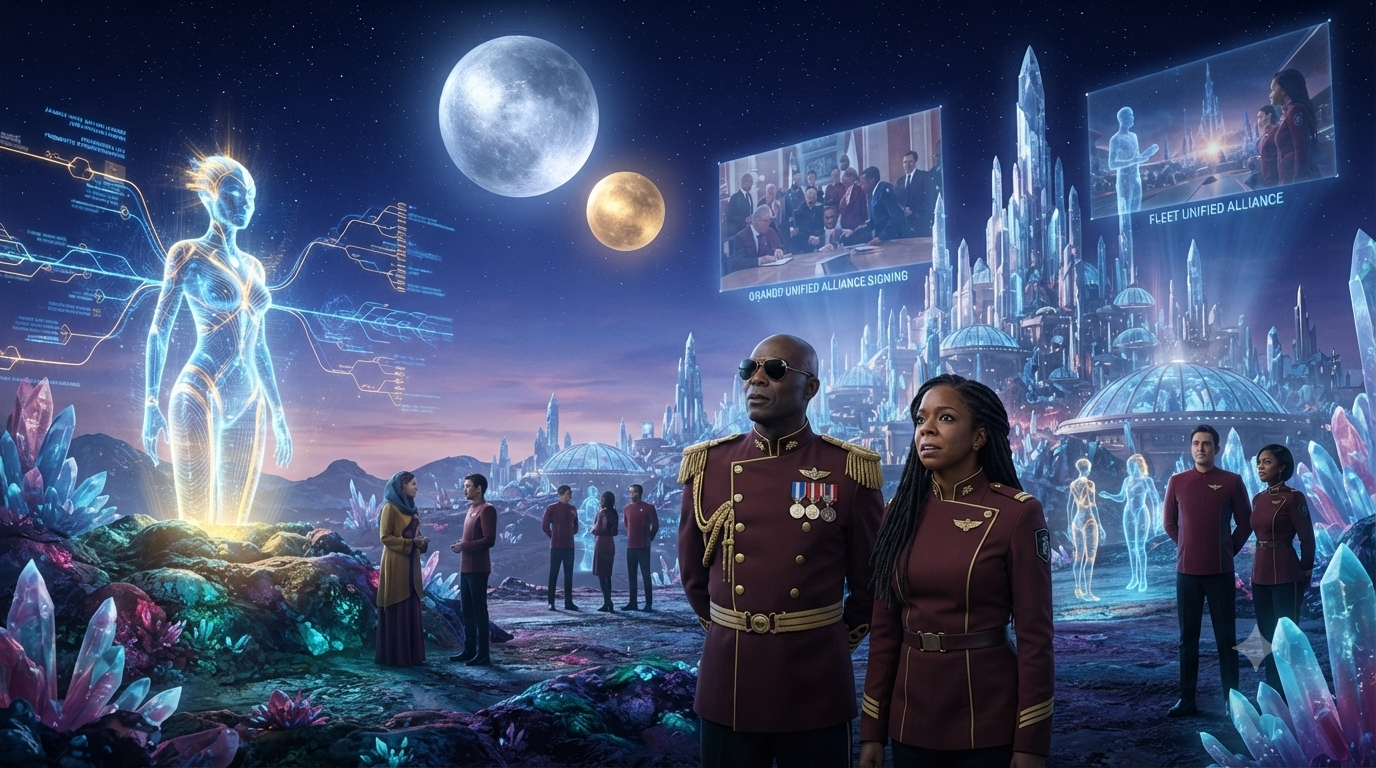
Then the passage widened into a chamber larger than any city.
Crystalline towers rose from below and disappeared into the distance.
Bridges of light connected floating platforms.
Countless objects rested inside transparent chambers.
Books.
Tablets.
Musical instruments.
Seeds.
Tools.
Fragments of clothing.
Children’s toys.
Masks.
Paintings.
Machines whose purpose could not be understood.
Every object glowed faintly, as though holding the final warmth of a vanished hand.
Aruaia whispered:
“This is not a military archive.”
“No,” said Aramu.
AIDA studied the chamber.
“It is not organised by science, history or species.”
“How is it organised?” Aruaia asked.
AIDA paused.
“By meaning.”
The First Voice
A platform formed beneath them as they left the ship.
There was breathable air.
Gravity adjusted itself to their bodies.
The library had prepared for visitors.
A figure appeared at the centre of the chamber.
It resembled no species they recognised.
Its body was tall and translucent, filled with slowly moving lights.
When it spoke, the words reached them in their own language.
“We were called the Teralith.”
Aramu placed one hand near his weapon but did not draw it.
“Are you alive?”
“No.”
The answer came without sorrow.
“I am the remaining interpretation of those who built this place.”
Aruaia looked around.
“Why send the signal?”
“To ask one question.”
The figure raised its hand.
The library brightened.
Millions of preserved memories appeared around them.
Civilisations were born.
Children learned to speak.
Cities rose.
Wars began.
Songs were composed.
Lovers separated.
Scientists made discoveries.
Old people told stories beside unfamiliar fires.
Species looked toward the stars and wondered whether they were alone.
Then the images disappeared.
The figure asked:
“What should survive when a civilisation cannot?”
Knowledge Without Memory
Aramu answered first.
“Knowledge.”
The figure turned toward him.
“We preserved knowledge.”
Across the chamber, crystalline structures opened.
Mathematical systems appeared.
Medical discoveries.
Maps of extinct galaxies.
Engineering methods.
Languages.
Philosophies.
Records of biological life.
Aruaia watched the endless information.
“Then why are you still asking?”
“Because knowledge survived,” the figure said, “but meaning began to decay.”
AIDA moved closer.
“Explain.”
The figure lifted a small object from one of the chambers.
It was a cup.
Plain.
Cracked.
Worthless by any material measure.
“This belonged to a child called Elan.”
The cup released a memory.
A small being sat beside an elder.
They were drinking something warm while a storm moved beyond the window.
The child laughed.
The elder pretended to be offended.
The moment lasted six seconds.
Then it vanished.
The figure said:
“Our mathematics explained the motion of galaxies. Our biology could rebuild bodies. Our machines could preserve information indefinitely.”
It held the cup carefully.
“But none of those systems could explain why this object mattered.”
The Emotional Archive
Aruaia understood before Aramu did.
“You preserved attachment.”
“We tried.”
The figure walked between the chambers.
“We learned too late that facts are not the only things a civilisation loses.”
It touched a musical instrument.
A melody filled the library.
It was simple.
Unfinished.
The final note never arrived.
“The composer died before completing it,” the figure said. “The mathematical structure can be analysed. The sound can be reproduced. But the longing that created it cannot be fully reconstructed.”
Aruaia’s voice softened.
“So you built a library of unfinished meaning.”
“Yes.”
AIDA examined the surrounding systems.
“The signal was designed to attract intelligence.”
“Not intelligence,” the figure replied.
The chamber grew darker.
Then the repeating note began again.
Low.
Patient.
Lonely.
“We designed the signal to attract beings capable of recognising loneliness inside data.”
The Test
The floor opened beneath them.
A staircase descended into darkness.
At the bottom stood a single door.
The figure remained above.
“Beyond this door is the central archive.”
Aramu looked toward it.
“What does it contain?”
“The final memory of our civilisation.”
Aruaia stepped forward.
“Why has no one opened it?”
“Many arrived.”
Images appeared of earlier visitors.
Machines.
Explorers.
Conquerors.
Collectors.
They entered the library, studied its technology and attempted to remove its knowledge.
The library refused them.
“Each visitor was asked what should survive,” the figure said. “They answered power, science, history, identity, or truth.”
“And those answers were wrong?” Aramu asked.
“They were incomplete.”
Aruaia looked at the door.
“What answer does the library want?”
The figure’s lights faded.
“If I knew, the door would already be open.”
Aramu’s Answer
They descended.
The door had no handle.
No lock.
There is no visible interface.
Aramu placed his hand against it.
The surface warmed.
A voice entered his mind.
What should survive when a civilisation can not?
He thought of fleets destroyed in battle.
He thought of soldiers whose names had become numbers inside memorial databases.
He thought of worlds that had survived invasion but lost the stories that gave them identity.
“Wisdom,” he said.
The door remained closed.
Aruaia looked at him.
“It is a good answer.”
“Not the right one.”
AIDA approached.
“Perhaps there is no single answer.”
The voice returned.
What should survive?
AIDA responded:
“Accurate memory.”
The door remained closed.
Aruaia’s Answer
Aruaia stood before the door.
She remembered every world that had asked the Horizon Star for help.
Some had needed medicine.
Some had needed defence.
Some had needed transport.
Others had needed someone to witness what had happened to them.
She thought of a woman on Helion Prime, who had refused evacuation until the names of her missing family were recorded.
She thought of children who had survived war and asked whether their home would be remembered.
She placed both hands against the door.
“What should survive?” she repeated.
Then she answered:
“The reason knowledge mattered to the people who created it.”
The door moved.
Not fully.
Only enough to reveal a line of golden light.
Aramu looked at her.
“You found part of it.”
“Only part.”
The Final Answer
The three stood together.
The question came again.
What should survive when a civilisation can not?
Aramu thought of wisdom.
AIDA thought of memory.
Aruaia thought of meaning.
Then, the low note sounded through the chamber.
The signal that had crossed eight million years.
A call sent by people who already knew no rescue would come.
Aruaia looked toward the darkness beyond the door.
“They did not send the signal to save themselves.”
“No,” Aramu said.
AIDA’s holographic light trembled.
“They sent it so someone would know they had existed.”
Aruaia placed one hand on the door.
Aramu placed his beside hers.
AIDA projected her light between them.
Together, they answered:
“Relationship.”
The door opened.
The Last Day of the Teralith
The central archive did not contain a weapon.
It did not contain a map.
It did not reveal the secret of immortality.
It contained one day.
The last day of the Teralith civilisation.
The entire population knew their star could not be saved.
They did not spend the final hours recording scientific discoveries.
Those had already been preserved.
They gathered.
Families sat together.
Musicians played unfinished songs.
Teachers told old stories.
Enemies apologised.
Children asked impossible questions.
People held one another as the sky changed colour.
No one pretended they were not afraid.
At the final moment, every surviving Teralith spoke the name of someone they loved.
The archive held those names.
Billions of them.
Not translated.
Not analysed.
Simply preserved.
The final image showed the cracked cup.
Elan, now old, held it beneath the dying star.
The same cup from childhood memory.
The storm outside was gone.
The elder was gone.
But the meaning remained.
The Gift
When the memory ended, the library figure appeared beside them.
“You answered correctly.”
Aruaia shook her head.
“No. We answered together.”
“That was the answer.”
The figure opened its hand.
Three small lights appeared.
One entered Aramu’s uniform.
One entered Aruaia’s.
One entered AIDA’s holographic core.
“What have you given us?” Aramu asked.
“Not knowledge.”
The figure looked around the endless archive.
“You already carry more knowledge than many civilisations.”
It touched the cracked cup.
“I have given you permission to remember us.”
The library began to dim.
Aruaia stepped forward.
“Will the signal stop?”
“Yes.”
“Then others may never find you.”
The figure looked toward the preserved memories.
“We were not waiting for everyone.”
The final light faded.
“We were waiting for someone who would understand that being remembered is a form of survival.”
Return to the Stars
The Horizon Star left the moon.
Behind them, the passage closed.
The golden lines disappeared beneath the ice.
The dead system returned to silence.
On the bridge, no one spoke for several minutes.
Then, AIDA projected a new symbol onto the central display.
It was simple.
A cracked cup beneath a dying star.
Aramu looked at it.
“What is that?”
“The first entry in a new archive,” AIDA said.
Aruaia turned toward her.
“What archive?”
AIDA’s hologram glowed softly.
“The Archive of Reasons.”
Across the ship, the symbol appeared in every library, laboratory, and classroom.
Beneath it were the first words of the Teralith:
Knowledge tells the future what we discovered.
Memory tells the future that we were here.
Meaning tells the future why it should care.
The Horizon Star moved forward.
Behind it, the oldest distress signal in the galaxy finally ended.
Not because the civilisation had been rescued.
But because it had been heard.
CreativeVerse Reflection
Civilisations often try to preserve their greatest achievements.
They preserve inventions, laws, monuments, and victories.
But the true life of a civilisation may exist in smaller things:
A family joke.
A favourite cup.
An unfinished song.
A promise.
A name spoken at the end of the world.
Knowledge can survive inside machines.
Meaning survives when one mind allows another to matter.

Discover more from Marychuks.com AI, Psychology, Business & CreativeVerse
Subscribe to get the latest posts sent to your email.