Slug: bonfire-hedgehog-wildlife-safety-check
Tags: Wildlife, Nature, Public Safety
Meta description: Before lighting a garden bonfire, use this wildlife and fire-safety check: move the pile, inspect it carefully, preserve an escape route and supervise it.
A heap of branches can look like fuel to a person and shelter to a hedgehog. That difference in perspective is why a bonfire check must be more than a quick glance from above.
The safest routine begins before anyone strikes a match: decide whether a fire is necessary, separate the temporary bonfire from permanent wildlife habitat, move the material to clear ground on the day, and inspect every section immediately before lighting. Fire safety and wildlife safety are not competing jobs. They are two parts of the same preparation.
Why an old pile cannot be treated as an empty pile
Hedgehogs seek covered, quiet spaces. A loose pile of leaves, twigs and logs offers darkness, insulation and gaps at ground level—the same qualities people intentionally create in a wildlife refuge. The longer bonfire material sits undisturbed, the more opportunity an animal has to enter it.
This leads to an important distinction. It is reasonable to infer that a long-standing pile may be occupied; it is not possible to prove that it is empty merely because no animal is visible from the outside. A check performed days earlier is also not current evidence. An animal could have moved in afterwards.
The British Hedgehog Preservation Society’s current advice is built around three actions: move the material, check the whole pile, and light from one side. Its detailed guidance says to use a torch, gently lift sections with a pole or broom, and never probe with a spade or fork, which could injure an unseen animal.
First ask whether you need the fire
A bonfire is not the only way to manage autumn material. Dry leaves can become leaf mould; suitable prunings can be chipped; garden waste may be composted or collected through the local council. Choosing one of those routes removes the ignition risk and can retain useful habitat or soil material.
In England and Wales, the headline legal position is often misunderstood. The government’s garden-bonfire guidance does not impose a blanket ban on garden bonfires, but it does prohibit disposing of household waste by burning when that causes pollution or harms health. Smoke that becomes a nuisance or a traffic danger can also trigger action. Local rules and conditions still matter, so check your council’s advice before planning a fire.
Evidence: there are legal controls on harmful waste burning, smoke nuisance and road danger. Interpretation: “legal somewhere” is not the same as “sensible today”. Wind, dry ground, nearby structures, neighbours and local restrictions can all make postponement the responsible decision.
Build a two-pile system
The easiest way to avoid confusion is to give permanent habitat and burn material different locations and different meanings.
- Keep the refuge. Leave a clearly separate log pile, leaf heap or hedgehog house in a quiet part of the garden. Never borrow material from it for burning.
- Stage the burn material elsewhere. Store branches in manageable sections, away from the final lighting point.
- Rebuild on the day. Move the material by hand to clear ground shortly before the planned fire. Moving is stronger than looking because it exposes the base, where an animal may be concealed.
- Check again immediately before lighting. A pile rebuilt in the morning is not guaranteed empty by evening.
This is not a promise of zero risk. Wildlife can move unpredictably, and a human inspection can miss something. It is a practical risk-reduction system: shorten the time available for occupation, expose hidden spaces, and retain a route away from heat.
The five-minute pre-light inspection
Assign one sober adult to lead the inspection. Children can learn why the check matters, but they should remain outside the working and ignition area.
- Stop and listen. Approach quietly. The British Hedgehog Preservation Society notes that a disturbed hedgehog may make a huffing sound.
- Light the gaps. Shine a torch into the pile at ground level and from several directions. Do not rely on daylight reaching the centre.
- Lift—do not stab. Use a broom handle or pole to raise sections gently. Do not thrust a garden fork or spade into hidden spaces.
- Inspect the base and perimeter. Look beneath sheets, pallets or dense leaves as well as between logs. Remove plastic, treated wood, aerosols, batteries, paint tins and foam.
- Leave one clear direction of travel. If the pile is judged clear and the fire proceeds, light from one side only rather than surrounding it with ignition points.
If you find a healthy hedgehog, stop the process and give it time and a clear route to move into safe cover well away from the fire site. If an animal appears injured, trapped or unwell, do not improvise prolonged care. The RSPCA advises taking a sick or injured hedgehog to a vet and provides handling and transport guidance. Protect yourself as well: frightened wild animals can bite or scratch.
Wildlife-safe does not automatically mean fire-safe
An empty pile can still be badly located or poorly controlled. The London Fire Brigade says a bonfire should be well clear of buildings, sheds, fences, trees and hedges. It also advises keeping a bucket of water or hose nearby, never using flammable liquids such as petrol or paraffin, and supervising the fire until it has burnt out.
Make those controls visible before ignition. Place the water supply where it can be reached without crossing the fire’s path. Keep people and pets beyond a defined boundary. One adult should have responsibility for the fire rather than assuming “everyone” is watching it. If conditions change—particularly wind direction or strength—do not be embarrassed to cancel.
What not to burn
A wildlife check does not make mixed rubbish suitable fuel. Never burn batteries, aerosol cans, paint tins, foam furniture, plastics or treated and painted timber. Some can explode; others can release dangerous smoke. Wet or green material also creates more smoke and is a poor choice near neighbours, roads or people with respiratory conditions.
Do not use petrol, paraffin or another accelerant. A slow start is inconvenient; an unpredictable flash fire can cause severe injury and spread beyond the pile. If safe ignition cannot be achieved without an accelerant, the correct decision is not to light it.
The end of the fire is part of the plan
Supervision continues after the visible flames fall. Turn and damp the remains carefully, watching for hot spots and wind-blown embers. The London Fire Brigade advises damping a bonfire with plenty of water if it must be left; a better plan is to allow enough time for the responsible adult to supervise it until it is fully out.
Keep animals and children away from ash until it is completely cold. Clear safe, cold residue rather than allowing the former burn site to become an ambiguous new heap. Restore the separate wildlife refuge—not the burn pile—as the garden’s intentional shelter.
A compact go/no-go check
- Could the material be composted, chipped or collected instead?
- Have local council guidance, weather and wind been checked?
- Was the material moved to clear ground today?
- Was every section checked again immediately before lighting?
- Were only a torch and blunt pole or broom used—never a fork or spade?
- Is there a clear wildlife escape direction?
- Are structures, hedges, pets, children and neighbours protected?
- Is water ready, and is one sober adult responsible until the fire is cold?
If any answer is no, pause. A delayed bonfire is an inconvenience; an injured animal, person or neighbour is not.
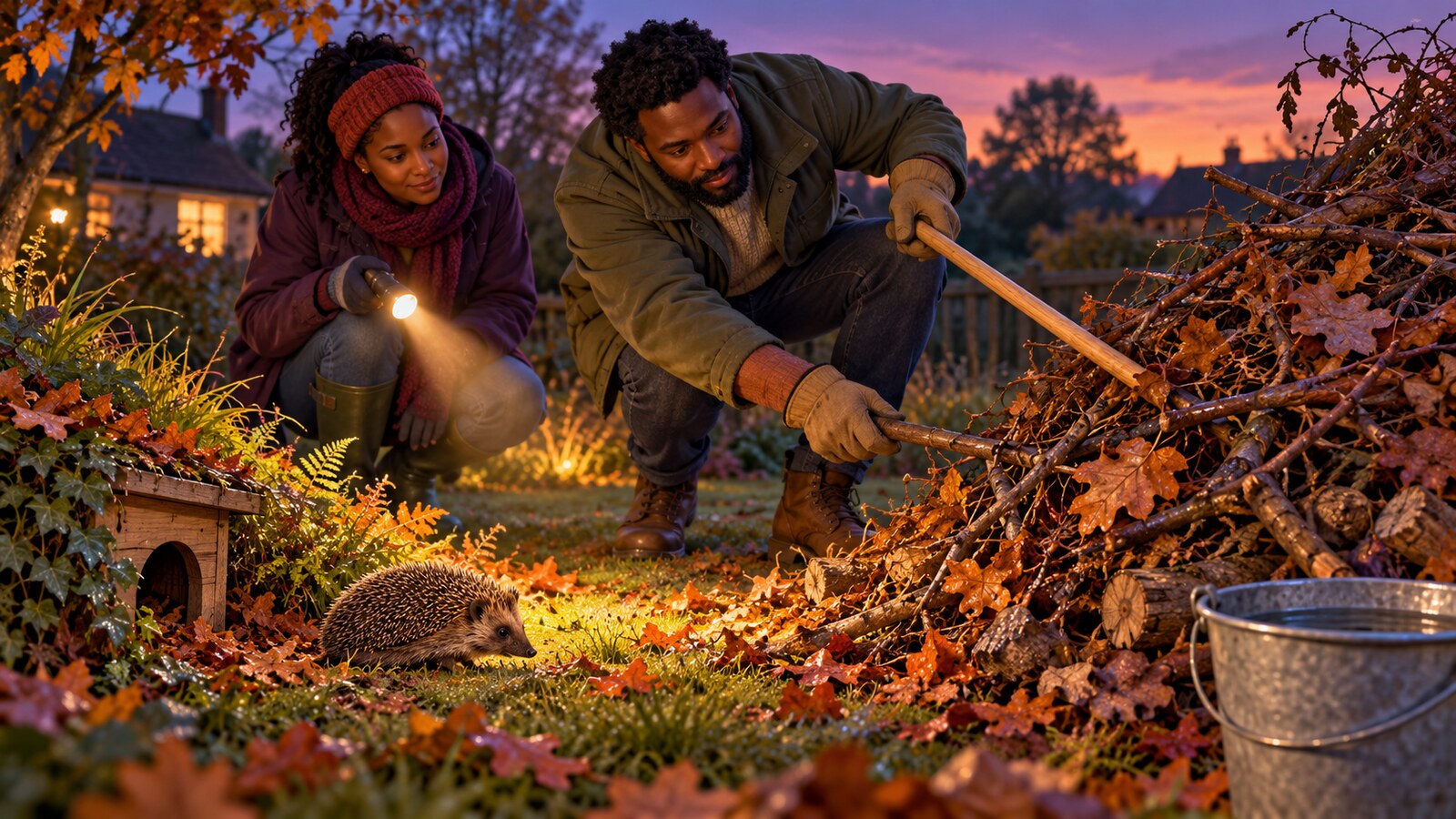
Featured image: original conceptual AI illustration created for this article. It depicts a safety check and is not documentary evidence of a real event.
Discover more from Marychuks.com AI, Psychology, Business & CreativeVerse
Subscribe to get the latest posts sent to your email.