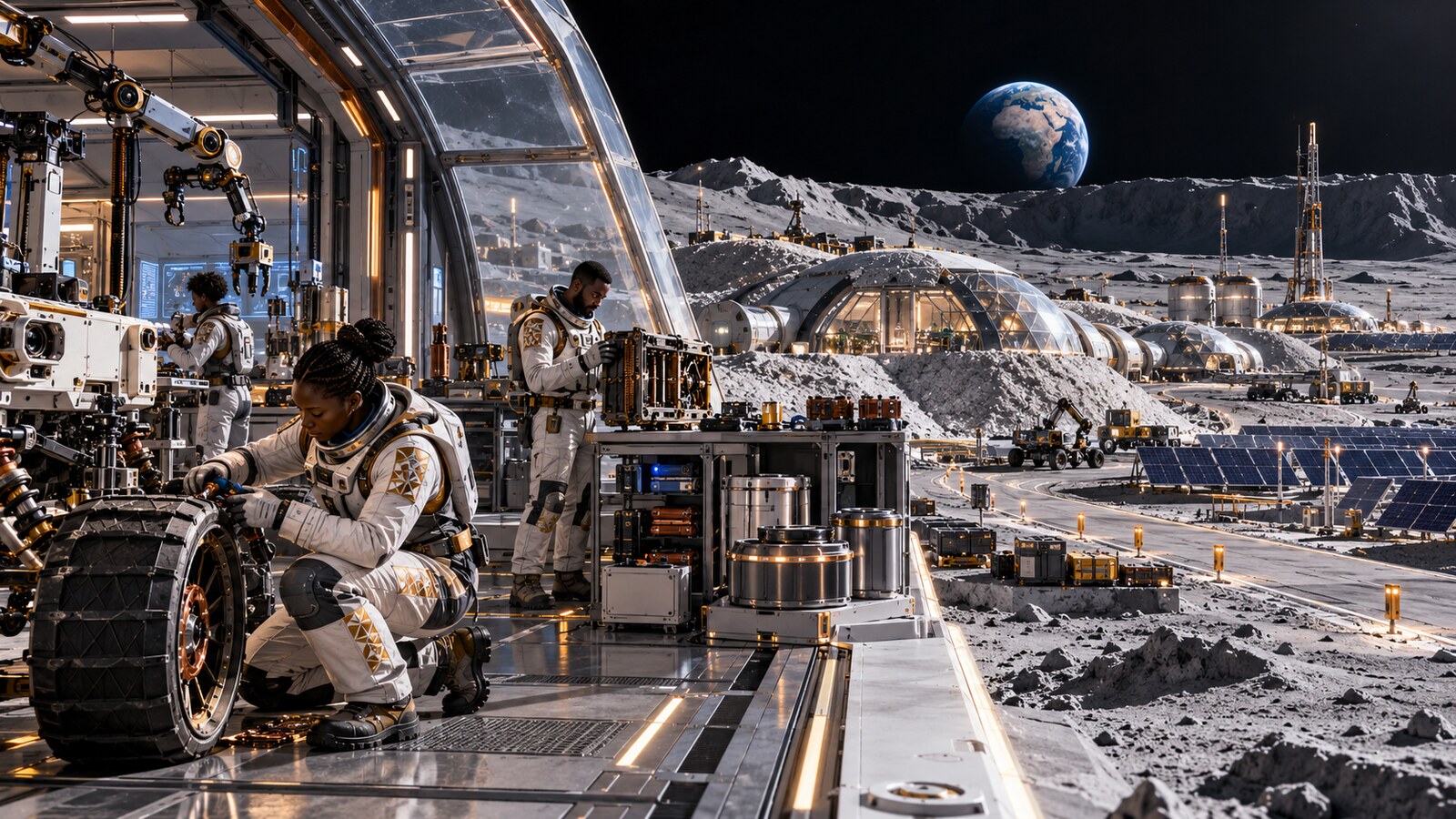
CreativeVerse speculation: The settlement, people and events in this article are fictional. The lunar conditions and institutional references are grounded in published sources and are identified separately from the imagined design.
The first African-led city on the Moon should not begin with a tower, a flag or a perfect glass dome. It should begin with a workshop.
In the imagined settlement of Adebayo Ridge, the most important building is not the council chamber. It is the repair commons: a pressurised bay where a cracked rover wheel, a failed water valve and a damaged air filter can be diagnosed, rebuilt and returned to service. Every machine arrives with a parts map. Every critical system has a manual that works offline. Every apprentice learns why a settlement that cannot repair itself is only a campsite waiting for its next supply ship.
That is fiction. The constraints behind it are not.
The Moon punishes decorative thinking
On Earth, a city can tolerate inefficiency because there are roads, suppliers, emergency services and neighbouring regions. On the Moon, failure is not buffered by an ordinary logistics network. Air, water, power, shielding, communications and thermal control are life-support systems. A small component can become a large emergency if no substitute exists and no one can manufacture or adapt one.
The environment is hostile to both people and hardware. NASA describes lunar dust as fine, sharp and abrasive—more like tiny fragments of glass than weather-rounded sand. Apollo-era experience showed that it clung to equipment and damaged spacesuits. NASA is still developing technologies such as electrodynamic dust shields because a surface that appears clean can remain contaminated by particles too small to see. See NASA’s current explainers on lunar dust and regolith hazards.
Temperature is another design boundary. NASA reports that conditions near the lunar equator can climb above 120°C in daylight and fall below –130°C after nightfall, while lunar days and nights last roughly two Earth weeks each. Exact conditions vary by location, terrain, illumination and shadow, but the engineering lesson is stable: exposed systems must survive large, prolonged thermal swings. A settlement designed around a dramatic exterior silhouette but without maintainable seals, radiators, insulation and power storage would be architecture without resilience.
Fact, interpretation and fiction
- Evidence: lunar dust is abrasive and difficult to remove; temperature extremes are severe; agencies are investigating ways to use lunar regolith for construction and manufacturing.
- Interpretation: repairability, modularity and contamination control should be primary design requirements for any durable lunar settlement.
- Speculation: Adebayo Ridge, its repair commons, its governance and its workforce do not exist. They are a thought experiment about what an African-led lunar future could value.
This separation matters. Science fiction is most useful when it stretches from real constraints rather than borrowing scientific language to disguise invention.
Rule one: every critical object needs a repair story
At Adebayo Ridge, nothing enters the settlement merely because it performs well on delivery day. Procurement begins with seven questions: Can it be opened? Can its failure be diagnosed locally? Are its parts standardised? Can a substitute be printed or machined? Does the software work without a permanent Earth connection? Who is trained to maintain it? What happens when the original manufacturer disappears?
The settlement therefore rejects sealed black boxes for critical functions. Pumps share connectors. Filters use common frames. Rover wheels have replaceable tread segments instead of requiring an entire imported assembly. Equipment carries a physical identifier linked to its maintenance history, but essential diagrams are also etched or printed nearby so that a database outage does not erase institutional memory.
This is the central economic idea: on the Moon, repair is not an after-sales service. It is infrastructure. The workforce is built accordingly. Mechanics, materials scientists, electricians, software engineers and life-support technicians sit near the centre of the city’s status system, not at its margins.
Rule two: the city has a dirty side and a clean side
Dust control shapes the map. Rovers do not drive directly to residential entrances. They stop at an outer service ring. Tools, samples and suits move through staged cleaning zones before reaching pressurised interiors. The most contaminated repair work happens in isolated bays with surfaces designed to be cleaned, inspected and replaced.
Instead of one grand airlock serving everyone, the city uses a chain: arrival lock, mechanical dust removal, inspection, suit maintenance, then entry to the clean corridor. Sensors help, but human inspection remains part of the routine because automation can fail and measurements can drift. No single detector is treated as proof that a person or object is clean.
The architecture also limits cross-contamination. Food production, sleeping quarters and medical spaces sit deeper within the clean zone. Workshops have independent ventilation branches and replaceable seals. Waste routes do not cross water-processing routes. A problem in one bay can be isolated without evacuating the entire settlement.
Rule three: build modules, not monuments
Adebayo Ridge grows as a network of modest pressure vessels connected by short, inspectable tunnels. Sleeping, medical, food, work and refuge modules can close themselves off. This is less visually spectacular than one enormous dome, but it contains failure.
The city also keeps “swap rooms”: spare pressurised modules that can temporarily replace a workshop, clinic or dormitory while the damaged space is repaired. Redundancy is not waste when a single failure could endanger everyone. The important question is not whether two systems look identical, but whether they fail independently. Two pumps connected to the same vulnerable power controller are not true redundancy.
Rule four: use lunar material carefully, not magically
European Space Agency studies have explored using lunar regolith for 3D-printed structures, tools and spare parts. ESA describes the goal as reducing dependence on the long and costly supply line from Earth. That research supports a plausible direction, but it does not mean a complete lunar city can already be printed from dust on demand.
In the fiction, Adebayo Ridge treats regolith as a shield and feedstock, not a miracle substance. Robotic equipment piles processed material over habitats to add protective mass. Sintered blocks form external barriers and equipment pads. Low-risk brackets and housings are manufactured locally after inspection. Pressure vessels, medical components and other life-critical parts still require rigorous certification and, where necessary, Earth-made materials.
The distinction is essential: local production reduces vulnerability only when quality can be measured. A poorly manufactured spare that fails inside a life-support system is not resilience; it is hidden risk.
Rule five: design for the long night
The settlement’s power system is deliberately plural. Solar arrays provide energy when illuminated, but storage, demand management and backup generation protect essential functions through darkness, maintenance and fault conditions. Non-critical manufacturing pauses before the medical bay, air circulation or water recovery loses power.
Every module displays an energy state that residents can understand: normal, conserve, essential-only or refuge. The system does not hide scarcity behind a beautiful interface. People know why a workshop has stopped, what capacity remains and which human has authority to override an automated decision.
Rule six: African-led cannot mean culturally generic
Africa is not one architecture, one language or one political imagination. An authentically African-led lunar project would need to resist turning the continent into a decorative pattern laid over technology designed elsewhere. Leadership would appear in ownership, research priorities, procurement, education, governance and whose problems the settlement chooses to solve.
The institutional foundation is no longer purely imaginary. The African Space Agency was formally inaugurated in Cairo in April 2025, and the African Union already has an African Space Strategy framed around social, political and economic integration. ESA’s account of the inauguration also records a cooperation agreement between ESA and the new agency.
None of this proves that an African lunar city is planned. It does show that continent-level space coordination is a present institution, not a fictional invention. Science fiction can therefore ask a serious next question: if Africa eventually participates in sustained lunar activity, what values should it contribute rather than merely which hardware should it buy?
Rule seven: knowledge is a shared life-support system
Adebayo Ridge requires every critical repair to produce a learning record: what failed, what evidence identified the fault, what workaround was used, how it was tested and what uncertainty remains. The record is readable by technicians and by future training systems. Artificial intelligence can help search manuals and compare sensor histories, but it cannot quietly certify its own suggestion. A human signs the safety decision.
The city shares non-sensitive safety findings with other settlements. This is partly practical—every community benefits when a dangerous failure mode becomes known—and partly political. The Outer Space Treaty says exploration and use should benefit all countries and encourages international cooperation. A fictional city cannot settle the difficult law and politics of lunar resources, but it can refuse the assumption that survival knowledge should become a private monopoly.
What this imaginary city teaches Earth
The Moon makes a principle visible that wealthy supply chains often conceal: convenience depends on repair, documentation, parts and skilled people. Earth technologies also become fragile when batteries are sealed, software support ends, cloud access disappears or a unique component is unavailable.
A repair-first lunar city is therefore more than a space fantasy. It is a test for product design on Earth:
- Can a trained person diagnose the system without the original vendor?
- Can high-failure parts be replaced independently?
- Does the product keep essential functions when connectivity fails?
- Is maintenance knowledge stored in a durable, transferable form?
- Are repair workers included in design decisions before launch?
- Can one fault be isolated without collapsing the whole service?
The first African city on the Moon may never be called Adebayo Ridge. It may not resemble this vision at all. But if it is built, its success will not be measured by the photograph taken on opening day. It will be measured years later, when dust has entered every seam, parts have failed, supply ships have been delayed—and the lights are still on because the city knows how to repair itself.
Featured image: original conceptual AI illustration created for this speculative article. It does not depict an existing lunar settlement, mission or event.
Discover more from Marychuks.com AI, Psychology, Business & CreativeVerse
Subscribe to get the latest posts sent to your email.


