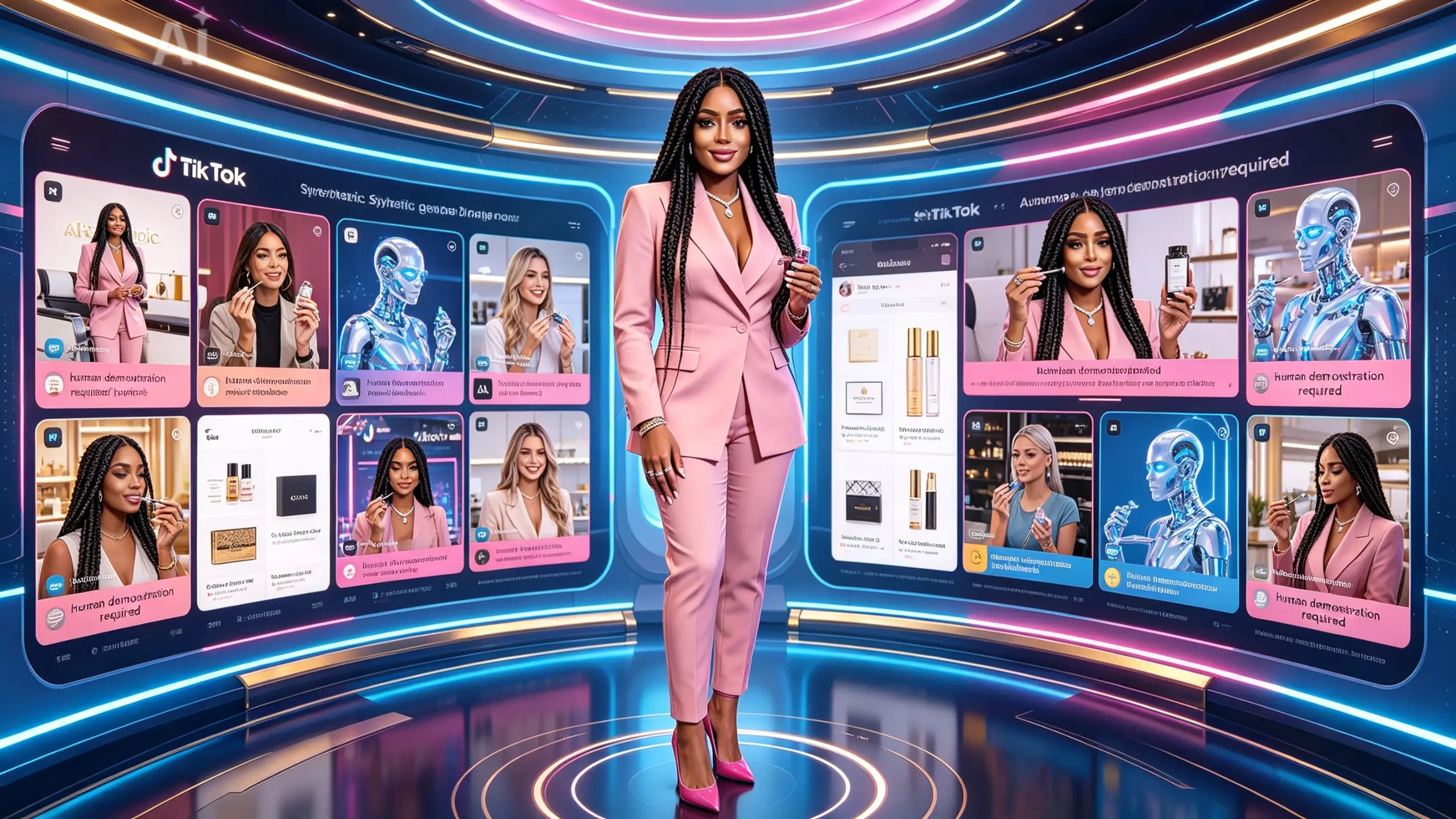
TikTok Shop is filling with product videos created by people who never held, tested or even saw the products they are promoting.
Artificial intelligence now allows affiliate sellers to generate synthetic presenters, digital demonstrations, voiceovers and complete shoppable videos within minutes.
The technology makes advertising faster and cheaper.
It also threatens the psychological promise at the heart of influencer marketing:
“I used this product, and this is what happened.”
The Wall Street Journal reported that AI-generated shopping videos have become increasingly common across TikTok Shop. Some videos feature entirely synthetic presenters, while others digitally recreate or imitate real creators.
Major brands including SharkNinja have responded by restricting or banning AI-generated affiliate promotions. SharkNinja reportedly warned affiliates that commissions could be withdrawn where products were marketed using synthetic content. �
The Wall Street Journal +1
How AI Shopping Videos Are Made
A seller may begin with a product photograph and a short description.
AI tools can then generate:
A synthetic influencer
A demonstration scene
A spoken product review
Captions
Background music
Multiple language versions
A call to purchase
Dozens of variations for testing
The creator may never possess the item.
In some videos, an AI presenter appears to hold or use a digitally generated version of the product.
The result can look like an ordinary personal recommendation even though no personal experience occurred.
Why TikTok Shop Is Attractive
TikTok combines entertainment, recommendation and purchasing inside one feed.
A user may watch a 20-second demonstration and buy the product without leaving the platform.
Affiliates can earn commission from sales, encouraging creators to produce large volumes of promotional content.
AI dramatically increases that volume.
Instead of recording five genuine videos, a seller may generate hundreds of synthetic clips targeting different audiences.
This creates a competitive problem for human creators: authenticity takes time, while synthetic content can multiply continuously.
Why Brands Are Concerned
A poor AI demonstration can misrepresent how a product works.
It may show:
Features the product does not have
Unrealistic results
Incorrect colours or dimensions
Unsafe usage
Impossible before-and-after transformations
A person claiming experience they never had
Brands may have limited control because TikTok’s open affiliate system allows eligible creators to promote products without being directly selected by the manufacturer.
Rare Beauty was reportedly among the companies discovering synthetic promotions connected to its products without having actively approved the individual video. �
The Wall Street Journal +1
Disclosure Does Not Solve Everything
TikTok permits certain AI-generated promotional material provided that it is labelled and does not make false claims.
But a small label may not remove the implied meaning of a review.
When a presenter says, “I tried this foundation,” viewers reasonably assume a real person applied the real product.
A disclosure that the video contains AI may not explain that:
The presenter is fictional
The product was never tested
The result was generated
The review is a sales script
The demonstration may not reflect reality
Transparency must therefore describe the commercial truth, not merely the production technology.
Why the Story Went Viral
People increasingly suspect that online reviews are staged, sponsored or automated.
AI shopping videos intensify that mistrust.
The story also threatens creators economically. Human influencers have spent years building personal brands around experience and credibility. Synthetic copies can reproduce the appearance of that trust without living the experience behind it.
Shoppers are left asking a disturbing new question:
Did anybody actually use the thing being sold?
Mary Chuks’ Perspective
A product video performs two different jobs.
One is creative presentation.
AI can do that brilliantly.
The other is personal testimony.
AI cannot truthfully claim a lived experience it never had.
The industry must distinguish between:
AI advertisement: a creative commercial presentation
Human review: a real person describing genuine use
Confusing the two may produce short-term sales while destroying long-term trust.
Practical Advice for Shoppers
Before buying from a short product video:
Look for an explicit sponsorship or AI disclosure.
Search for independent reviews.
Compare demonstrations from several creators.
Check the manufacturer’s official specifications.
Be suspicious of perfect transformations.
Review the returns policy.
Look for evidence that the presenter physically possesses the product.
Conclusion
AI can create a convincing salesperson.
It cannot create authentic product experience without a human using the product.
TikTok Shop’s next challenge is not generating more videos.
It is preserving enough trust that viewers still believe what those videos show.
Original Sources and Further Reading
Original investigation: The Wall Street Journal, “AI Videos Are Flooding TikTok Shop,” published in July 2026. �
The Wall Street Journal
Additional reporting: The Independent, “Brands Urge TikTok Shop Creators to Ditch AI Fakes,” published 15 July 2026. �
The Independent
Discover more from Marychuks.com AI, Psychology, Business & CreativeVerse
Subscribe to get the latest posts sent to your email.