
A futuristic African city can have flying vehicles, glowing towers and patterned clothing yet still feel strangely empty. The problem is rarely a shortage of spectacle. It is that the future has been decorated as African without being designed from African lives, places, institutions and choices.
Strong African science fiction does more than place familiar symbols on imported technology. It asks how people in a specific community might adapt science, infrastructure, language, memory and social organisation to solve—or deepen—the pressures around them. The world becomes convincing when its technology has users, costs, maintenance, politics and consequences.
This is not an argument for one correct African future. Africa contains thousands of communities, many languages, sharply different ecologies and contested histories. It is an argument for specificity. “African” should be the beginning of your research question, not the answer.
Why surface symbolism is not enough
Surface symbols can be meaningful. Textiles, architecture, hairstyles, music, sculpture, ritual forms and colour systems may all belong in a story. The weakness appears when they function as visual proof of Africanness while the deeper world—government, family, trade, education, belief, transport and conflict—could have been copied from anywhere.
A patterned control panel tells us little by itself. A control panel designed for several local languages, intermittent connectivity, bright sunlight, shared devices and oral instruction tells us how people actually interact with technology. That difference is the heart of credible worldbuilding.
The African Union’s Agenda 2063 aspirations deliberately place science and technology alongside cultural identity, heritage, creative arts and African languages. For fiction writers, that combination is useful: culture and innovation are not opposing forces. They shape one another.
1. Begin with a place, not a continent
Select a location or construct one from carefully researched influences. Is your setting coastal, Sahelian, forested, mountainous or built around a river? Is it an established metropolis, a border town, a rural district, an island or a mobile settlement? What happens during the hottest hour, the rainy season, a power cut, a festival or a market day?
Then define the pressures that shaped its future:
- water availability and flooding;
- heat, shade and building materials;
- migration and changing household structures;
- transport between neighbourhoods and regions;
- land ownership and informal economies;
- energy production, storage and repair;
- the relationship between local, national and continental authority.
A place becomes futuristic not when it receives more neon, but when you can explain how it changed and who benefited.
2. Design the ordinary day before the extraordinary crisis
Worldbuilders often begin with the coup, invasion, discovery or machine uprising. Start one day earlier. How does a nurse travel to work? Who watches a child after school? How is food kept cool? What does a trader do when a payment network fails? Where do people meet without spending money? Who repairs a household robot?
These questions reveal the systems beneath the plot. They also make a later crisis more consequential because readers understand what is being disrupted.
Worldbuilding test: If your protagonist did not have a mission today, could you still describe how they would obtain breakfast, information, transport, privacy and help?
3. Give every technology a social life
A technology is not only a device. It is a relationship between design, access, skill, trust, maintenance and power. When you invent one, answer seven questions:
- Problem: What does it claim to solve?
- Owner: Who controls the infrastructure or data?
- User: Who can operate it confidently?
- Exclusion: Who is priced out, misread or ignored?
- Maintenance: Who repairs it, and with which parts?
- Adaptation: How do people use it differently from the designer’s intention?
- Failure: What happens when it is unavailable, corrupted or refused?
This method turns a prop into a story engine. A solar microgrid can create local autonomy and a new political struggle. A translation implant can improve communication while flattening meanings that depend on tone, kinship or proverbs. A delivery drone can connect remote clinics while shifting work and surveillance into the sky.
4. Treat language as infrastructure
Language determines who can use a system, whose knowledge can be searched and which distinctions a machine recognises. Decide which languages are spoken at home, in government, in trade, in education and between regions. Consider code-switching, accents, sign languages, naming systems and non-verbal communication.
Do not use a language merely as flavour. Ask what becomes possible—or impossible—when technology supports it. Perhaps a community archives oral histories through voice interfaces. Perhaps an AI performs well in formal language but fails during rapid multilingual conversation. Perhaps a character controls access by deciding when to translate and when not to.
The AU’s Agenda 2063 explicitly connects cultural renaissance with the restoration and preservation of African languages. That does not dictate a fictional outcome, but it reminds writers that language policy is a future-making decision, not background decoration.
5. Use living heritage with care
Culture is not a warehouse of symbols waiting for a creator to extract. UNESCO defines intangible cultural heritage through practices, expressions, knowledge and skills that communities recognise as part of their heritage. Its framework emphasises the participation of the communities, groups and individuals who create and transmit that heritage.
For a writer, the ethical lesson is practical:
- research beyond image searches and tourist summaries;
- distinguish public knowledge from restricted, sacred or community-governed knowledge;
- credit sources and cultural advisers;
- avoid combining unrelated peoples into a fictional “tribe” merely for visual effect;
- use sensitivity readers or knowledgeable collaborators when the material is outside your experience;
- show culture changing through debate, migration, technology and generational difference.
UNESCO’s ethical principles call for transparent collaboration, dialogue and informed consent in work involving living heritage. A novelist is not running a heritage programme, but the underlying respect still matters: communities are participants in cultural meaning, not raw material.
6. Build power into the map
Every future has winners, gatekeepers and people who find unofficial routes around them. Map who controls land, identity records, energy, models, satellites, seeds, medical data and transport. Then map counter-power: unions, cooperatives, elders’ councils, neighbourhood networks, religious institutions, artists, hackers, courts and diaspora finance.
A city owned entirely by one corporation behaves differently from a federation of community-run districts. A continental digital identity system creates different plot possibilities from a patchwork of local credentials. Technology becomes believable when it sits inside institutions rather than floating above them.
7. Let beauty emerge from function
Once the systems are clear, visual design becomes richer. Buildings may use shaded courtyards because of heat. Clothing may carry flexible solar fibres because charging is mobile. Public displays may combine symbols, speech and text because the city is multilingual. Transit stations may double as flood shelters. Beauty grows from adaptation.
This does not mean every design must be strictly utilitarian. People decorate, signal status, honour memory and play. But the aesthetic choices now belong to a world with history and constraints.
A fictional example: Ndera Bay, 2089
The following example is invented for demonstration. It is not a prediction or a description of an existing African city.
Ndera Bay is a fictional coastal federation built after decades of flooding. Instead of one continuous seawall, its districts maintain floating gardens, tidal-energy gates and elevated market routes. Energy is traded between neighbourhood microgrids, but water data remains under community control after an earlier insurance scandal.
Public interfaces work through speech, text and tactile tokens because residents use several languages and not everyone owns a personal screen. The tokens are produced by licensed local workshops, creating jobs but also a black market in copied identity patterns. During the annual tide ceremony, transport algorithms must yield the central route to human processions—a rule contested by emergency planners.
The story could now grow in several directions: a technician discovers falsified flood forecasts; a cooperative refuses an external energy contract; a child’s copied token opens a restricted archive; or an autonomous ferry must choose between an optimisation rule and a community obligation.
Notice that the setting did not begin with a costume. It began with water, authority, language, maintenance and memory. The visual world followed.
An eight-box worksheet for your next story
- Place: Name the ecology and settlement type.
- Pressure: Identify the long-term force that changed it.
- Everyday system: Choose food, care, transport, housing or communication.
- Technology: Define its promise, owner and failure mode.
- Language: Decide who understands which interface.
- Living culture: Identify a practice and how it changes.
- Power: Name the gatekeeper and the counter-power.
- Character cost: Show what the system demands from one person.
The future should feel inhabited
The Smithsonian’s Afrofuturism work describes a tradition expressed across literature, music, film, fashion, art and activism—a broad practice of imagining Black futures and alternatives. African science fiction is not identical to African American Afrofuturism, and neither tradition is internally uniform. The useful shared lesson is that speculative futures can question who has been permitted to imagine, design and belong.
Your fictional future does not need to represent an entire continent. It needs to know where it stands, whose knowledge built it, how its systems work and who pays when they fail. Start there. Then add the spacecraft.
Sources and further reading
- African Union: Our Aspirations for the Africa We Want
- African Union: Goals and Priority Areas of Agenda 2063
- UNESCO: Convention for the Safeguarding of the Intangible Cultural Heritage
- UNESCO: Ethical Principles for Safeguarding Intangible Cultural Heritage
- Smithsonian NMAAHC: Afrofuturism—A History of Black Futures
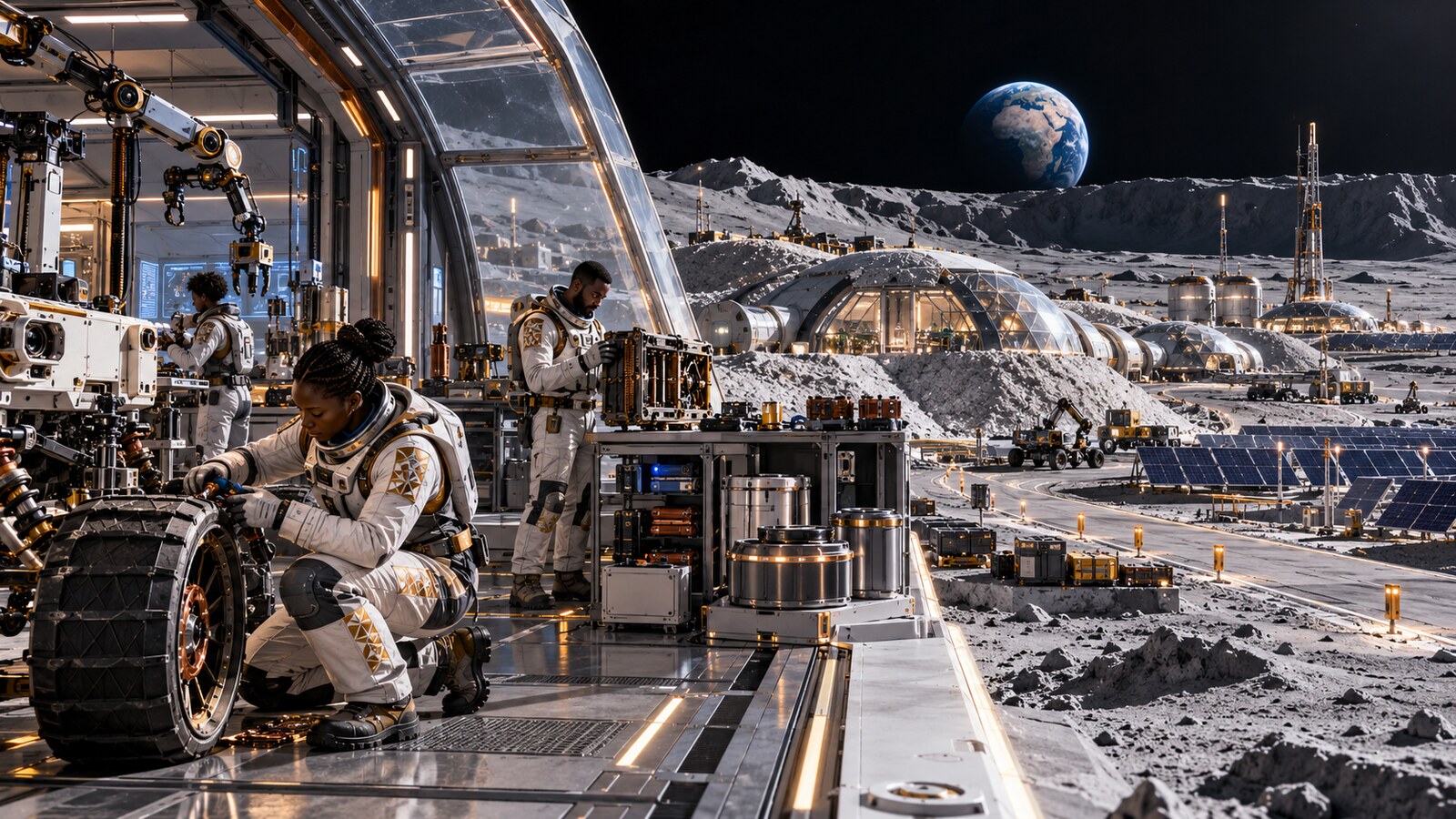
Featured image: original conceptual AI-generated illustration of a fictional collaborative design process and speculative coastal city. It is not documentary evidence or a prediction.
Explore more work in African Sci-fi on MaryChuks.com and the wider CreativeVerse.
Discover more from Marychuks.com AI, Psychology, Business & CreativeVerse
Subscribe to get the latest posts sent to your email.


One thought on “Build an African Sci-Fi World From Systems, Not Surface Symbols”