Slug: how-to-look-at-contemporary-art-five-questions
Tags: Art, Artists, Critical Thinking
Meta description: Learn how to look at contemporary art without specialist jargon using five practical questions about attention, material, context, interpretation and evidence.
You enter a gallery, stop in front of an artwork and feel that everyone else understands something you have missed. The label sounds scholarly. The work may be abstract, minimal, digital or made from ordinary objects. You wonder whether there is a correct answer—and whether you are about to reveal that you do not know it.
That anxiety is common, but it begins with a faulty premise: looking at art is not a test of whether you can guess a curator’s password. It is a practice of attention. You can start with what is genuinely present, notice how the work acts on you, add reliable context, and build an interpretation that another person can follow even if they disagree.
The Museum of Modern Art describes slow looking as a way to refine observation, thought and personal meaning. Its advice is practical: give yourself time, notice where your attention goes, examine elements one at a time and try different vantage points. The method below turns that principle into five questions you can use in a museum, classroom, studio visit or online collection.
First, stop trying to solve the artwork
An artwork can have an artist’s intention, a documented historical context and recognisable conventions without having only one permissible meaning. At the same time, “anything goes” is not a useful alternative. A strong interpretation is not simply a feeling announced with confidence; it connects a claim to details in the work and to trustworthy context.
Think of looking as a sequence:
- Observation: What can I actually see, hear or encounter?
- Inference: What might those details suggest?
- Context: What reliable information changes or sharpens that reading?
- Judgement: What do I think the work achieves, and why?
This order matters. The National Gallery of Art similarly advises learners to look first at what is visible before moving to questions or interpretations. That small delay prevents the wall text—or your first emotional reaction—from doing all the thinking for you.
Question 1: What has captured my attention?
Do not begin with “What does it mean?” Begin with the first thing your eyes, ears or body register. It might be a bright edge, an empty space, a repeated shape, a rough surface, an awkward silence or the way an object interrupts the room.
Name it precisely. “The red is interesting” is a start; “a narrow red line cuts through three pale, rounded forms” gives you something to investigate. Precision slows down automatic judgement and turns vague reaction into usable evidence.
Try this: Look for 60 seconds before reading the label. Write down five nouns, five adjectives and one question. Do not interpret yet.
Question 2: How was this encounter made?
Material is not decoration added after the idea. Paint absorbs or reflects light. Video imposes duration. Fabric folds, frays and carries associations with clothing or labour. A digital image can be copied perfectly, while a clay surface records pressure and touch. Scale, weight, sound, placement and technical process all shape what the audience experiences.
Ask what seems handmade, manufactured, found, performed or generated. Look for joins, edits, erasures, repetition and deliberate irregularities. If the information is available, check the materials listed on the label. MoMA’s discussion guidance recommends sharing core label facts—including artist, date and materials—while moving through observation, description and interpretation rather than jumping straight to conclusions.
Question 3: What changes when I change position or spend more time?
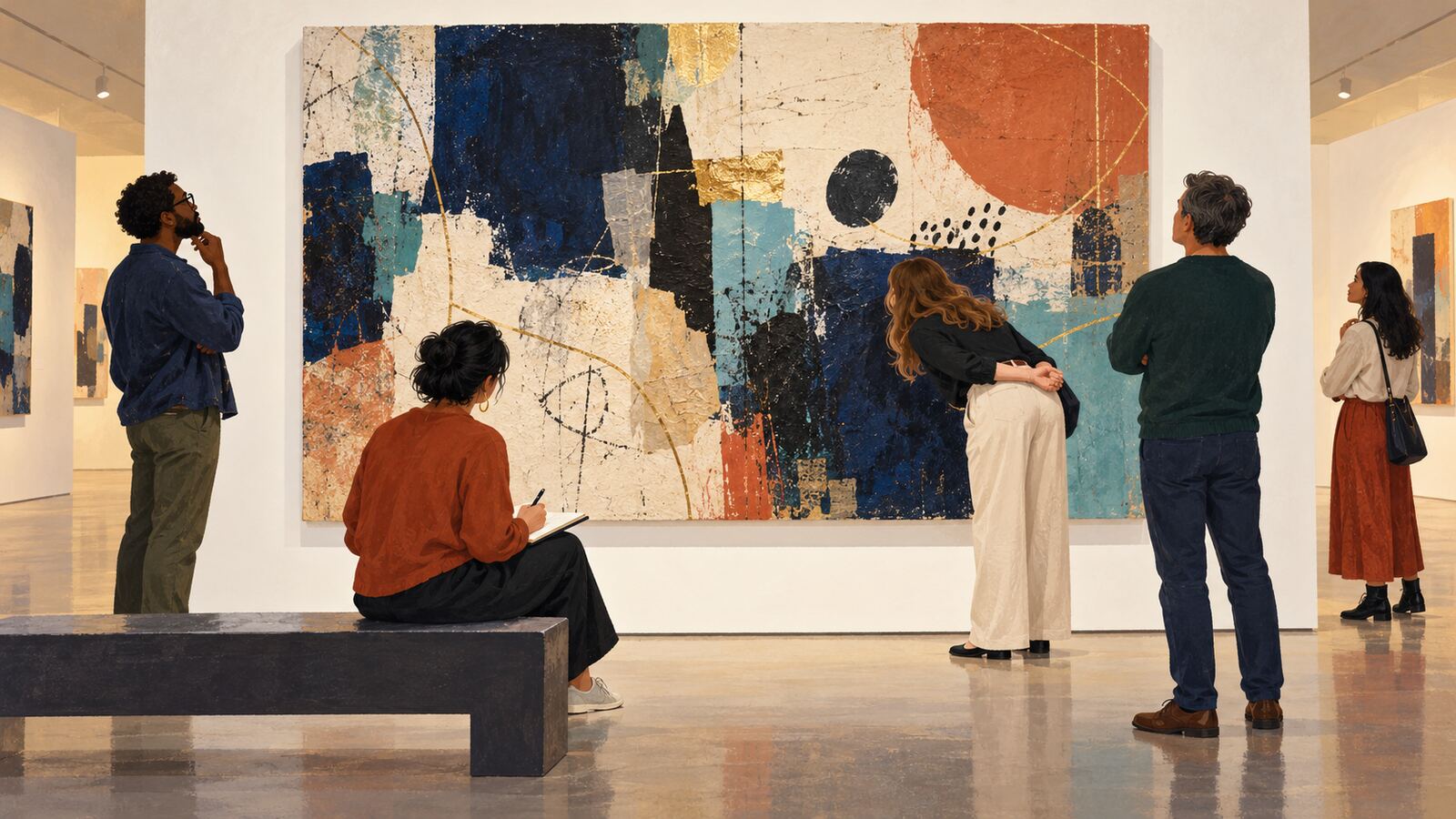
Some works disclose themselves in layers. A surface that looks flat from across a room may reveal stitching, pixels or scratches nearby. A sculpture changes as you walk around it. A sound work may make the space itself feel like part of the piece. A video may overturn its opening impression after several minutes.
Spend three to five minutes with one work. Step back, move closer where permitted, shift left and right, and notice what disappears or becomes newly visible. This is not empty ritual: it is a way of testing whether your first reading survives more evidence.
The Museum of Fine Arts Boston’s close-looking guide makes a valuable distinction: connect an interpretation to visual evidence—for example, if a scene feels joyful, identify which colours, gestures or relationships support that view.
Question 4: Which context genuinely matters?
Now read the label or collection entry. Check the artist, title, date, place, medium and commissioning or exhibition context. Then ask which fact changes your understanding rather than merely decorating it with trivia.
- Does the title redirect your attention?
- Did a material have a political, domestic, spiritual or industrial use?
- Was the work made for this site, moved from somewhere else or reconstructed?
- Does the artist belong to a tradition that the work extends, challenges or refuses?
- Whose account is the label presenting, and what might be absent?
Context should sharpen observation, not replace it. Use museum collection records, the artist’s own statements, catalogues and credible scholarship. Be cautious with unsourced social-media summaries that turn a complex work into a single dramatic fact.
Question 5: What interpretation can I support?
Build one provisional sentence using this structure: “I think the work is exploring ___ because ___.” The second blank must contain observable or documented evidence.
For example: “I think this installation explores unstable memory because familiar household objects are partly buried, the recorded voices contradict one another and the title refers to reconstruction.” Someone may offer a different interpretation, but yours is discussable because its reasoning is visible.
Then test it:
- Which detail best supports my reading?
- Which detail complicates it?
- What alternative explanation could fit the same evidence?
- What would I need to verify before presenting this as fact?
A worked example with an imaginary artwork
Imagine a gallery contains twelve transparent shopping bags suspended at eye level. Each holds a small speaker playing a different person reading a shopping list. The lights dim and brighten slowly.
Observation: The bags are transparent, repeated and positioned where faces might be. The voices overlap. The lighting changes.
Inference: Repetition could suggest routine or mass consumption. Individual voices introduce difference inside a standardised object. Transparency may evoke exposure, fragility or disposability.
Context to verify: Who recorded the lists? Were participants credited and consenting? Is the bag associated with a particular place, policy or period? Did the artist intend visitors to walk among the speakers?
Provisional interpretation: “The installation may explore how ordinary consumption reveals intimate lives, because identical bags carry distinct voices and private lists in a public space.”
Notice what this method avoids. It does not claim the artist’s intention without evidence. It does not pretend the viewer’s emotional response is universal. It also does not retreat into “I like it” or “I do not get it”.
Three common mistakes that close down looking
1. Reading the label before seeing the work
The label can become a script that tells your eyes what to find. Give the object a short period of undirected attention first, then use the label to test and deepen what you noticed.
2. Treating difficulty as fraud
Some work is weak, poorly explained or inflated by reputation. But unfamiliar form is not evidence of deception. Describe what fails for you: perhaps the concept depends entirely on wall text, the execution contradicts the claim, or the experience offers too little evidence for its ambition. Specific criticism is stronger than dismissal.
3. Treating the artist’s explanation as the final verdict
An artist’s statement is important evidence, but audiences can notice effects and contradictions the maker did not anticipate. Compare intention with outcome. Ask whether the work itself makes the proposed idea perceptible.
A five-minute gallery routine
- Minute 1: Look silently; follow your attention.
- Minute 2: Inventory colour, shape, material, scale, sound and space.
- Minute 3: Change your position and notice what changes.
- Minute 4: Read reliable context and identify one fact that matters.
- Minute 5: Write one evidence-backed interpretation and one honest question.
If you are with another person, compare observations before opinions. Different viewers often notice different parts of the same work; that is not a failure of looking but one of its richest results.
You are allowed to leave uncertain
A worthwhile encounter with art does not have to end in admiration, certainty or agreement. You may decide that a work is formally compelling but ethically troubling, intellectually ambitious but emotionally distant, or memorable even though you dislike it. The goal is not compulsory appreciation. It is better attention and a more accountable judgement.
Next time a contemporary artwork makes you feel excluded, do not ask whether you possess the right vocabulary. Ask what has your attention, how the encounter was made, what changes with time and position, which context matters, and what interpretation your evidence can support. That is already serious looking.
Sources and further looking
- Museum of Modern Art: Slow Looking
- MoMA: Foundations for Engagement with Art
- National Gallery of Art: Afro-Atlantic Histories Teaching Tips
- Museum of Fine Arts Boston: Close Looking
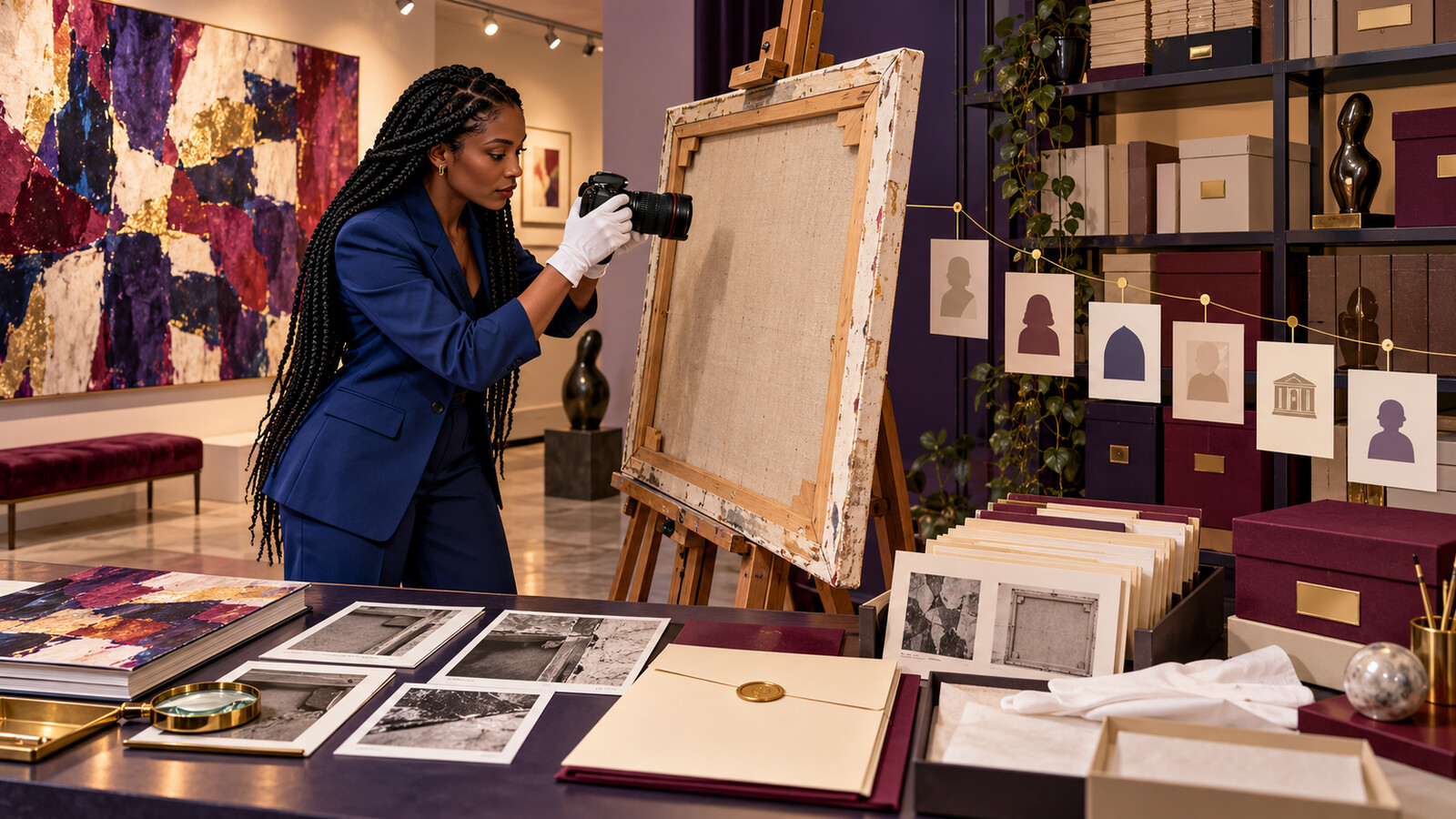
Featured image: original conceptual AI-generated illustration. It does not depict a real gallery, named artwork or documented event.
Explore more practical creative thinking in MaryChuks Art, or read how artists can write better social captions without flattening the work.
Discover more from Marychuks.com AI, Psychology, Business & CreativeVerse
Subscribe to get the latest posts sent to your email.