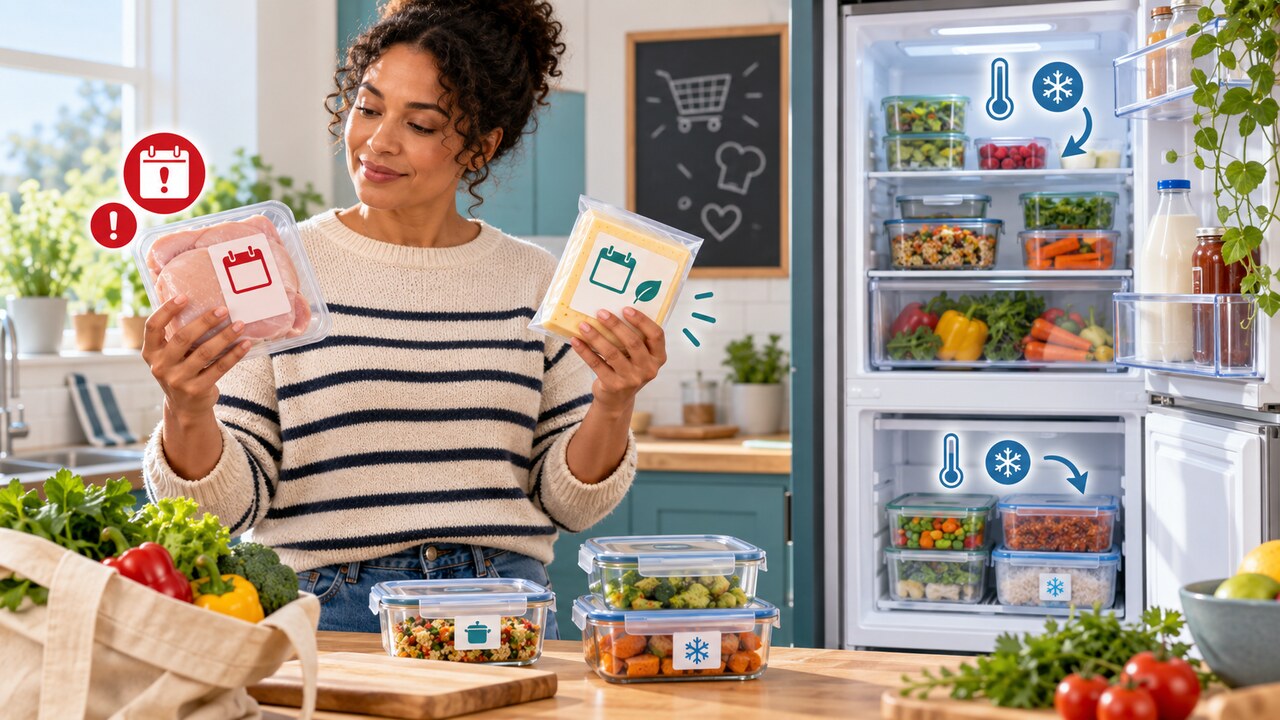
Two food packages can display dates that look almost identical while asking you to make completely different decisions. One date is about safety. The other is about quality. Confusing them can either create unnecessary waste or expose a household to avoidable risk.
The practical answer is not to memorise a long list of foods. It is to read the wording on the label, respect the storage instructions and decide early whether the food belongs in tonight’s meal, the fridge or the freezer.
The distinction that controls everything
Use-by relates to safety. Government guidance says foods carrying a use-by date should not be eaten after that date because doing so could make you ill. These dates commonly appear on foods that can become unsafe relatively quickly, such as meat products and ready-to-eat salads.
Best-before relates to quality. Food may lose flavour, texture or freshness after this date, but it is usually still safe if it has been stored correctly. Dried pasta, rice, tins and some cheeses are typical examples.
The official government guide to use-by and best-before dates makes this separation explicit. That is the evidence. The useful household interpretation is simple: never apply a quality judgement to a safety date.
Why the smell test has limits
A sniff can help assess some food after a best-before date. The government guidance suggests that sight, taste or smell may reveal mouldy bread, stale biscuits or soured dairy products. That does not make the senses a universal food-safety detector.
Food carrying a use-by date can be unsafe even when it looks and smells normal. The correct question is not “Does this seem fine?” but “Is it still within its use-by date, and has it been stored as directed?” If either answer is no or uncertain, do not gamble.
A four-way decision at the fridge door
1. Eat or cook it now
If a use-by food is approaching its date and you can use it safely, move it to the front of the meal plan. Follow the packet’s cooking instructions. For foods that need thorough cooking, the Food Standards Agency advises following time-and-temperature guidance, checking that food is cooked throughout and considering a clean food thermometer.
2. Freeze it before the deadline
You can freeze suitable food on or before its use-by date, subject to the package instructions. Freezing does not rescue food that has already crossed that safety boundary. Label the container with what it is and when it entered the freezer; otherwise a sensible plan becomes a drawer of unidentified frozen objects.
3. Inspect quality
If the label says best-before, confirm that the packaging is intact and the food was stored correctly. Then assess the product in a way appropriate to that food. Visible mould, unusual spoilage, damaged packaging or a clearly wrong smell are reasons not to continue. Do not taste food you suspect may be unsafe.
4. Discard when safety is uncertain
A passed use-by date, failed refrigeration, leaking raw meat or an unknown storage history is not a sustainability opportunity. Preventing food waste begins earlier—with planning, rotation and timely freezing—not by overriding safety guidance at the last moment.
The date only works with correct storage
A printed date is not a guarantee independent of temperature. The label may tell you to refrigerate after opening, keep the product below a certain temperature or use it within a shorter period once opened. Those instructions are part of the safety decision.
The Food Standards Agency’s chilling, freezing and defrosting guidance advises keeping a fridge between 0°C and 5°C and a freezer around −18°C. It recommends checking a fridge with a thermometer, ideally weekly, rather than assuming the dial number equals the air temperature.
- Keep chilled food out of the fridge for as little time as possible during preparation.
- Store raw meat, fish and poultry sealed on the bottom shelf so they cannot drip onto other food.
- Follow instructions that change after a packet is opened.
- Do not overfill the fridge so tightly that cold air cannot circulate.
Leftovers need a clock, not a guess
Cooked food has its own timeline. FSA guidance says to cool cooked food and place it in the fridge within one to two hours. Dividing a large dish into smaller, shallow portions helps heat escape more quickly.
Eat refrigerated leftovers within 48 hours or freeze them if that will not be possible. When reheating, the FSA advises that leftovers should be steaming hot throughout and reheated only once. Its detailed cooking guidance explains visual checks and temperature-time combinations for thorough cooking.
These limits should not be stretched simply because a dish contains expensive ingredients. Cost affects how disappointing waste feels; it does not change bacterial growth.
Freezing pauses growth; it does not reset history
Freezing is often described as a pause button because most bacteria cannot grow at freezer temperatures. It is not a sterilisation process. Bacteria may become active again as food defrosts, which is why safe thawing matters.
Defrost food in the fridge where possible, in a container that can catch drips. If a microwave’s defrost function is used, cook the food immediately afterwards. FSA guidance says food should be used within 24 hours after it has fully defrosted. Always follow the product’s instructions when they are more specific.
Build a “first to use” zone
The easiest food-waste intervention is visual. Give one fridge shelf or box a clear role: food that needs attention first. Put approaching use-by items, opened products and refrigerated leftovers there. Check it before planning dinner or ordering a takeaway.
This system separates three questions that households often blur:
- Safety: is the food within its use-by date and correctly stored?
- Quality: if it is past best-before, is it still acceptable?
- Timing: if it will not be used soon enough, should it be frozen now?
A five-minute weekly routine
- Check the fridge thermometer.
- Move the shortest-dated safe items to the first-to-use zone.
- Label leftovers with the date they were cooked.
- Freeze suitable food before its use-by date if plans have changed.
- Review freezer labels before buying duplicates.
The evidence does not support one rule for every package. It supports a disciplined sequence: read the label, respect the temperature, distinguish safety from quality and act before uncertainty takes over. That is how a household can reduce avoidable waste without turning economy into risk.
Official guidance consulted
- GOV.UK and Food Standards Agency: Best-before and use-by dates
- Food Standards Agency: Chilling, freezing and defrosting food safely
- Food Standards Agency: Cooking your food
Scope note: The cited FSA chilling and cooking guidance states that it applies to England, Wales and Northern Ireland. Readers in Scotland should also follow current Food Standards Scotland advice and the instructions on the specific product.
Discover more from Marychuks.com AI, Psychology, Business & CreativeVerse
Subscribe to get the latest posts sent to your email.