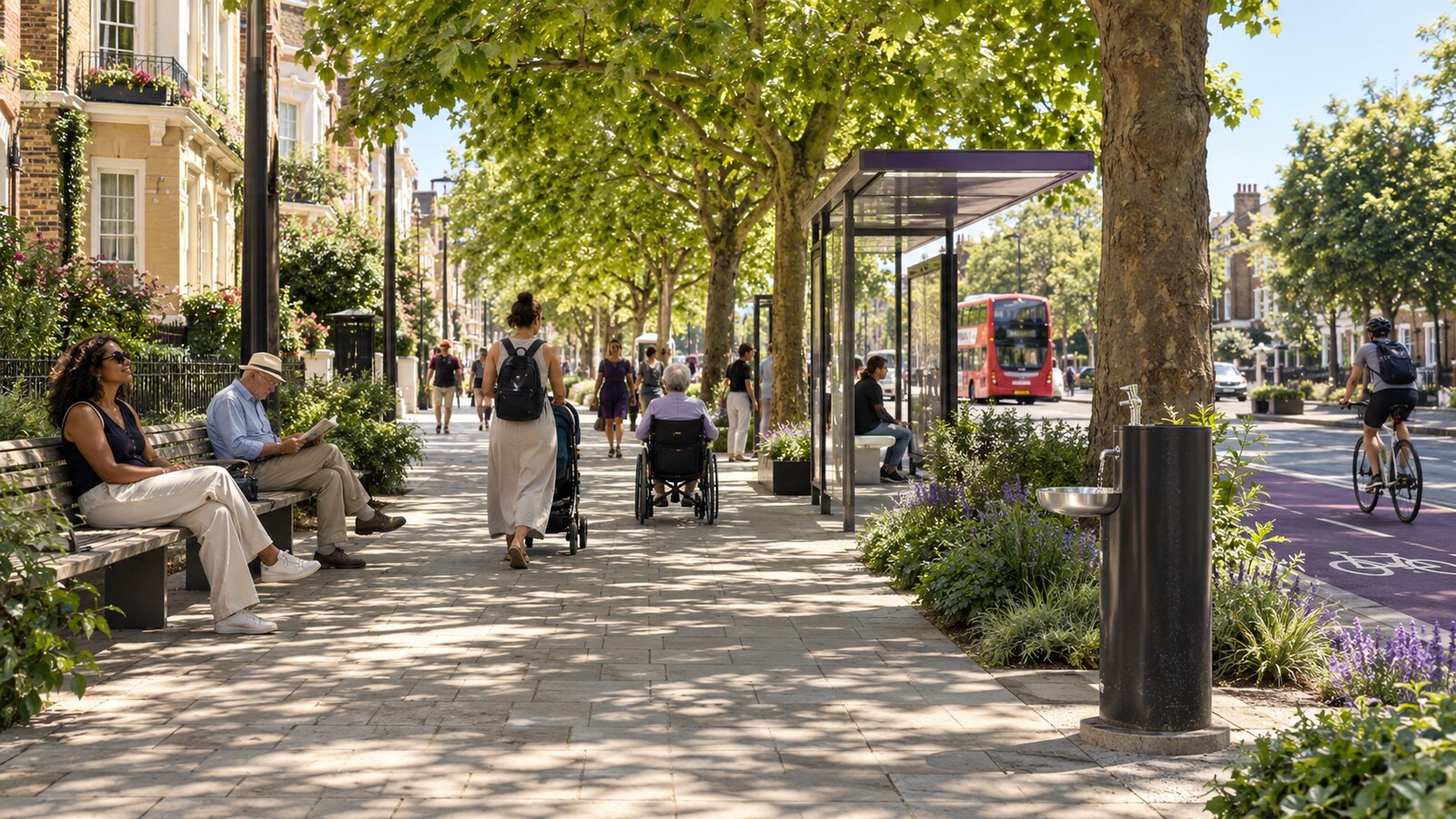
Featured image: conceptual AI-generated illustration; not documentary evidence.
A single tree beside a wide, sun-baked pavement is pleasant. It is not a heat-resilience system. If the next patch of shade is five minutes away, the bus shelter has a transparent roof and the route to the health centre offers nowhere to rest, the street still exposes people to sustained heat.
Cities often treat shade as landscaping: an attractive extra added after roads, buildings and transport stops have been designed. A hotter climate demands a different view. Shade is public infrastructure. It should form a connected network that helps people complete necessary journeys, especially those who cannot simply stay indoors or move quickly between air-conditioned spaces.
Heat risk is shaped by the street
Temperature alone does not determine a person’s exposure. Direct solar radiation, humidity, wind, dark surfaces, reflected heat, physical effort and the length of time outdoors all matter. Dense urban areas can also retain heat after sunset, delaying overnight relief.
The UK Health Security Agency’s Adverse Weather and Health Plan treats hot weather as a health risk requiring preparation across health, care and community systems. The Met Office’s UK Climate Projections provide evidence for planning around a warmer climate and more severe hot spells. These national frameworks do not prescribe one universal street layout, but they make the direction clear: infrastructure decisions must account for heat, not only respond after an alert is issued.
Vulnerability is uneven. Older people, young children, people with some health conditions or disabilities, outdoor workers, pregnant people and those living in homes that overheat may face greater risk. Poverty also shapes exposure: a person who cannot afford a taxi, home cooling or a flexible workday has fewer ways to avoid a hostile route.
Think in cool routes
A cool route is a connected path between everyday destinations—homes, schools, transport stops, shops, clinics, parks and community buildings—designed to reduce sustained heat exposure. The aim is continuity. A shaded bench is useful; a sequence of shade, rest and water is infrastructure.
Mapping should begin with journeys people actually make. A council may have a leafy park yet leave the walk from a care home to the nearest bus stop exposed. A new tree programme may increase total canopy while missing streets used by people with the least capacity to tolerate heat. Area-wide averages can hide route-level gaps.
Seven components of a useful shade network
1. Mature canopy where footfall and vulnerability meet
Trees can shade pavements and buildings while contributing to biodiversity and local character. But species, soil volume, root space, watering, pruning and long-term maintenance determine whether planting survives to provide meaningful canopy. A small ornamental tree in a cramped pit should not be counted as equivalent to future street shade merely because it appears on a planting schedule.
2. Built shade while trees grow
New trees take years to mature. Canopies, arcades, awnings, pergolas and carefully designed shelters can provide immediate cover. Built shade is also essential where utilities, narrow pavements or underground structures restrict planting. Materials should block solar gain rather than create greenhouse-like enclosures.
3. Bus stops that protect waiting passengers
Waiting turns a short journey into prolonged exposure. Shelters should be assessed for the sun’s angle at the hottest times, not simply for rain. Transparent panels may need shading treatments, ventilation and seating. Route planning should prioritise stops serving hospitals, care facilities, schools and high-use interchanges.
4. Rest points with accessible space
Shade is more valuable when people can pause beneath it. Provide seating with backs and arms, space for wheelchairs and pushchairs, and clear pedestrian width. A bench placed in full afternoon sun or blocked by clutter technically exists but does not perform its intended function.
5. Drinking water and trusted public facilities
Reliable fountains and refill points can support hydration, but only if they are maintained, hygienic, easy to find and usable by people with different reach and grip. Nearby toilets and open public buildings matter too. A cooling strategy that assumes everyone can buy a drink or enter a café is not universal infrastructure.
6. Surfaces that do not intensify the problem
Dark, impervious materials can absorb and reradiate heat. Lighter and more reflective surfaces may reduce heat absorption, but glare, durability, drainage and maintenance require evaluation. Permeable landscapes, planting and water-sensitive design can contribute to a broader cooling strategy. No single material is a substitute for shade.
7. Cool refuges with dependable opening hours
Libraries, community centres and other public buildings can serve as cool spaces during hot weather. Their value depends on accessibility, staffing, communication and opening when people need them—including evenings or weekends during prolonged heat. A refuge on a map is not useful if the door is closed.
Measure performance, not decoration
Counting trees or shelters is easy; measuring protection is more meaningful. Useful questions include:
- What proportion of key walking routes is shaded during peak summer hours?
- How far must someone travel between shaded rest points?
- Do high-vulnerability destinations have protected approaches?
- Are fountains, shelters and cooling spaces working and open?
- Which neighbourhoods have the largest shade deficit?
- Will today’s planting still have adequate soil, water and maintenance in ten years?
Measurements should combine physical data with lived experience. Walk routes with residents during hot conditions where safe, including older people, disabled people, carers, delivery workers and parents. A thermal map cannot reveal every obstacle, inaccessible kerb, broken fountain or shelter that feels unsafe.
Avoid the green-gentrification trap
New greenery and attractive public space can increase neighbourhood desirability. Without protections, the people who endured years of underinvestment may face rising rents or displacement before they enjoy the full benefit. Heat adaptation should therefore connect with affordable housing, tenant protection and community ownership rather than treating land value as the only measure of success.
Equity also means funding maintenance. Wealthier streets should not receive reliable watering and replacement while lower-income areas are left with dead saplings and broken shelters. Capital budgets create visible projects; operating budgets keep protection alive.
What residents can ask for
- A published map of shade and heat vulnerability, not just total tree canopy.
- Continuous cool routes to schools, clinics, shops and public transport.
- Interim canopies while new trees mature.
- Accessible seating, water and toilets along priority routes.
- Maintenance standards and public reporting for failed assets.
- Community involvement before locations and designs are fixed.
A heat-resilient street is not defined by one photogenic intervention. It is a chain of protection that still works for the slowest traveller on the hottest realistic day. Once shade is treated like transport, drainage or lighting—as a service that must connect, perform and be maintained—cities can design routes that help everyone keep moving safely.
Primary sources
- UK Health Security Agency, Adverse Weather and Health Plan.
- Met Office, UK Climate Projections.
- Greater London Authority, Climate risk in London.
- World Health Organization, Climate change, heat and health.
Discover more from Marychuks.com AI, Psychology, Business & CreativeVerse
Subscribe to get the latest posts sent to your email.