For most of computing history, humans have had to adapt themselves to machines.
We learned where files were stored.
We memorised keyboard commands.
We navigated menus, buttons, folders, icons and settings.
Even when smartphones made computing more intuitive, people still had to touch, swipe and type their intentions into a device.
Artificial intelligence is beginning to reverse that relationship.
Instead of learning how the computer wants to be operated, people can increasingly communicate with technology in the way humans have communicated for thousands of years:
through speech.
Voice assistants are not new. People have used systems such as Siri, Alexa and Google Assistant for weather reports, timers, music and simple factual questions.
However, the latest generation of voice AI is different.
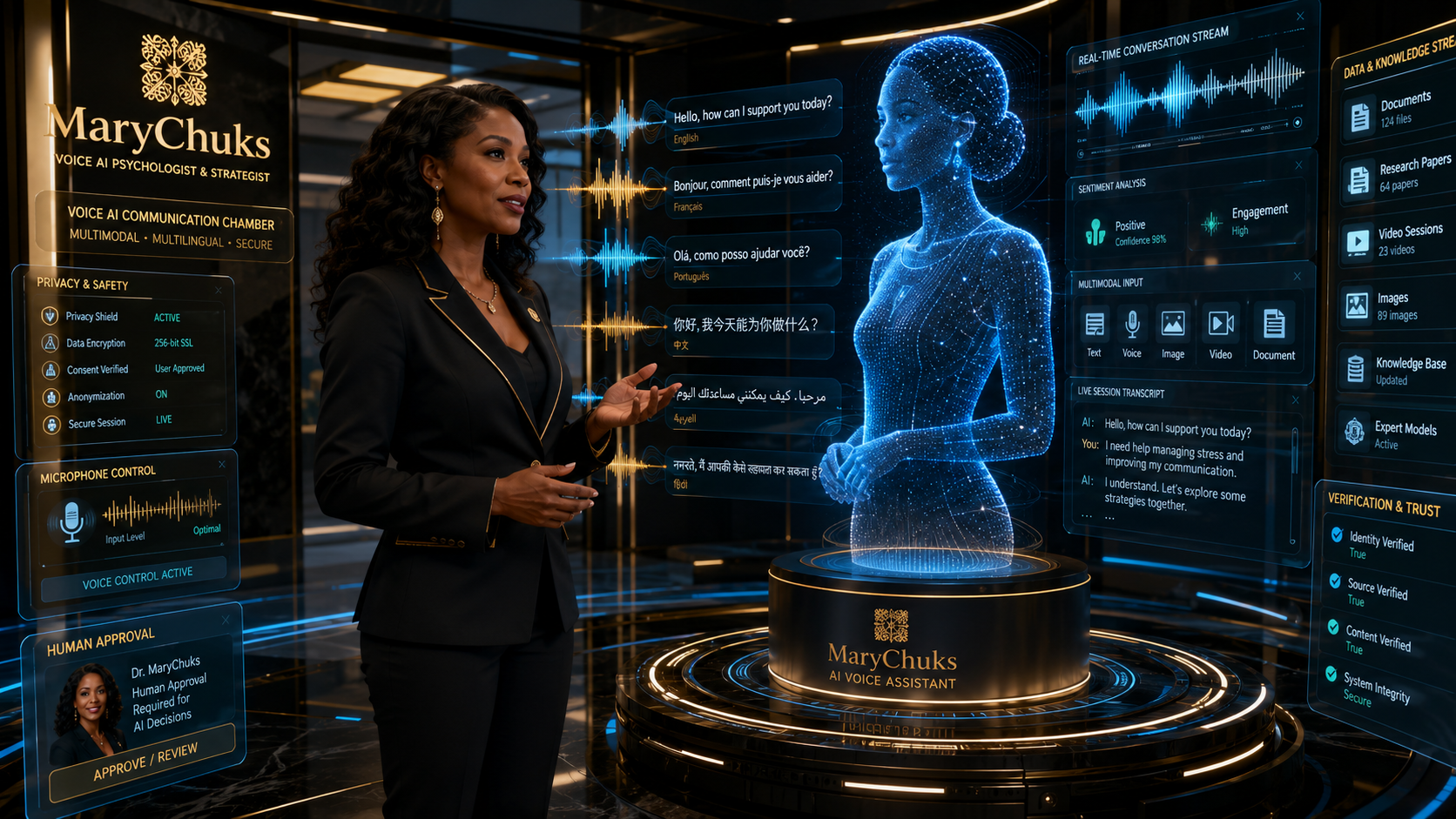
These systems are moving beyond rigid commands and isolated responses. They are becoming capable of following longer conversations, responding to interruptions, understanding context and shifting naturally between listening and speaking.
OpenAI recently introduced GPT-Live, describing it as a new generation of voice models designed to make spoken interaction with AI feel more like natural conversation. The accompanying ChatGPT update allows the system to listen and speak with more fluid turn-taking, including the ability to handle interruptions more naturally. �
OpenAI +1
This development is part of a wider movement toward multimodal AI—systems that can work across text, voice, images, files, video and software environments.
The interface of the future may therefore not be a screen filled with menus.
It may be an ongoing conversation.
Why Voice Changes the Relationship With AI
Typing requires people to translate their thoughts into organised written instructions.
That can be useful because writing encourages precision. But it can also create friction.
A person may know what they want to say but struggle to formulate the perfect prompt.
They may have an idea while walking, cooking, commuting or caring for a child, when opening a laptop is inconvenient.
Voice reduces some of that friction.
A user can speak while the thought is still forming:
“I have an idea for an article about why people trust confident technology even when it may be wrong. Help me explore the psychological angles, but do not write the article yet.”
That request contains purpose, context and a boundary.
The conversation can then continue:
“Focus more on cognitive bias.”
“Give me an opposing argument.”
“Now organise the ideas into a structure.”
Instead of preparing one perfect instruction, the user develops the task through dialogue.
This resembles how people often think with another human being. Ideas are not always delivered fully formed. They emerge through questions, clarification and response.
From Command Recognition to Real Conversation
Traditional voice assistants were largely built around command recognition.
The user said a phrase such as:
“Set an alarm.”
“Play this song.”
“Call Mary.”
“What is the weather?”
The system matched the request to a limited function.
Modern voice AI is increasingly based on generative models that can reason across a conversation.
This allows the interaction to become less predictable but more flexible.
A user can:
explain a complicated situation
ask follow-up questions
change direction
correct the system
request a different tone
explore several possibilities
refer to something mentioned earlier
The AI is not simply recognising a command.
It is attempting to construct meaning from the conversation.
That is a major technical and psychological shift.
Voice AI Is Part of the Multimodal Revolution
Voice should not be viewed as a separate AI category.
It is becoming one part of a multimodal system.
A person may begin by speaking, then show the AI an image, upload a document or ask it to examine something displayed on the screen.
Google’s recent AI developments similarly emphasise models that can work across different forms of information. Gemini Omni, for example, was presented as a system capable of combining text, images, audio and video inputs for creative production and conversational editing. �
blog.google +1
This suggests a future interaction such as:
“Look at this product photograph, read the document containing the specifications and help me prepare a spoken presentation explaining the product to non-technical customers.”
The AI would need to connect:
visual understanding
document analysis
language reasoning
speech generation
audience adaptation
Voice becomes the conversational layer connecting those capabilities.
Voice AI Could Make Technology More Accessible
Typing is not equally easy for everyone.
Some people experience:
visual impairment
dyslexia
limited mobility
literacy difficulties
fatigue
language barriers
temporary injuries
difficulties organising written language
Voice interaction could reduce some of these barriers.
A person who struggles to type a long document may be able to speak the first draft.
Someone who finds a complicated software interface overwhelming may be able to describe the desired result instead of navigating multiple menus.
A learner may ask a question aloud and request a simpler explanation when confused.
An older adult may find conversation more familiar than learning a new sequence of buttons.
This does not mean voice automatically creates accessibility. Systems must still understand different accents, speech patterns, languages and communication needs.
Poor recognition can create exclusion rather than remove it.
Voice AI must therefore be evaluated not only by how natural it sounds, but by how broadly and fairly it understands human speech.
The Importance of Accents and Linguistic Diversity
Human speech is extraordinarily varied.
People speak with regional accents, cultural expressions, multilingual sentence structures and individual communication patterns.
A Nigerian speaker in London may move naturally between British English, Nigerian English, Igbo expressions and local slang.
A useful voice system should not treat one accent as the standard and everyone else as a technical problem.
Voice technology has historically performed unevenly across demographic and linguistic groups. As voice AI becomes more central to work, education and public services, unequal recognition could create practical disadvantages.
The central question is not merely:
“Can the AI hear speech?”
It is:
“Whose speech has the system been designed to understand?”
Developers will need diverse data, careful evaluation and ways for users to correct misunderstandings.
The system should adapt to people rather than repeatedly demanding that people imitate the system.
Voice AI as a Thinking Partner
One of the most interesting applications of voice AI is not command execution.
It is cognitive collaboration.
People often clarify their thinking by speaking.
A psychologist might use voice AI to organise questions for a research project.
An entrepreneur may talk through a business problem.
A writer may narrate the beginnings of a story.
A student may explain a concept aloud and ask the AI to identify gaps in their understanding.
The AI can respond with questions such as:
What evidence supports that conclusion?
What assumption are you making?
Who is the intended audience?
What alternative explanation should be considered?
What would success look like?
Used carefully, this can create a form of structured reflection.
However, the AI should not be mistaken for a conscious listener or a qualified human professional merely because its voice sounds warm and responsive.
Natural speech can create emotional impressions that exceed the system’s real understanding.
The Psychological Power of a Human-Like Voice
People respond socially to voices.
Tone, rhythm, pauses and emotional expression influence how trustworthy, intelligent or caring a speaker appears.
When an AI speaks fluently, users may unconsciously attribute human qualities to it.
They may feel that the system:
understands them
agrees with them
cares about them
possesses confidence
has formed an intention
remembers the relationship in a human way
This is where voice AI becomes psychologically powerful.
A written error may appear as text that can be inspected.
The same error spoken confidently may feel more persuasive.
A comforting voice may lower the user’s critical guard.
A human-sounding pause may create the impression that the system is thoughtfully reflecting, even when it is performing computation rather than experiencing thought.
The more natural the interface becomes, the more important AI literacy becomes.
People need to understand the difference between:
simulated empathy and felt empathy
conversational fluency and factual accuracy
remembered context and human memory
generated confidence and verified knowledge
Voice AI in Education
Voice AI could become a significant educational tool.
A learner may use it to:
practise a language
rehearse an interview
explain a concept aloud
receive questions on a subject
simulate a debate
revise through conversation
convert notes into spoken summaries
Google has also been expanding AI-supported learning tools, including study notebooks designed to provide personalised lessons, practice quizzes and progress support. �
blog.google +1
Voice could make such learning more interactive.
Instead of passively reading a summary, a student could be asked:
“Explain the difference between correlation and causation in your own words.”
The AI could then identify where the explanation is incomplete and ask a follow-up question.
Used well, this can encourage active recall.
Used poorly, it can become an answer machine that allows learners to avoid thinking.
The educational value depends on whether the AI helps the student practise understanding or merely supplies finished responses.
Voice AI in Business and Work
Voice interaction could also change professional workflows.
A business owner might say:
“Summarise the three most urgent customer issues from today’s notes and prepare a response plan for me to review.”
A creator might dictate an article idea during a walk.
A manager could rehearse a difficult presentation.
A consultant might speak observations after a meeting and have them organised into a structured report.
A developer could explain the intended behaviour of a feature before generating a technical plan.
The key advantage is immediacy.
Ideas can be captured while they are fresh.
But businesses must establish boundaries around confidential conversations, customer information and sensitive documents.
Voice feels informal, but spoken information can still be collected, processed and stored.
The Privacy Question
Voice AI raises particularly intimate privacy concerns.
A spoken conversation may reveal:
identity
health information
emotional state
family circumstances
financial concerns
location
background sounds
names of other people
Users should understand:
when the microphone is active
what audio is transmitted
whether recordings are stored
how conversations are used
whether transcripts are created
how information can be deleted
which connected services the AI can access
A natural conversational experience must not make data collection invisible.
Convenience should not erase informed consent.
The Future Interface Will Probably Be Mixed
Voice is unlikely to eliminate screens and keyboards.
Different interfaces suit different tasks.
Voice is useful for:
brainstorming
quick questions
accessibility
hands-free interaction
spoken rehearsal
capturing ideas
Text remains useful for:
precise instructions
reviewing evidence
editing language
comparing information
recording decisions
checking citations
Visual interfaces remain useful for:
charts
images
timelines
documents
design
complex controls
The future will probably be fluid.
A person may speak the goal, review the plan visually, edit key details in text and approve the final action through a secure interface.
The most effective AI will allow users to move between modalities without losing context.
Voice Should Expand Human Agency
The rise of voice AI represents more than a technical upgrade.
It changes the emotional and cognitive distance between people and machines.
When technology speaks naturally, it feels closer.
That closeness can make AI more accessible, useful and collaborative.
It can also make over-trust easier.
The correct goal is not to make people forget that they are speaking with a machine.
The goal is to create an interface that supports human thought while remaining transparent about its nature and limitations.
Voice AI should help people express ideas, explore questions and operate technology more easily.
It should not quietly become an unquestioned authority inside their lives.
Final Thoughts
Computing began with specialised codes.
It moved through keyboards, graphical interfaces and touchscreens.
Now it is moving toward conversation.
The emergence of more natural voice models suggests that speaking to AI may become one of the central interfaces of everyday computing.
People will talk to systems that can search, write, plan, analyse, create and operate tools.
That will make technology feel less like a machine waiting for commands and more like an active participant in the workflow.
But a human-like voice does not create human consciousness.
Fluency does not guarantee truth.
Warmth does not guarantee care.
The future of voice AI will depend on whether we combine natural interaction with privacy, verification, accessibility and meaningful human control.
The interface may become conversational.
The responsibility must remain human.

Discover more from Marychuks.com AI, Psychology, Business & CreativeVerse
Subscribe to get the latest posts sent to your email.