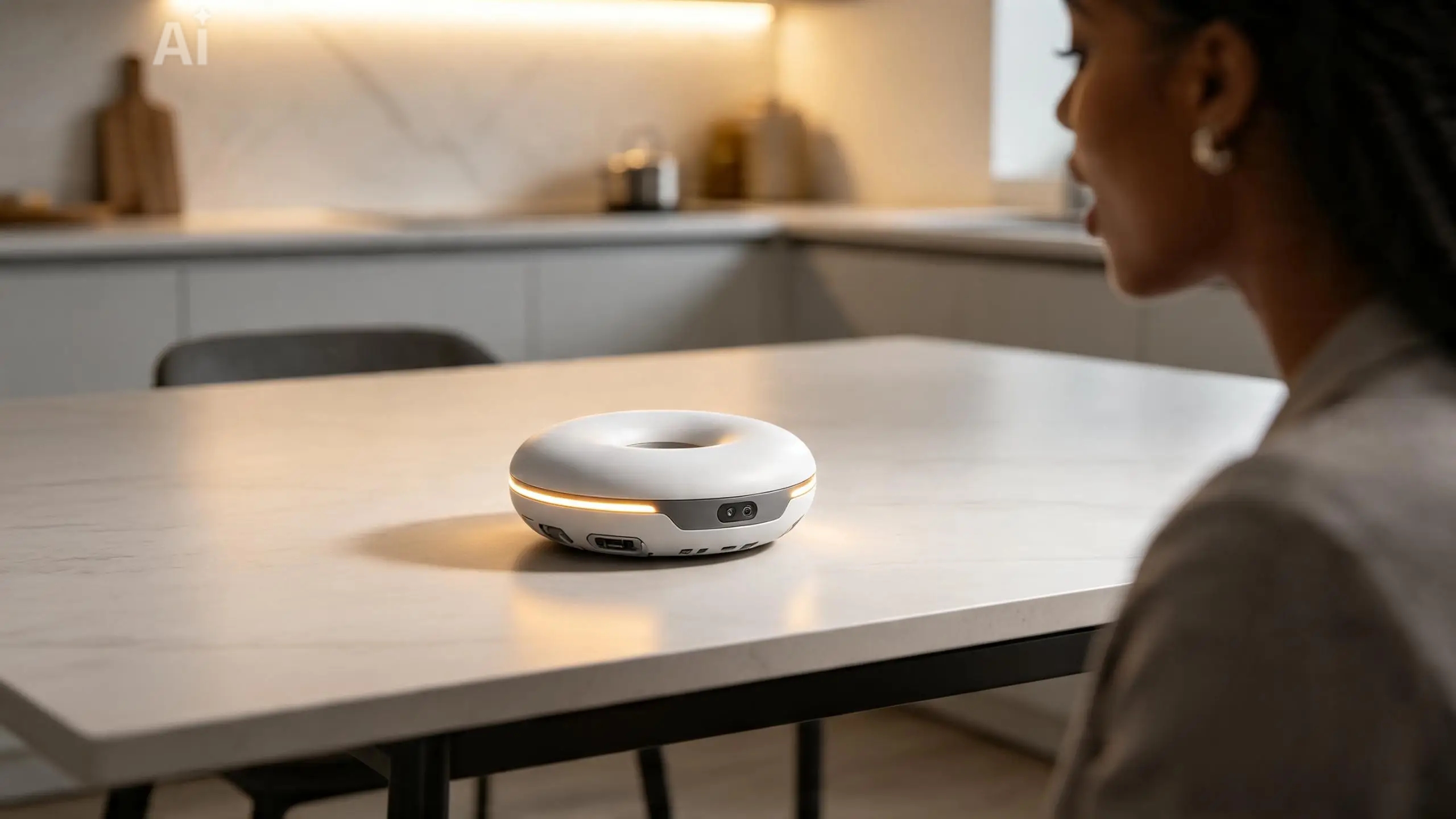
OpenAI may be preparing to move ChatGPT out of the phone and onto the kitchen table.
The company’s first hardware project with legendary former Apple designer Jony Ive is reportedly a battery-powered AI device roughly the size of a hockey puck.
According to reporting cited by The Verge from Bloomberg’s Mark Gurman, the device is expected to be screenless, doughnut-shaped, and portable enough to carry around the home in one hand. �
The Verge
It could launch in 2027 at a price above $300. �
The Verge
If accurate, the product reveals something important about OpenAI’s hardware strategy:
It does not want to build another smartphone.
It wants to create an environment where talking to AI becomes more natural than opening an application.
What Might the Device Include?
Reports suggest the gadget could contain:
A camera system
Multiple sensors
Lights
Moving mechanical elements
A battery
No traditional display
Some moving parts may physically respond when the device is interacting with the user. �
The Verge
The experience is reportedly intended to resemble an advanced version of ChatGPT Voice Mode.
Instead of picking up the phone, unlocking it, and opening ChatGPT, a person may simply speak to the device.
That removes friction.
Removing friction dramatically increases usage.
Why No Screen?
Screens dominate modern technology.
A screenless AI product would deliberately move in another direction.
Voice-based interaction could allow users to:
Ask questions while cooking
Plan the day while getting dressed
Talk through ideas
Control connected devices
Receive reminders
Discuss documents or images captured through cameras
The assistant becomes ambient.
It exists in the room rather than inside one app.
This could make AI feel more natural—but also more intrusive.
The Privacy Problem Is Huge
A portable device containing microphones, cameras and sensors will immediately create concerns.
Consumers will want to know:
Is it always listening?
Is video stored?
Can recordings train models?
How do you know the camera is active?
Can children interact with it?
Can it recognise individual household members?
What happens if it is stolen?
Design cannot treat privacy as a settings page hidden after purchase.
Users need physical and unmistakable controls.
A camera shutter should be visible.
A microphone-off switch should actually disconnect the microphone.
Trust becomes part of industrial design.
Why Jony Ive Matters
Jony Ive helped shape some of Apple’s most influential products.
His design philosophy emphasised simplicity and making complicated technology feel approachable.
OpenAI does not merely need attractive hardware.
It needs a new physical language for AI.
A keyboard made computers approachable.
A touchscreen made smartphones approachable.
OpenAI is effectively asking:
What physical interface makes artificial intelligence feel natural?
The answer may not look like anything currently on a desk.
The $300 Question
A device above $300 would enter a difficult consumer market.
Phones already provide excellent microphones, cameras and ChatGPT applications.
Users will ask:
“Why do I need another object?”
OpenAI must therefore create an experience that feels dramatically more convenient than simply talking to a smartphone.
If the device becomes merely an expensive ChatGPT speaker, it may struggle.
If it genuinely changes the interaction model, it could create a new category.
Mary Chuks’ Perspective
AI is moving from:
website → app → operating system → physical environment.
That progression matters.
The most successful technologies eventually disappear into ordinary behaviour.
Nobody says:
“I am now operating telecommunications infrastructure.”
They say:
“I’m calling Mum.”
OpenAI wants AI to become that invisible.
But invisible intelligence needs highly visible boundaries.
A screenless assistant should never leave users guessing whether it is watching, listening or recording.
Conclusion
The rumored OpenAI–Jony Ive device may look surprisingly simple.
That may be the point.
The challenge is no longer putting more computing inside a rectangle.
It is finding a physical form for intelligence itself.
And apparently, the first answer might be:
a $300 talking hockey puck. 🤣
Source: The Verge, 6 August 2026, citing Bloomberg reporting. �
The Verge
Discover more from Marychuks.com AI, Psychology, Business & CreativeVerse
Subscribe to get the latest posts sent to your email.