Artificial intelligence has officially reached the television channel.
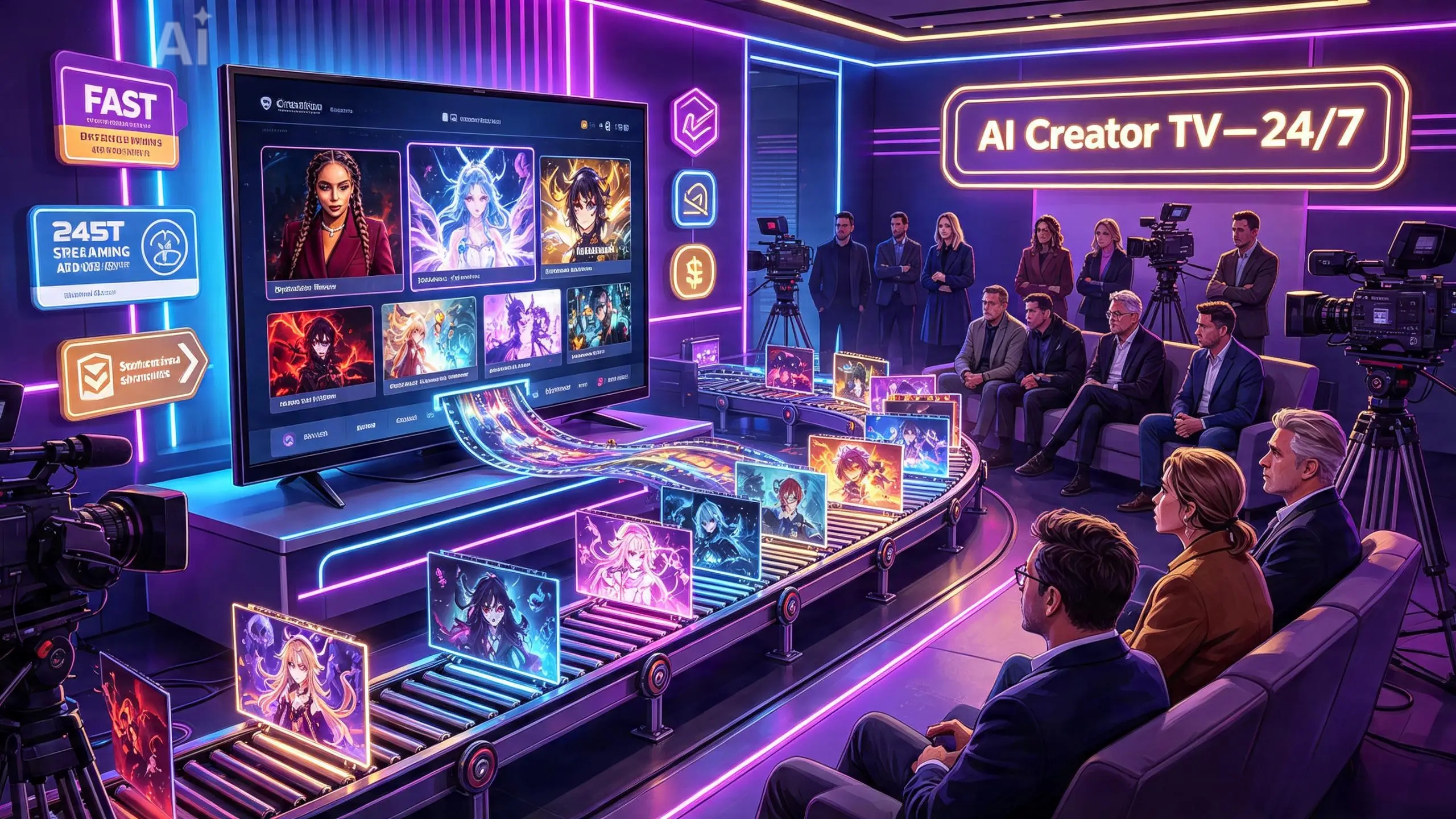
Roku has added a 24/7 stream made entirely around AI-generated programming from startup Fairground.
The channel, called Fairground AI Creator TV, sits alongside Roku’s ordinary free ad-supported streaming channels and continuously serves machine-generated entertainment created by Fairground’s content partners. �
The Verge
The Verge’s verdict after watching for about an hour was brutal: much of the material resembled the short-form “AI slop” already common on social-media platforms. �
The Verge
And that is exactly why the story matters.
AI-generated video is no longer confined to experimental clips.
It has entered television distribution.
What Is Fairground?
Fairground launched in 2025 as an AI-focused entertainment startup.
It works with creators producing synthetic video and says it shares revenue with participating creators. �
The Verge
The company has reportedly explored AI-generated adaptations of familiar stories such as Robin Hood and Dracula. �
The Verge
Its Roku channel mixes different styles rather than presenting one consistent genre.
Viewers may encounter:
Fantasy
Horror
Anime-inspired scenes
Surreal comedy
Synthetic live-action
Short narrative experiments
The stream operates like conventional FAST television: the viewer turns it on and watches whatever happens to be playing.
The Quality Problem
AI video has improved enormously.
It still struggles with consistency.
Characters can change appearance.
Movement may become strange.
Scenes can feel disconnected.
Audio quality varies.
Narratives sometimes resemble a collection of attractive clips rather than a deliberately directed production.
The Verge described Fairground’s material as visibly stitched together from machine-generated video despite signs of human post-production. �
The Verge
This does not mean AI filmmaking is doomed.
It means distribution has moved faster than artistic maturity.
Quantity Versus Quality
Traditional filmmaking is expensive.
It requires actors, crews, locations, equipment, editing and distribution.
AI dramatically lowers production costs.
That enables experimentation.
It also creates a dangerous incentive:
Why spend months creating one polished production when a platform can cheaply generate enough footage to fill 24 hours every day?
The economics reward abundance.
The artistic question is whether viewers actually want abundance without craft.
Why Roku Is Doing It
FAST television depends on advertising.
Platforms need large amounts of inexpensive programming to keep viewers watching between ads.
AI-generated content may be economically attractive because production costs can be much lower than traditional television.
If synthetic programming keeps people watching even passively, it may become commercially useful even when nobody considers it high art.
That creates a strange possibility:
AI entertainment does not need to become better than Hollywood.
It may only need to become cheap enough to fill dead airtime.
The Copyright Question
The Verge notes that Fairground does not clearly identify which AI models are used across its programming or whether all underlying training material was licensed. �
The Verge
Some programming reportedly shows visual characteristics reminiscent of professionally produced anime.
That makes transparency especially important.
Viewers and creators should know:
Which models generated the footage
Whether characters or voices imitate real artists
Whether content is fully synthetic
How human creators are compensated
As AI video enters mainstream distribution, disclosure needs to become more sophisticated than a tiny “AI-generated” label.
The Opportunity for Real AI Creators
There is another side.
Lower production barriers could allow independent creators with strong ideas but limited budgets to build films and series that previously required studios.
The problem is not AI video itself.
It is confusing generation volume with creativity.
A talented creator using AI deliberately could produce something distinctive.
A platform endlessly filling space with automated clips produces something else entirely.
Tools do not eliminate artistic standards.
They make standards more important because generating material becomes easier.
Mary Chuks’ Perspective
AI has solved the scarcity of footage.
It has not solved the scarcity of story.
That distinction matters.
A creator should not ask:
“How many videos can my AI produce?”
Ask:
“Why should somebody keep watching this one?”
CreativeVerse, independent filmmaking and AI-assisted storytelling become valuable when the human creator provides:
Worldbuilding
Continuity
Character
Emotion
Meaning
Direction
AI can scale production.
It cannot automatically provide purpose.
Practical Takeaways for AI Video Creators
Write the story before generating clips.
Maintain character and visual continuity.
Edit aggressively.
Use AI disclosure.
Confirm voice and image rights.
Avoid flooding platforms with every generation.
Treat AI output as raw footage—not finished art.
Build a recognisable creative universe.
Conclusion
Roku’s AI channel may look rough today.
But its existence signals something bigger.
Synthetic video has moved from the feed to the living room.
The next battle is no longer whether AI can create endless entertainment.
It obviously can.
The question is whether anyone wants to watch it.
Primary review and reporting: The Verge, 7 August 2026. �
The Verge
Discover more from Marychuks.com AI, Psychology, Business & CreativeVerse
Subscribe to get the latest posts sent to your email.