Artificial intelligence has answered our emails.
Written our code.
Generated our pictures.
Helped create our music.
Now it is going to work on:
the Moon.
Not metaphorically.
NASA and IBM announced on 10 September 2026 the open-source release of the NASA-IBM Lunar Foundation Model, one of the first publicly available foundation models specifically designed for lunar science.
The model was trained primarily on data from NASA’s Lunar Reconnaissance Orbiter and incorporates observations from multiple lunar missions. NASA says it was trained on roughly two million image tiles, including more than one million high-resolution images at one-metre resolution and almost 964,000 multispectral images at roughly 100-metre resolution. It also incorporates data from missions including NASA’s GRAIL and Lunar Prospector and Japan’s SELENE/Kaguya mission. �
NASA Science +1
Reuters reports that the broader machine-learning-ready dataset contains more than 30 aligned data layers from nine instruments, and benchmark tests showed improvements of up to 23% over widely used techniques on certain lunar-feature-identification tasks. �
Reuters
That sounds technical.
The bigger story is philosophical.
We are moving from AI that helps humans create information
toward AI that helps humans discover things about:
reality itself.
Scientific AI Is a Different Kind of AI Story
Most public discussion about generative AI revolves around:
writing;
chatbots;
images;
workplace productivity.
Useful.
But scientific foundation models could eventually become one of AI’s most consequential applications.
Science has a very particular problem.
We are becoming extremely good at:
collecting data.
We are not always equally good at:
examining all of it.
NASA has decades of lunar observations.
Satellites and instruments have produced enormous volumes of:
images;
spectral readings;
topographic maps;
gravitational measurements.
At some point the bottleneck becomes:
human attention.
A Scientist Cannot Manually Inspect Everything
Imagine millions of detailed lunar image tiles.
One researcher can inspect:
some.
A team can inspect:
more.
But machine learning can compare patterns across:
millions.
That does not make the AI:
the scientist.
It makes AI:
a new scientific instrument.
The Telescope Extended Vision
The microscope extended vision into:
the very small.
The computer extended:
calculation.
AI may extend:
pattern detection.
That may become one of the most useful ways to understand scientific artificial intelligence.
Not:
AI replacing the researcher.
But:
AI expanding the scale of what the researcher can notice.
Why Does Lunar Ice Matter?
One especially important application is identifying possible deposits of:
water ice.
Some regions near the Moon’s poles remain in permanent shadow.
These areas are extremely cold and difficult to observe.
Yet they may contain ice beneath or around the surface. �
IBM Newsroom +1
Why should anyone care about frozen water on the Moon?
Because water could potentially provide:
drinking water;
oxygen;
hydrogen.
And hydrogen plus oxygen can become:
rocket propellant.
Suddenly lunar ice becomes:
infrastructure.
The Moon Could Become a Logistics Node
Imagine future exploration.
Today:
launch almost everything from Earth.
Expensive.
But if some resources can eventually be obtained locally:
future missions may need to launch less mass from Earth.
That is one reason the search for lunar resources matters to plans for:
sustained human presence
and eventually:
Mars exploration.
NASA’s Artemis programme currently plans to return astronauts to the Moon in 2028, with the broader objective of developing experience and technologies relevant to longer-term lunar operations and later Mars missions. �
Reuters
AI Can Also Help Map Craters
Craters are not merely:
interesting holes.
They can matter for:
landing safety;
navigation;
geological history;
infrastructure planning.
A future lunar base needs to know:
Where is the terrain stable?
Where are dangerous slopes?
Where are rocks?
Where are potentially useful resources?
AI can help turn historical observation data into:
decision infrastructure.
This Is Where Scientific Foundation Models Become Interesting
Traditional machine learning often builds:
one model
for:
one problem.
Crater detector.
Ice detector.
Volcanic-feature classifier.
Foundation models attempt something broader.
Train a general representation on:
large, diverse data.
Then adapt it to:
multiple scientific questions.
That is similar to what happened with language models.
A language foundation model can be adapted to:
translation;
summarisation;
coding;
analysis.
A lunar foundation model may be adapted to:
craters;
ice;
geology;
surface classification.
One Foundation, Many Scientific Questions
This is potentially transformative economically.
Instead of starting every research project from:
zero,
scientists begin from:
a model that already understands something about the structure of the domain.
NASA describes foundation models as useful because broad pre-training can allow relatively rapid fine-tuning for additional scientific applications. �
NASA Science
That can reduce:
time;
data requirements;
compute.
The Open-Source Part Matters
NASA and IBM have released:
the model;
associated datasets;
code
for the scientific community to inspect and build upon. �
NASA Science +1
That is important.
Science progresses through:
replication;
critique;
extension.
A closed system saying:
“Trust us, the crater is there.”
is less scientifically useful than an architecture researchers can:
test;
benchmark;
improve.
Open Scientific AI Could Create Distributed Discovery
Imagine:
NASA builds foundation.
IBM contributes technical expertise.
Universities investigate specialised questions.
Researchers in:
India;
Nigeria;
Brazil;
UK;
Japan
can build applications on top.
Now scientific capacity becomes:
more distributed.
That is exciting.
You Do Not Need to Own a Spacecraft to Study Space
This is another important consequence.
Historically, participation in planetary science depended heavily on access to:
missions;
telescopes;
large institutional resources.
Open datasets and open AI models can reduce some barriers.
A researcher may be able to contribute from:
a university laboratory
using data already collected in space.
That democratises part of the scientific pipeline.
AI Could Become a Scientific Memory Layer
NASA has collected data for decades.
New scientists arrive.
Older missions end.
But observations remain.
A foundation model can potentially encode useful statistical relationships across:
multiple generations of instruments.
It becomes a way of making enormous scientific archives:
computationally accessible.
This Is Not the Same as “AI Discovered Ice”
Important distinction.
AI predictions are not automatically:
scientific facts.
If the system identifies a possible ice deposit:
scientists still need:
validation.
AI generates:
candidate interpretation.
Science requires:
evidence.
That Distinction Will Become Increasingly Important
We will probably see headlines saying:
AI DISCOVERS X.
Sometimes correct.
Often exaggerated.
A more careful chain looks like:
AI detects unusual pattern
↓
scientists investigate
↓
independent data supports interpretation
↓
scientific conclusion strengthens.
The machine participates.
The scientific method remains.
Hallucinations Are Different in Scientific AI
A chatbot hallucination may invent:
a citation.
Annoying.
A scientific system producing:
false feature detection
could misdirect:
research;
landing planning;
resource exploration.
The stakes change.
Therefore scientific AI requires:
benchmarks;
uncertainty estimates;
validation.
The Model Must Know What It Does Not Know
That may be more important than:
raw accuracy.
Imagine lunar system says:
ICE: YES.
versus:
Possible ice signature, confidence 63%; insufficient supporting evidence from instrument B.
The second answer is scientifically richer.
Scientific AI Needs Uncertainty
Because nature is not obliged to fit:
the training distribution.
There will always be:
strange terrain;
sensor noise;
unexpected phenomena.
And sometimes the most scientifically valuable observation may be:
the thing the model does not understand.
Anomaly Detection Could Become Discovery
This is especially exciting.
AI says:
This region does not resemble anything in my training data.
Scientist:
Interesting.
That moment might become:
more valuable
than classification.
Scientists Need AI That Says “Look Here”
Not merely:
“Here is the answer.”
The machine can narrow:
billions of observations
into:
hundreds worth investigating.
That changes human research productivity dramatically.
The Same Architecture Could Spread Across Science
Astronomy.
Climate.
Genomics.
Materials.
Ocean science.
Medicine.
Particle physics.
In each field, humans increasingly possess:
more data than any individual can interpret.
Foundation models can become:
scientific lenses.
NASA and IBM Already Have a Broader Prithvi Family
The lunar model joins IBM and NASA’s broader Prithvi family of open foundation models across areas including:
geospatial science;
weather;
heliophysics. �
IBM Newsroom +1
That tells us the strategy is broader than:
Moon AI.
It is:
foundation models for science.
This Could Change How Universities Train Scientists
Future scientist may need three literacies:
domain science;
statistics;
AI.
Astronomer:
understands astronomy
and:
model behaviour.
Psychologist:
understands human behaviour
and:
AI inference.
Biologist:
understands cells
and:
machine-learning representations.
AI literacy may become another:
scientific instrument skill.
But We Should Not Outsource Curiosity
There is a subtle danger.
If AI continually tells scientists:
where interesting patterns are,
researchers may become biased toward:
what models can recognise.
Science also progresses because someone asks:
a weird question.
Something outside:
the dataset;
benchmark;
conventional pattern.
AI can surface patterns.
Human curiosity still determines:
which questions matter.
The Moon Is a Beautiful Example
For thousands of years humans looked at:
the Moon.
Then:
telescopes.
Then:
spacecraft.
Then:
orbital imaging.
Now:
foundation models.
Same Moon.
New layer of observation.
Technology keeps changing:
what humans can ask of the same object.
This Is Why Scientific AI Excites Me More Than Yet Another Chatbot Feature
Another chatbot can:
draft an email faster.
Useful.
An AI helping scientists detect:
water;
geological structures;
previously overlooked patterns
can expand:
human knowledge.
That is a different scale of value.
Final Thoughts
The NASA-IBM Lunar Foundation Model represents something much bigger than:
AI goes to space.
It illustrates a transition in artificial intelligence itself.
From:
content generation
toward:
knowledge discovery.
The scientific revolution of AI may not look like a robot wearing:
a laboratory coat.
🤣
It may look like:
millions of observations becoming searchable through learned patterns.
Scientists asking:
questions that previously required years of manual analysis.
Machines pointing toward:
anomalies humans had not noticed.
And researchers deciding:
which signals deserve belief.
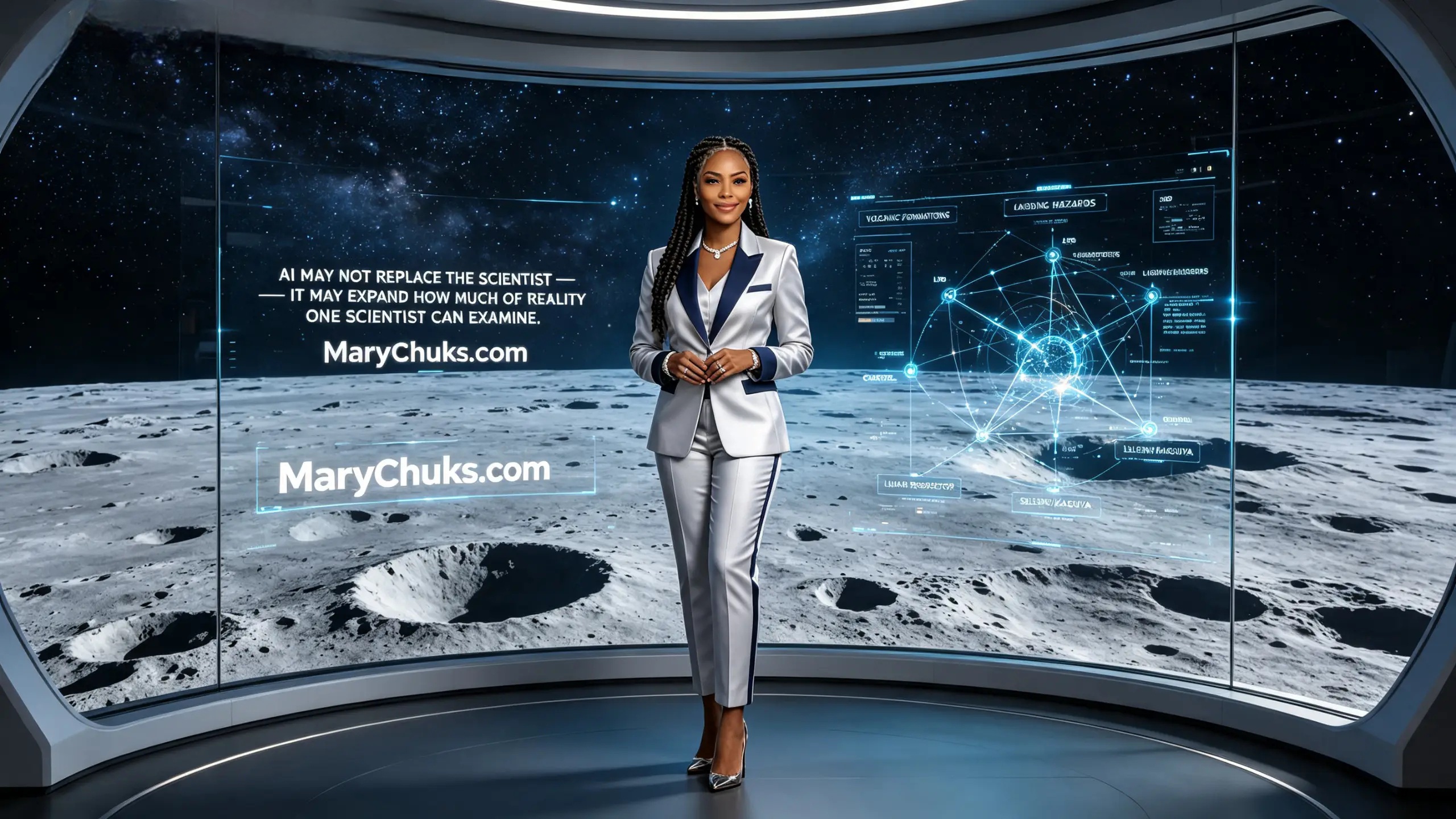
The AI does not need to replace the scientist.
The more interesting possibility is that it expands:
the amount of universe one scientist can meaningfully examine.
For centuries, science has built instruments that extend human senses.
The telescope let us see farther.
The microscope let us see smaller.
Perhaps foundation models will allow us to:
notice more.
And sometimes the next major discovery may begin when an AI looks across two million lunar images and quietly tells a human researcher:
“You may want to look here.”
Verification note: NASA and IBM announced the open-source Lunar Foundation Model on 10 September 2026. NASA says the model was trained primarily on roughly two million image tiles from lunar mission data; IBM says the associated machine-learning dataset combines more than 30 aligned data layers from nine instruments. IBM and Reuters report benchmark improvements of up to 23% on certain lunar-feature-identification tasks. These benchmark results do not mean the model has independently discovered or confirmed lunar ice. �
NASA Science +2
NASA: Lunar Foundation Model announcement�
IBM: NASA-IBM Lunar Foundation Model announcement�
Discover more from Marychuks.com AI, Psychology, Business & CreativeVerse
Subscribe to get the latest posts sent to your email.