You sit down to work.
Music starts.
Twenty minutes disappear.
Then:
forty.
Then:
two hours.
You look up.
“How is it already lunchtime?”
That experience has a name psychologists know very well:
flow.
And now artificial-intelligence-generated music is entering the conversation.
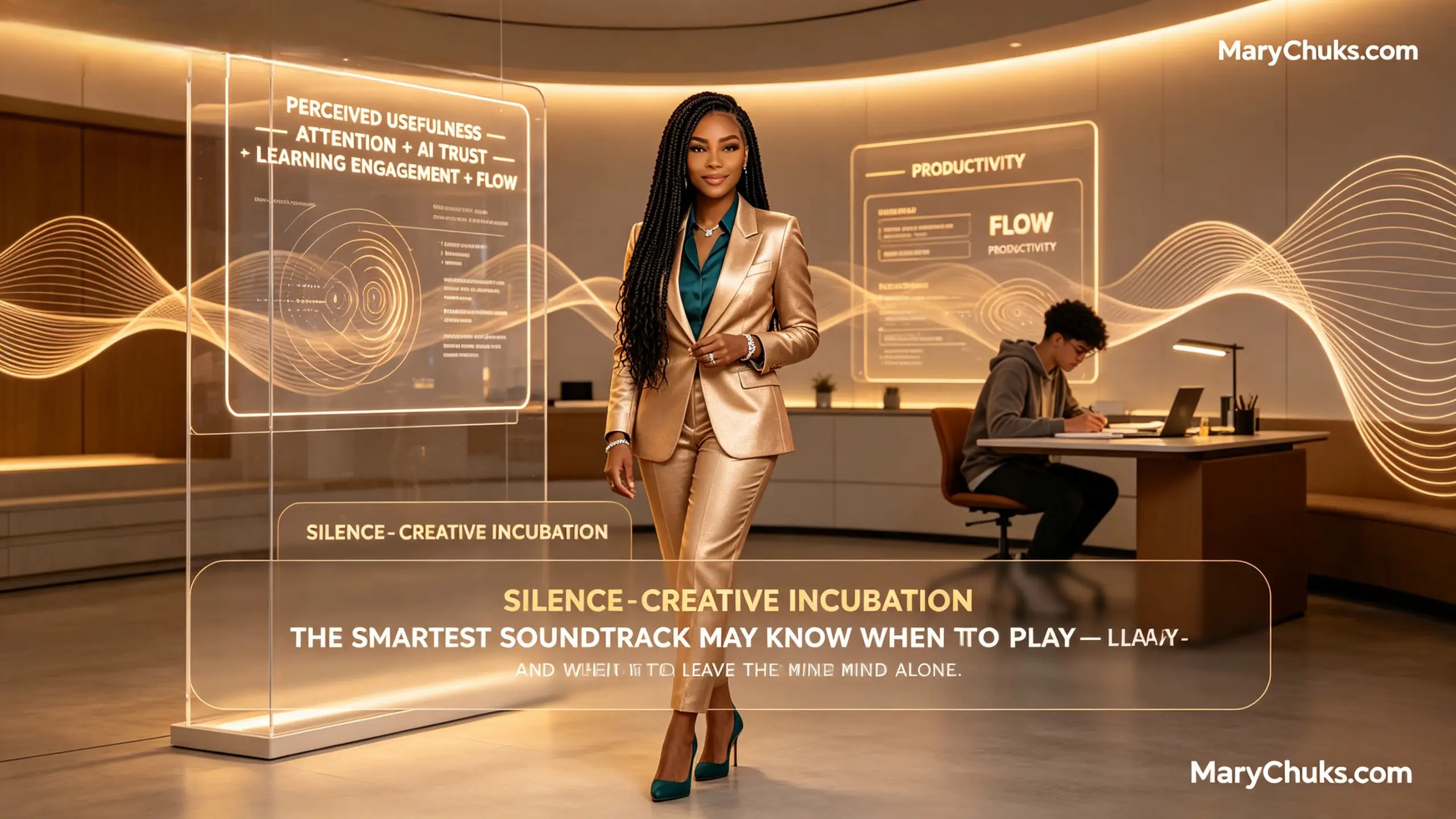
A peer-reviewed study published in Scientific Reports on 9 September 2026 investigated relationships between:
perceived usefulness of AI-generated music;
attention;
AI trust;
learning engagement;
flow.
Researchers Wanting Li and Ruikai Yuan surveyed 407 university students after a four-week naturalistic AI-music listening protocol.
They found that students who perceived AI-generated music as more useful also reported stronger:
mindful attentional awareness
and:
trust in AI.
Both, in turn, were positively associated with:
learning engagement
and:
flow experience. �
Nature +1
That result is fascinating.
But it requires careful interpretation.
The study does not prove:
Play AI music and your brain becomes more productive.
Psychology rarely gives us gifts that simple.
🤣
The more interesting story involves:
how usefulness, attention and trust may interact with the experience.
First: What Is Flow?
Flow is the psychological state commonly associated with deep immersion in:
a task.
Typical features include:
intense concentration;
reduced self-consciousness;
altered sense of time;
strong task engagement.
The concept is closely associated with psychologist Mihaly Csikszentmihalyi.
Many people experience flow during:
writing;
coding;
music;
sport;
painting;
research.
It is that:
completely inside the activity
feeling.
Music Can Shape the Cognitive Environment
People have always used music to influence:
mood;
energy;
attention.
Study music.
Gym music.
Sleep music.
Driving music.
Heartbreak music.
And then the very special category:
“I am cleaning this house like my enemies are coming to inspect it.”
🤣
Music can change:
arousal;
pace;
emotional tone.
AI adds something new:
personalisation.
Imagine Music That Adapts to the Task
You are reading.
AI selects:
low lyrical interference;
steady tempo;
moderate complexity.
You begin difficult problem-solving.
Music adjusts.
You become distracted.
System lowers stimulation.
This is speculative.
But technologically:
not absurd.
AI Music Could Become Functional Music
Traditionally we ask:
Do I like this song?
AI-generated music introduces another question:
What does this music help me do?
Focus.
Sleep.
Exercise.
Relax.
Learn.
That changes the product category.
Music becomes both:
art
and:
cognitive environment.
The New Study Focused on Perceived Usefulness
This part is critical.
The researchers did not simply test:
AI music present
versus:
no music.
Instead, they examined whether students who perceived AI-generated music as useful also differed in:
attention;
AI trust;
engagement;
flow. �
Nature
That means user interpretation matters.
Psychology Often Works Through Meaning
Two people hear:
the same music.
Person A:
“This helps me focus.”
Person B:
“This is distracting.”
Same sound.
Different cognitive meaning.
The psychological outcome may differ.
Trust Also Matters
This is particularly interesting.
Students who perceived the technology positively tended to report greater AI trust, which was associated with stronger engagement and flow in the model tested by the researchers. �
Nature
Why might trust matter?
One possibility:
cognitive friction.
If you constantly think:
This AI music is weird.
Is this safe?
Is the system manipulating me?
attention is divided.
If the system feels:
useful;
predictable;
reliable,
you may stop monitoring it.
It fades into:
the background.
Good Productivity Technology Often Becomes Invisible
Keyboard.
Chair.
Lighting.
Music.
When they work:
you focus on:
the task.
When they fail:
they become the task.
🤣
AI music may work similarly.
Attention Was Another Pathway
The study found mindful attentional awareness positively associated with:
engagement
and:
flow. �
Nature
That makes intuitive psychological sense.
Flow requires:
attention.
You cannot become deeply immersed while your attention jumps between:
assignment;
WhatsApp;
TikTok;
email;
fridge;
back to assignment.
Modern life is basically an Olympic competition in attentional fragmentation.
🤣
Could Music Become an Attention Boundary?
Headphones on.
Specific music begins.
Brain learns:
work mode.
Over time, the cue itself may become:
ritual.
This is not unique to AI music.
Humans already create behavioural contexts through:
sound.
AI could make those contexts:
more personalised.
Personalisation Could Be More Important Than Generation
This is an important distinction.
Perhaps the commercial value is not:
AI can create millions of songs.
We already have:
millions of songs.
The value might be:
AI can create or select exactly the auditory environment useful for this person at this moment.
That is a much more interesting product.
Think of Adaptive Focus Soundtracks
User says:
“I need 90 minutes of deep writing.”
System creates:
continuous soundtrack.
No:
song changes;
advert interruptions;
jarring vocals.
After 45 minutes:
subtle transition.
Task ends:
sound resolves.
That becomes:
functional design.
Music Could Become Responsive
Future wearable detects:
heart rate;
movement;
task behaviour.
Music adapts.
Too sleepy?
Slightly increase stimulation.
Too agitated?
Reduce.
Now music behaves more like:
an adaptive environment.
But Here Comes the Psychology Warning
More adaptation does not automatically mean:
better.
Humans can become:
dependent on ideal conditions.
Imagine:
“I cannot work unless my AI creates exactly the right soundtrack.”
Now tool becomes:
requirement.
That may reduce:
cognitive flexibility.
Sometimes We Need to Work in Imperfect Conditions
Train.
Cafe.
Children making noise.
Office.
Life.
Psychological resilience includes:
ability to function when environment is not perfectly optimised.
So AI should support:
attention
without turning attention into:
environmental fragility.
Another Question: What Happens to Silence?
This is important.
Humans increasingly fill:
every gap.
Walking:
podcast.
Cooking:
music.
Bus:
video.
Waiting:
social media.
Perhaps we are already reducing:
cognitive silence.
AI-generated endless audio could accelerate that.
Silence Has Cognitive Value
Mind wandering can support:
reflection;
memory integration;
creative incubation.
Not every moment needs:
optimisation.
This connects beautifully with tonight’s CreativeVerse story.
Sometimes the brain may need:
nothing.
Music and Learning Are Not the Same for Everyone
Some people work beautifully with:
instrumental music.
Others need:
silence.
Lyrics may interfere with language-heavy tasks for some people.
Familiar music may comfort one learner and distract another.
The average effect does not determine:
your effect.
This Is Why Personal Experimentation Is Better Than Universal Rules
Try:
silence.
Instrumental.
AI music.
Nature sounds.
Compare:
how long you sustain attention;
how much work you complete;
how well you remember.
Now you have:
personal data.
Flow Is Not the Same as Productivity
Another important point.
You can enter flow doing:
something useless.
Gaming for six hours:
flow.
Organising fonts instead of writing article:
possibly flow.
🤣
Flow feels intrinsically rewarding.
It does not guarantee:
the activity advances your goals.
We Should Distinguish
Flow quality
from:
task value.
The ideal state is:
flow
inside:
important work.
AI Could Help Create That Match
Imagine AI notices:
user enters deep focus repeatedly at:
certain time;
certain task;
certain music characteristics.
Then suggests:
protect this period.
Now the system helps build:
behavioural architecture.
This Connects to Positive Psychology
Flow is often discussed as part of:
optimal functioning;
engagement.
But flow usually requires a good relationship between:
challenge
and:
skill.
Too easy:
boredom.
Too difficult:
anxiety.
Ideal challenge:
engagement.
Music may influence:
the environment around that balance.
But it cannot replace:
meaningful challenge.
Bad Assignment + Beautiful AI Soundtrack
Still:
bad assignment.
🤣
AI Trust Needs Calibration
The study found AI trust positively associated with the outcomes examined.
That does not mean:
more AI trust is always better.
Uncritical trust can create:
overreliance.
Healthy trust should be:
calibrated.
The system works for:
this purpose.
You understand:
its role.
You do not assume:
magic.
This Is Important for Education
Suppose students begin using AI-generated music because:
“research says it improves learning.”
That would overstate the study.
The design was a:
post-exposure, cross-sectional survey
after four weeks of naturalistic listening.
That design can identify:
relationships.
It cannot prove:
causality. �
Nature
Perhaps students who naturally engage deeply with learning were also more likely to:
see AI music positively.
The causal direction needs stronger experimental research.
We Need Controlled Studies
AI music versus:
human-created music;
silence;
non-AI ambient sound.
Random assignment.
Objective learning measures.
Different task types.
Now we begin understanding:
when music helps
and:
for whom.
Creativity Raises Another Question
Can AI music create flow for:
artists
without reducing originality?
If everyone works to algorithmically optimised:
focus music,
do creative states become:
homogenised?
Probably not automatically.
But worth studying.
AI Music Could Become a Digital Product Category
This is commercially interesting.
Creators might offer:
focus soundscapes;
meditation soundscapes;
writing sessions;
sleep environments;
learning tracks.
Not sold only as:
songs.
Sold as:
experiences.
The Product Becomes an Outcome
Instead of:
“30-minute ambient track.”
Try:
“90-Minute Deep Writing Session.”
That communicates:
function.
But Authenticity Still Matters
People may also want:
music because another person expressed something.
Not because it maximises:
attention.
Functional music
and:
artistic music
can coexist.
We should not reduce all music to:
productivity wallpaper.
Music Has More Than One Job
It can help us:
focus.
Celebrate.
Mourn.
Remember.
Dance.
Love.
AI-generated music may expand:
what music can do.
It should not shrink:
music
into:
efficiency.
Final Thoughts
The new Scientific Reports study offers an intriguing glimpse into the psychology of AI-generated music.
Among 407 students who had listened to AI-generated music during a four-week naturalistic protocol, perceived usefulness was positively associated with:
attention;
AI trust;
learning engagement;
flow.
That is not proof that AI music automatically improves learning.
But it suggests a richer research question:
What happens when music stops being a fixed recording and becomes an adaptive cognitive environment?
AI may eventually create soundtracks for:
work;
learning;
exercise;
sleep
that respond to the individual.
That could be extraordinarily useful.
But perhaps the best design will know two things.
When to play.
And:
when to stop.
Because flow needs:
attention.
Creativity sometimes needs:
silence.
And a psychologically intelligent AI should understand the difference.
Research note: Li and Yuan’s peer-reviewed study was published in Scientific Reports on 9 September 2026. It involved 407 university students surveyed after a four-week naturalistic AI-music listening protocol. Perceived usefulness predicted attention and AI trust in the authors’ structural model, and both were positively associated with learning engagement and flow. Because the design was cross-sectional after exposure, the results support associations and proposed pathways, not causal proof that AI-generated music improves learning. �
Nature +1
Read the Scientific Reports study�
Discover more from Marychuks.com AI, Psychology, Business & CreativeVerse
Subscribe to get the latest posts sent to your email.