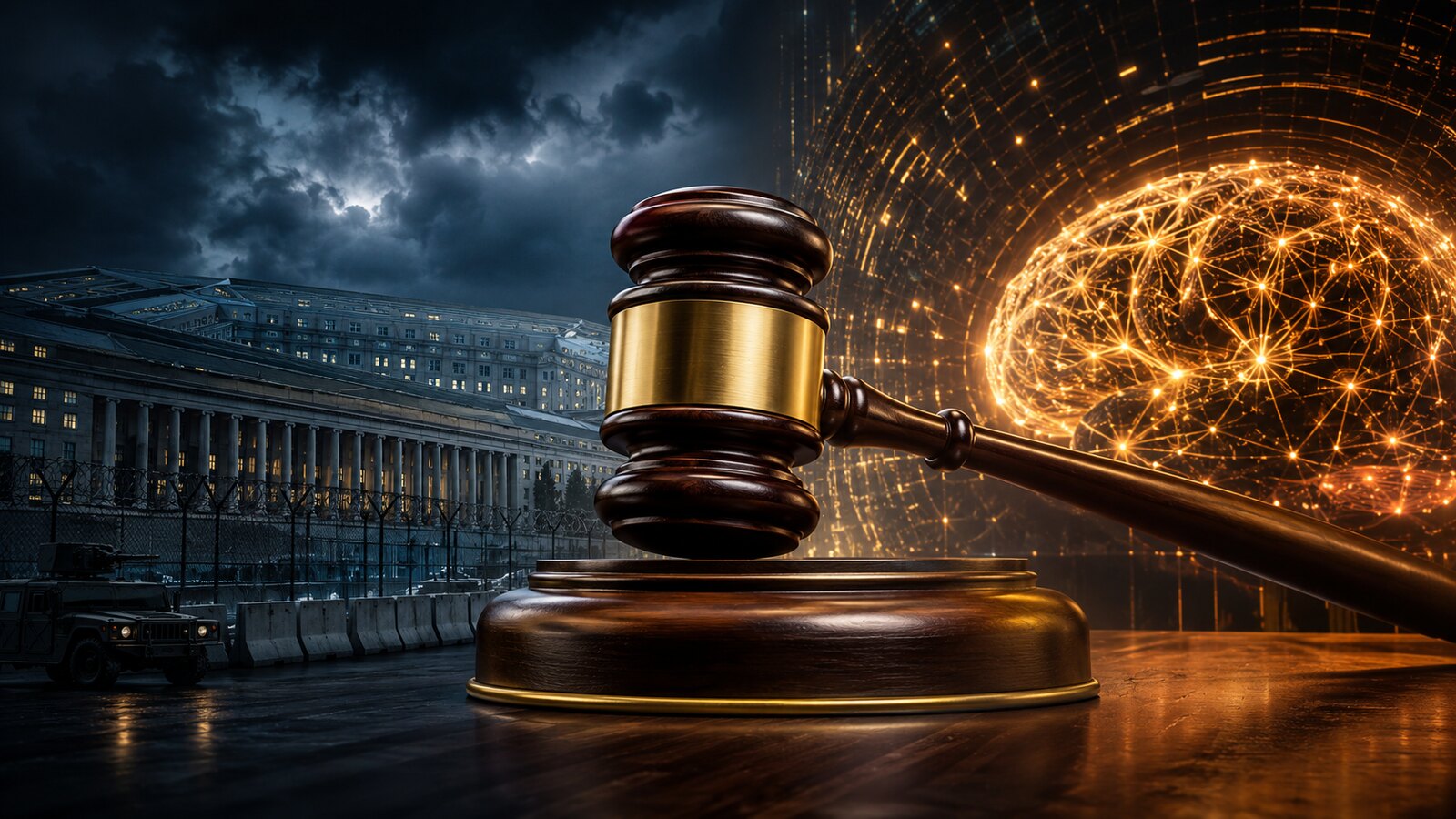

A US federal judge has blocked the Pentagon’s attempt to designate Anthropic as a national-security supply-chain risk, finding that the action was unlawful and unsupported by the record presented to the court.
The dispute emerged after Anthropic refused to permit unrestricted use of its AI technology for domestic surveillance or autonomous weapons. The Department of Defense argued that the company’s restrictions created unacceptable procurement risks. Anthropic countered that the designation was retaliation for its stated safety position and could damage both its reputation and access to government contracts.
Why the ruling is significant
Supply-chain powers are designed to protect government systems from genuine security threats. Applying such a label to a domestic AI company because of a disagreement over acceptable use creates a different constitutional and commercial problem. The judge concluded that national-security authority could not be used as a substitute for evidence or as punishment for criticism.
The decision does not settle every dispute between Anthropic and the US government. A separate legal challenge involving the potential reach of related restrictions into civilian contracting remains unresolved. The ruling nevertheless removes an immediate and potentially severe barrier.
The deeper argument: who controls military AI use?
Frontier AI companies increasingly operate at the boundary between private product governance and national defence. Governments may want broad operational freedom, while model developers may seek restrictions against uses they consider unreliable, unlawful or inconsistent with their safety commitments.
Anthropic’s position is that present systems should not be entrusted with certain high-consequence decisions, particularly autonomous lethal action or intrusive domestic surveillance. The Pentagon’s position has emphasized operational control and the difficulty of relying on a supplier that can independently constrain deployment.
Three principles now in collision
- National security: governments need dependable suppliers and cannot tolerate undisclosed technical constraints.
- Corporate responsibility: AI developers may have evidence about model limitations that procurement officials should not ignore.
- Democratic oversight: neither a private laboratory nor a defence department should unilaterally determine the boundaries of surveillance and lethal autonomy.
What the case could change
The ruling could encourage future military AI contracts to define prohibited uses, audit rights, failure reporting and model-update procedures much more precisely. Ambiguous agreements become dangerous when model behaviour is uncertain and the consequences involve civil liberties or human life.
It may also strengthen the argument that procurement disagreements should be resolved through transparent contracting rather than reputational sanctions. A supply-chain label can affect far more than one contract; it can signal to the whole market that a company is unsafe.
MaryChuks analysis
This is not an argument for allowing private companies to veto democratic governments. It is an argument for governance that forces both parties to justify their decisions. The state must explain the operational necessity; the AI company must disclose the evidence behind its restrictions; independent institutions must assess the public-interest balance.
Human oversight is not meaningful if it disappears at the moment a system enters the most consequential environment. The court’s intervention creates space for a more mature framework—one that distinguishes legitimate national-security requirements from pressure to remove every safety boundary.
Source: Reuters.
Discover more from Marychuks.com AI, Psychology, Business & CreativeVerse
Subscribe to get the latest posts sent to your email.