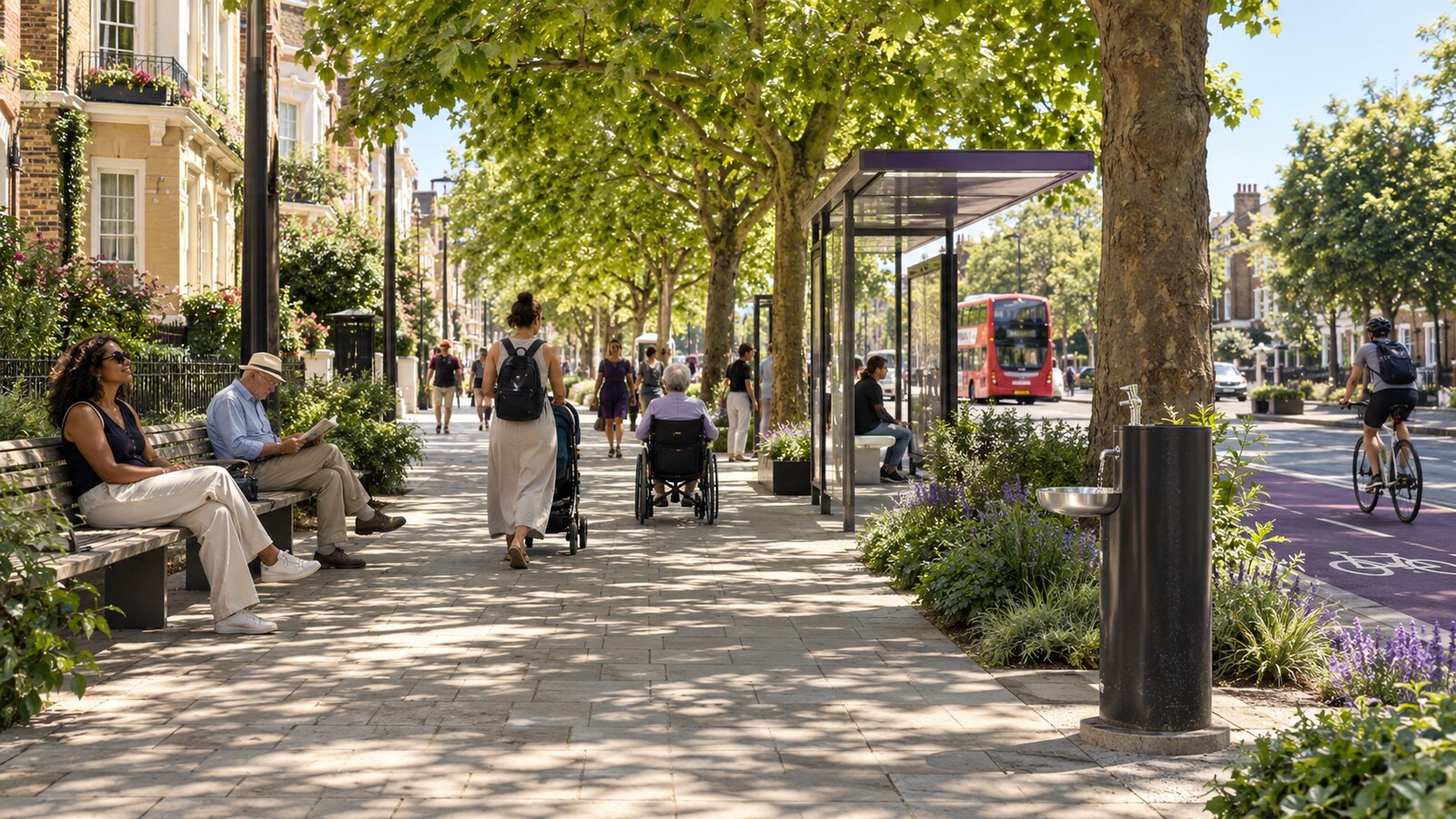
A bus stop can be marked by a pole, yet a pole does not make a usable stop. The real facility begins several metres away, where a passenger first has to reach the pavement, recognise the stop and find a safe place to wait. It continues through the kerb and bus doorway, then ends only when the vehicle has pulled away.
That wider view matters because a small obstruction can break the entire journey. A shelter may look modern but still be unusable if a bin blocks the wheelchair space. A raised kerb helps little if the driver cannot align the bus with it. A live-arrivals screen excludes people if the important information is too small, too high or available only through a smartphone. Good infrastructure is not a collection of objects; it is a sequence that has to work from end to end.
Start with the approach, not the sign
The first audit question is simple: can someone reach the stop without entering the carriageway or squeezing through a cluttered gap? Inspect the route from nearby crossings, homes, shops and public buildings. Look for broken paving, steep crossfalls, overhanging vegetation, poorly placed cabinets, parked vehicles and temporary works. A clear space at the stop is not enough when the connecting footway fails.
This is also where street management and public-transport planning meet. The Local Government Association’s Path to Inclusive Footways, an independent report prepared by Sustrans and Transport for All, argues for a disability-informed approach to footways rather than treating access as a specialist add-on. Its value is broader than any single design detail: it asks authorities to understand how real people experience the whole route.
A practical inspection should therefore include people who use wheelchairs and mobility scooters, people with sight or hearing loss, older residents, parents with buggies and anyone who finds standing difficult. A designer walking the route at noon cannot substitute for those perspectives.
Treat the boarding point as an interface
The kerb is where two systems have to meet: the street and the bus. Passengers need a level, firm waiting area and enough unobstructed room for the vehicle’s ramp where one is required. Drivers need a stopping position they can approach closely and leave safely. Traffic orders, parking enforcement and the shape of the kerb all affect whether that alignment is possible.
Active Travel England’s bus-stop guidance explicitly links inclusive provision with stop siting, raised boarding areas, shelters, seating and timetable information. That list is useful because it prevents a common mistake: concentrating on the shelter while neglecting the operational geometry.
Observe an actual bus, not just an empty road. Does it pull parallel to the kerb? Is the boarding door next to the intended clear area? Can a ramp deploy without meeting a tree pit, cycle stand or advertising panel? If several routes use the stop, does crowding push waiting passengers into the boarding zone? These are performance questions, not cosmetic ones.
Resolve cycle and pedestrian movements deliberately
Some stops place a cycle track between the footway and a boarding island, often described as a floating bus stop or bus-stop bypass. These layouts can reduce conflict between buses and cyclists, but they also create a crossing task for passengers. The needs of blind and partially sighted people, wheelchair users, people with cognitive impairments, children and cyclists cannot be assumed to align automatically.
In January 2026, the UK Department for Transport published research and design guidance on floating bus stops. It says the needs of different user groups must be considered and read alongside inclusive-mobility guidance. The sensible lesson is not that one layout is universally right or wrong. It is that crossings, priority, visibility, speed, tactile cues and the available waiting space must be designed as one system and tested with affected users.
Provide more than somewhere to stand
Waiting time is a physical demand. A seat can determine whether an older person, a pregnant passenger or someone living with pain can use the service at all. Seating should offer support, remain reachable without blocking circulation and leave a clear adjacent space for a wheelchair user or mobility aid. Where a full shelter is impossible, a perch or resting rail may still be helpful, but it should not be treated as equivalent to a supportive seat.
Shelter is equally practical. Rain should not collect where passengers board. Roofs and side panels should protect people without creating hidden corners or reducing visibility between passengers and drivers. In hot weather, shade matters; in winter, wind exposure matters. The correct balance depends on local climate, orientation, maintenance capacity and the surrounding street.
Benches and resting points are part of a wider walking network too. Active Travel England notes that places to rest help more people walk and use public space. A bus-stop seat therefore supports both the transport service and the journey to it.
Information must work without a perfect phone
A passenger should be able to answer four questions at the stop: am I in the right place, which services call here, where do they go, and when might the next one arrive? Printed timetables, stop names, route numbers and real-time displays should be positioned and presented for people with varied sight, height and reading ability. Reflections on glass, poor contrast and small type can make technically present information functionally absent.
Digital information is valuable, but an app cannot be the only channel. Phones run out of power; mobile data can fail; some passengers do not own a suitable device; and not every interface works well with assistive technology. Audio and visual information should complement one another where practicable. Changes and diversions need an accessible physical notice at the point where the passenger encounters them.
Lighting and personal security are service features
A stop that feels acceptable at 10am may become unusable after dark. Audit lighting at passenger height and along the approach, not merely whether a lamp column exists nearby. Check whether faces, the timetable and the approaching bus can be seen without harsh glare. Remove vegetation or advertising that creates concealed spaces, while preserving useful weather protection.
Location also affects perceived safety. Passive surveillance from homes and shops, a clear view along the road and reliable information about waiting time can all reduce uncertainty. These measures do not eliminate harassment or crime, but they can make the environment more legible and give passengers better choices.
Maintenance is part of the original design
A stop is not inclusive on opening day only. Drainage channels fill, paving settles, glass is damaged, lighting fails and foliage grows. Posters can cover route information. Shared e-scooters, bins and works barriers can appear in the clear zone. A robust design assigns responsibility for inspections, fault reporting and response times before problems occur.
Temporary arrangements deserve the same standard of attention. If roadworks close a stop, the replacement must be reachable and clearly signed. Passengers should not discover the diversion only after arriving. Maintenance contractors need to know which areas must remain clear for ramps, wheelchairs and pedestrian movement.
A ten-minute public audit
- Approach: walk to the stop from each likely direction and note every narrow, uneven or obstructed point.
- Identity: check that the stop name and routes are recognisable from the footway.
- Waiting space: look for a firm, level, uncluttered area that does not force people into the road or cycle track.
- Boarding: watch a bus arrive and check door alignment, kerb access and ramp clearance.
- Seating: confirm there is useful support without losing wheelchair and circulation space.
- Weather: inspect shade, rain protection, wind exposure and drainage.
- Information: try to plan a journey without using a phone.
- Conflict points: identify where cyclists, pedestrians and boarding passengers cross paths.
- After dark: return in low light or review a night-time inspection with local passengers.
- Ownership: find out who receives reports about paving, shelters, signs, lighting and vehicle operations.
Evidence, judgement and the limit of a checklist
The evidence base supports a whole-journey approach: official guidance repeatedly connects stop location, boarding, seating, shelter and information, while the UK government’s inclusive transport strategy evaluation frames equal access as a transport-system goal rather than a single-feature exercise.
Judgement is still required. Streets differ in width, traffic, climate and passenger demand. A checklist can expose omissions, but it cannot decide every trade-off. The strongest process combines standards, observation, collision and complaint data, maintenance records, driver experience and paid participation from disabled passengers.
The most important change is conceptual: stop measuring a bus stop by whether its pole and shelter exist. Measure whether different people can approach, understand, wait, board and leave with dignity. That is the difference between street furniture and functioning public infrastructure.
Featured image disclosure: conceptual AI-generated editorial illustration created for this article. It is not a photograph of a specific bus stop or documented event.
Discover more from Marychuks.com AI, Psychology, Business & CreativeVerse
Subscribe to get the latest posts sent to your email.