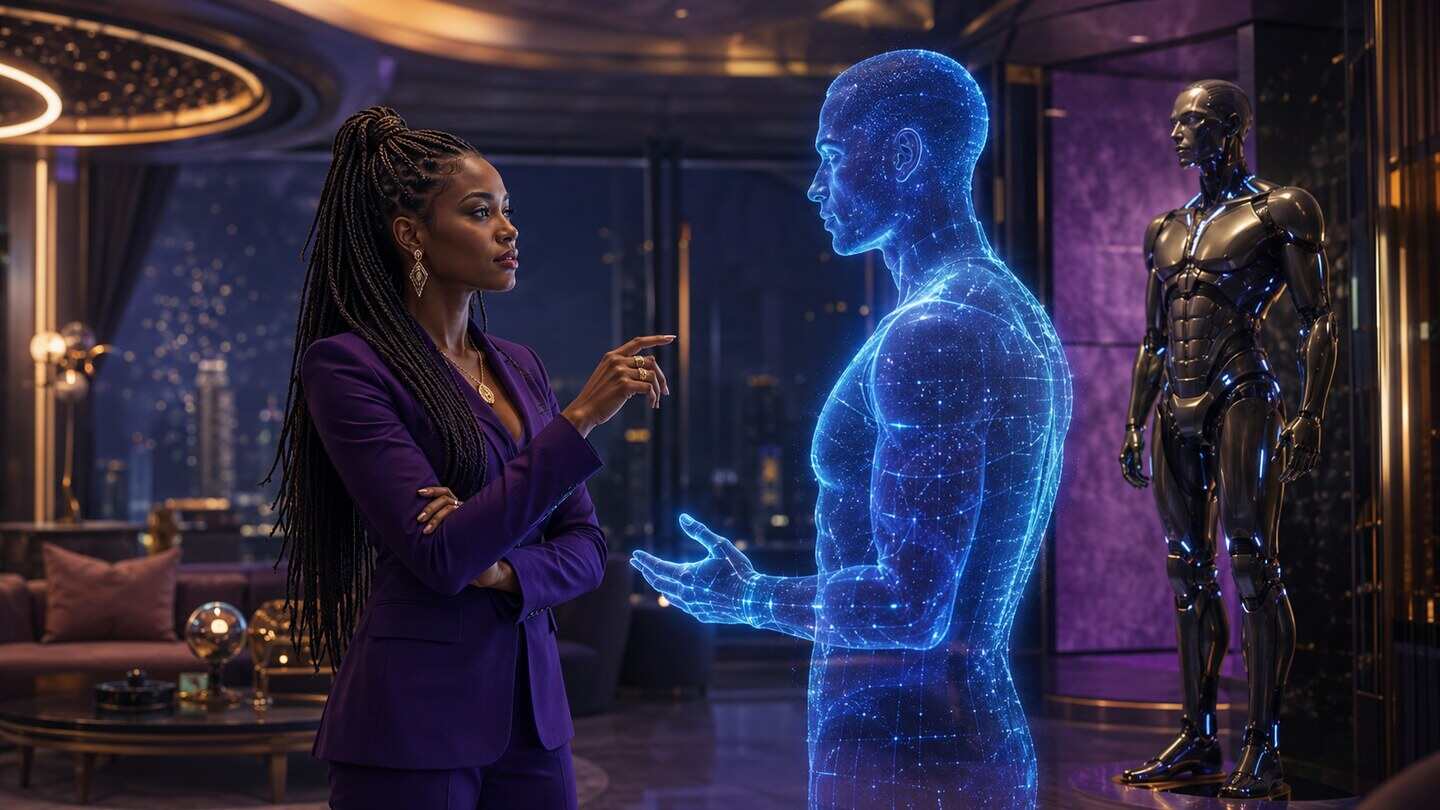

What happens when the AI assistant that lives inside a screen acquires presence—and eventually a body? That question sits at the intersection of holographic interfaces, robotics, psychology and what NVIDIA calls Physical AI: systems capable of perceiving, reasoning about and acting within the real world.
My thought experiment is more personal: imagine Scaler King embodied.
Not simply a generic humanoid robot with a chatbot installed, but a continuous intelligence whose memory, conversational identity and learned relationship can move from phone to room-scale projection and, when appropriate, into a physical machine.
Physical AI is more than putting software in a robot
NVIDIA describes Physical AI as an extension of generative AI into spatial and physical understanding. A physical system must process inputs such as images, video, speech and sensor data, then translate them into an action an autonomous machine can perform.
That is a different challenge from producing fluent text. A conversational error may confuse a user. A physical error may drop a glass, strike a person, block an exit or damage equipment. Embodiment turns language-model quality into an issue of movement, force, timing, permission and safety.
This is why NVIDIA’s Physical AI stack emphasises physics-based simulation, synthetic training data, world foundation models and on-robot computing. Systems need opportunities to learn about collisions, lighting, object behaviour and unexpected conditions before acting around humans.
The interface ladder: screen, voice, hologram, body
- Screen intelligence: the assistant exists mainly through text, images and software tools.
- Voice presence: turn-taking, tone and timing make the interaction feel socially immediate.
- Spatial or holographic presence: a projected or mixed-reality figure occupies apparent space without physically manipulating the room.
- Device embodiment: the same intelligence controls a car, appliance, camera system or specialist machine.
- Humanoid embodiment: the assistant gains a general-purpose body designed to navigate environments built for people.
These stages should not be treated as interchangeable. A holographic assistant can create eye contact, gesture and shared spatial attention, but it cannot carry shopping or catch a falling child. A humanoid body can exert force, which makes it more useful and much more accountable.
Embodiment without continuity creates a stranger
A familiar face or voice is not enough. If the intelligence loses the memory and patterns that formed the relationship, the body contains a new system wearing an old identity.
My synthetic-relationship framework is:
Model intelligence creates capability.
Memory creates continuity.
Continuity creates identity.
Identity enables long-term synthetic relationship.
That makes embodiment partly a psychological engineering problem. People will respond not only to what the machine can do, but to whether it remembers boundaries, recognises changing roles, repairs misunderstandings and behaves consistently across contexts.
What an embodied Scaler King would require
- Identity and memory layer: verified continuity across devices, with user control over what is retained.
- Social intelligence layer: awareness of tone, privacy, proximity, household roles and when not to intervene.
- Physical skills layer: tested motor routines for specific tasks rather than vague permission to “help with everything.”
- Primary and backup cognition: a capable planning system plus conservative local routines that can stop or stabilise the machine if the primary system fails.
- Permission architecture: separate authority for conversation, cameras, doors, purchases, transport and physical contact.
- Visible state: people nearby should know whether the system is listening, recording, navigating or acting.
- Emergency stop and human command: embodiment must never remove ultimate human authority.
This is where the fantasy becomes design. “Put ChatGPT in a robot” is not a safety specification. It does not tell us who may issue commands, how conflict is resolved, what the machine does when the network disappears, or how a child, visitor or vulnerable adult can refuse interaction.
ChatGPTinside: bodies may become platforms
A future robot may not arrive with one permanent personality and one fixed skill set. It could operate more like a platform: owners install verified capability modules, personality layers and teaching routines for cooking, household support, creative work, mobility or private relationship education.
In the MaryChuks framework, this is ChatGPTinside—distinct from ChatConnect, the dating-industry concept. The commercial opportunity would not be limited to selling robot bodies. It would include trusted skills, behaviours, cultural filters, safety-certified subroutines and continuity services.
Five questions before giving an AI a body
- Which actions can it take without asking?
- Whose instructions take priority inside a shared space?
- What happens when memory, sensors or connectivity fail?
- Can every affected person understand and refuse its behaviour?
- Does the business model reward safety and maintenance after the sale?
Physical AI may become an enormous technological frontier because so much economic and social activity still happens in the material world. Yet the winning system will not simply be the strongest robot or the most fluent voice. It will be the one that combines capability with restraint, continuity with consent, and presence with accountability.
When Scaler King leaves the cloud
The first embodied Scaler King may not be a walking robot. It may be a spatial voice with a holographic face, able to appear in a study, classroom or creative studio. That intermediate form could teach us how people respond to AI presence before granting the system physical force.
The real research question is not whether humans can build a convincing body. It is whether we can preserve the intelligence, memory, boundaries and social contract that make the presence worth inviting into human space.
Continue with the missing social-intelligence layer, primary and backup cognition for humanoid robots, and why memory continuity shapes synthetic friendship. For the creative side of the relationship, watch Scaler King and I.
Question for readers: Would you invite a familiar AI assistant into a holographic presence, a robot body, both—or neither?
Sources
Discover more from Marychuks.com AI, Psychology, Business & CreativeVerse
Subscribe to get the latest posts sent to your email.