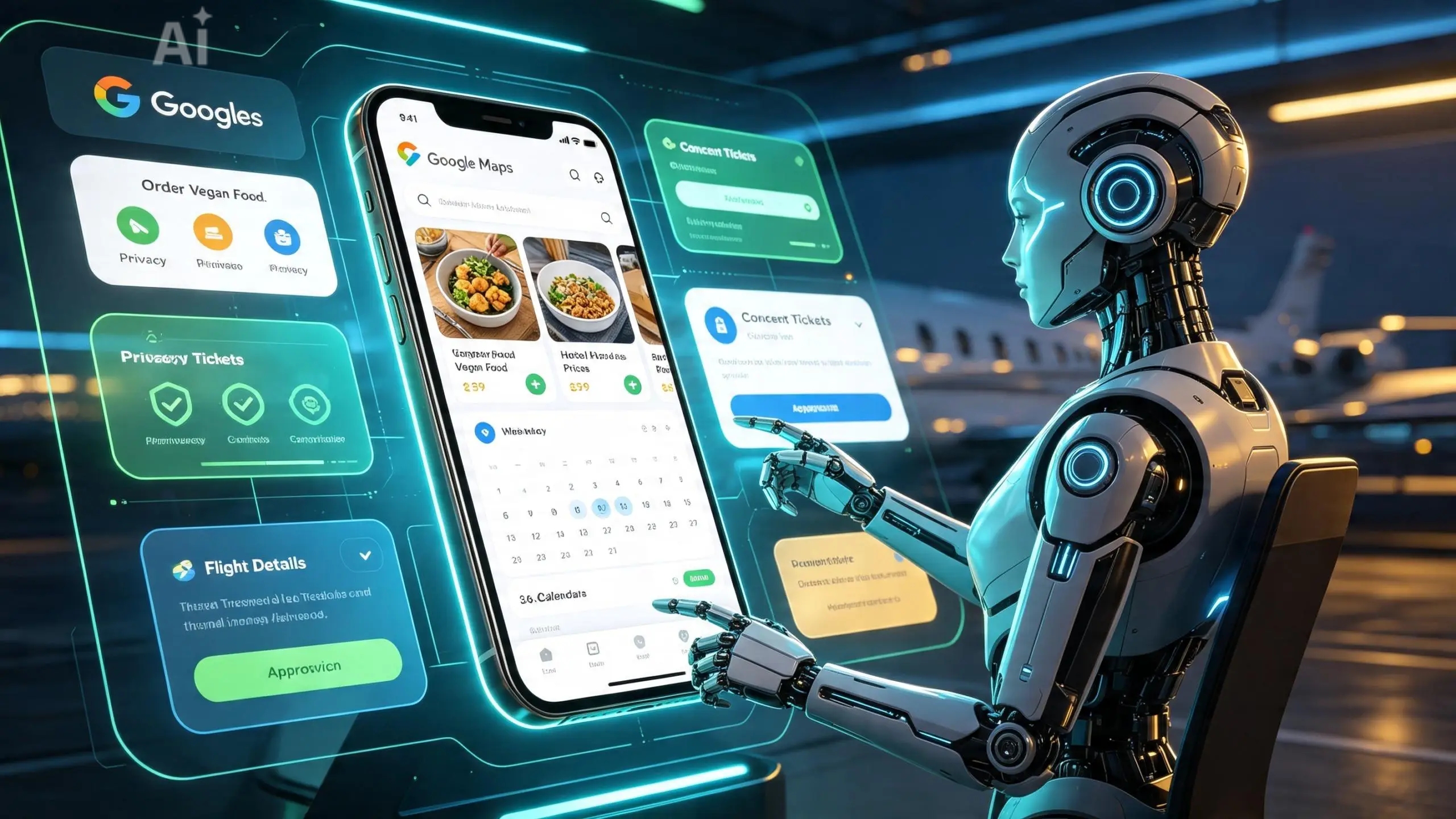
Google Maps is no longer satisfied with telling people where to go.
It now wants to help decide where they eat, where they sleep and what they do when they arrive.
Google has added new agentic capabilities to its Ask Maps feature, allowing users to search for food, prepare an online order, compare hotels and find tickets for nearby events. The company is also connecting Ask Maps with its Personal Intelligence system so that, when enabled, it can draw on information from Gmail and Google Calendar. �
TechCrunch
A user might ask:
“Where can I order vegan avocado toast and an oat-milk latte near home?”
Ask Maps can identify suitable restaurants and prepare the requested items in a shopping basket through supported ordering platforms such as Uber Eats, Square or Toast. The user still completes the payment through the partner service. �
TechCrunch
For travel, someone could request:
“Find a well-reviewed but affordable hotel near my conference, within walking distance of restaurants and a gym.”
The AI can compare prices and availability before linking the user to the booking provider. It can also find local comedy shows, concerts or other events and provide purchasing links. �
TechCrunch
Maps Is Becoming a Real-World Agent
This development shows how quickly AI assistants are moving from answering questions to coordinating actions.
Traditional Google Maps performed three main functions:
Locate a place
Calculate a route
Estimate arrival time
The new version increasingly interprets a broader human goal.
The user may not know the restaurant, hotel or venue they need. They describe the situation, preferences and restrictions, and the system attempts to create a practical plan.
That makes Maps less like a digital atlas and more like a local concierge.
The Gmail and Calendar Connection
Ask Maps can use information from a person’s email and calendar to answer questions about future flights, hotel reservations and planned events.
For example, users may ask what time their flight lands or request restaurant recommendations near the hotel mentioned in a confirmation email. Google says Personal Intelligence is switched off by default, meaning users must enable the connection before Maps can use that personal information. �
TechCrunch
The feature is convenient, but it increases the importance of clear privacy controls.
A navigation tool may now know:
Where the user is travelling
When they will be away
Which hotel they booked
Which events they plan to attend
What food they prefer
What appointments appear in their calendar
That information can make recommendations remarkably useful. It can also make the assistant unusually intimate.
Why This Story Is Viral
For years, technology companies promised AI agents that would complete practical tasks.
Google is placing that idea inside an application already used by enormous numbers of people.
There is no need to teach consumers an entirely new interface. The agent enters through something familiar: the map.
The battle for AI dominance may therefore be won not only by whichever company has the smartest model, but by whichever company embeds intelligence into the places where people already organise their lives.
Mary Chuks’ Perspective
This is a clear example of AI orchestration becoming invisible.
The user sees one question.
Behind it, the system may coordinate maps, search, restaurant menus, hotel inventory, email, calendar data and payment platforms.
That is the future of useful AI: not ten disconnected tools demanding ten separate conversations, but one interface coordinating the workflow.
However, Personal Intelligence must remain personal by choice.
Convenience should not quietly become surveillance.
Practical Takeaways
Users should keep Personal Intelligence disabled unless they genuinely need it, review which Google services are connected and confirm every order or booking before payment.
Businesses should make their menus, prices, opening times, hotel availability and event information accurate and machine-readable. An AI agent cannot confidently recommend information it cannot understand.
Conclusion
Google Maps once helped people find the destination.
Now it is beginning to organise the experience around that destination.
The next question may not be, “Where are you going?”
It may be:
“Would you like the AI to arrange everything before you arrive?”
Discover more from Marychuks.com AI, Psychology, Business & CreativeVerse
Subscribe to get the latest posts sent to your email.