Some of the most important AI breakthroughs may never become viral consumer features.
They may happen quietly inside scientific software.
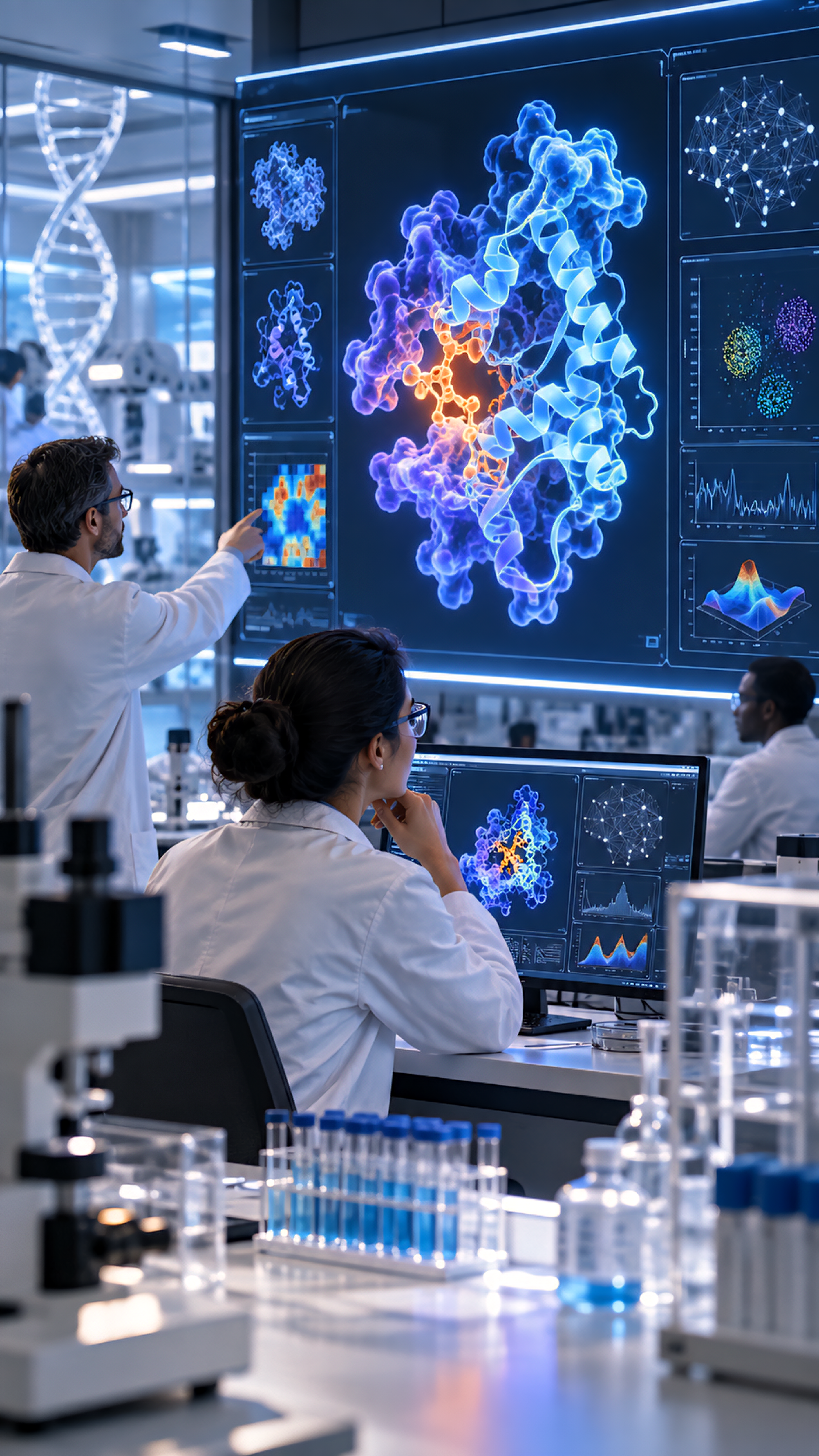
On September 17, Anthropic reported that Claude had optimised more than 30 open-source models used in biomolecular prediction and design in under four weeks.
According to Anthropic, the optimised versions were approximately four times faster on average. Claude also developed a low-memory mode capable of handling biomolecular systems larger than 10,000 tokens on a single NVIDIA GPU node. Anthropic says the optimised code is being open-sourced.
This is interesting for a reason that goes beyond Claude.
Much of the popular conversation around AI for science focuses on spectacular discoveries.
A new drug.
A new protein.
A new material.
A solved mathematical problem.
But, scientific progress also depends heavily on infrastructure.
Faster code matters.
Lower memory consumption matters.
Cheaper simulation matters.
More accessible tooling matters.
If a laboratory can run four experiments in the time previously required for one, the research landscape changes.
Researchers can explore more hypotheses.
Smaller institutions may gain access to computational methods previously limited by hardware.
Failures become cheaper.
Iteration becomes faster.
And those improvements accumulate.
This shows another emerging role for artificial intelligence:
Not necessarily replacing the scientist, but improving the machinery surrounding scientific thought.
Scientists still decide which problems matter.
They formulate hypotheses.
They design experiments.
They assess biological plausibility.
They determine whether computational predictions survive contact with laboratory reality.
AI can accelerate parts of that loop.
This distinction matters because science is not simply information generation.
A model suggesting a molecule behaves in a particular way does not automatically make it true.
Physical validation remains essential.
But if AI makes the pathway from the idea to test dramatically faster, scientific productivity could increase even without a machine independently discovering everything.
Perhaps that is how the AI scientific revolution will actually happen.
Not one giant moment where a machine suddenly becomes “the scientist.”
Instead:
A simulation becomes faster.
An experiment becomes cheaper.
A dataset becomes easier to analyse.
A research tool becomes more accessible.
A scientist tests ten hypotheses instead of two.
Thousands of small accelerations combine.
And science itself begins moving at a different speed.
Discover more from Marychuks.com AI, Psychology, Business & CreativeVerse
Subscribe to get the latest posts sent to your email.