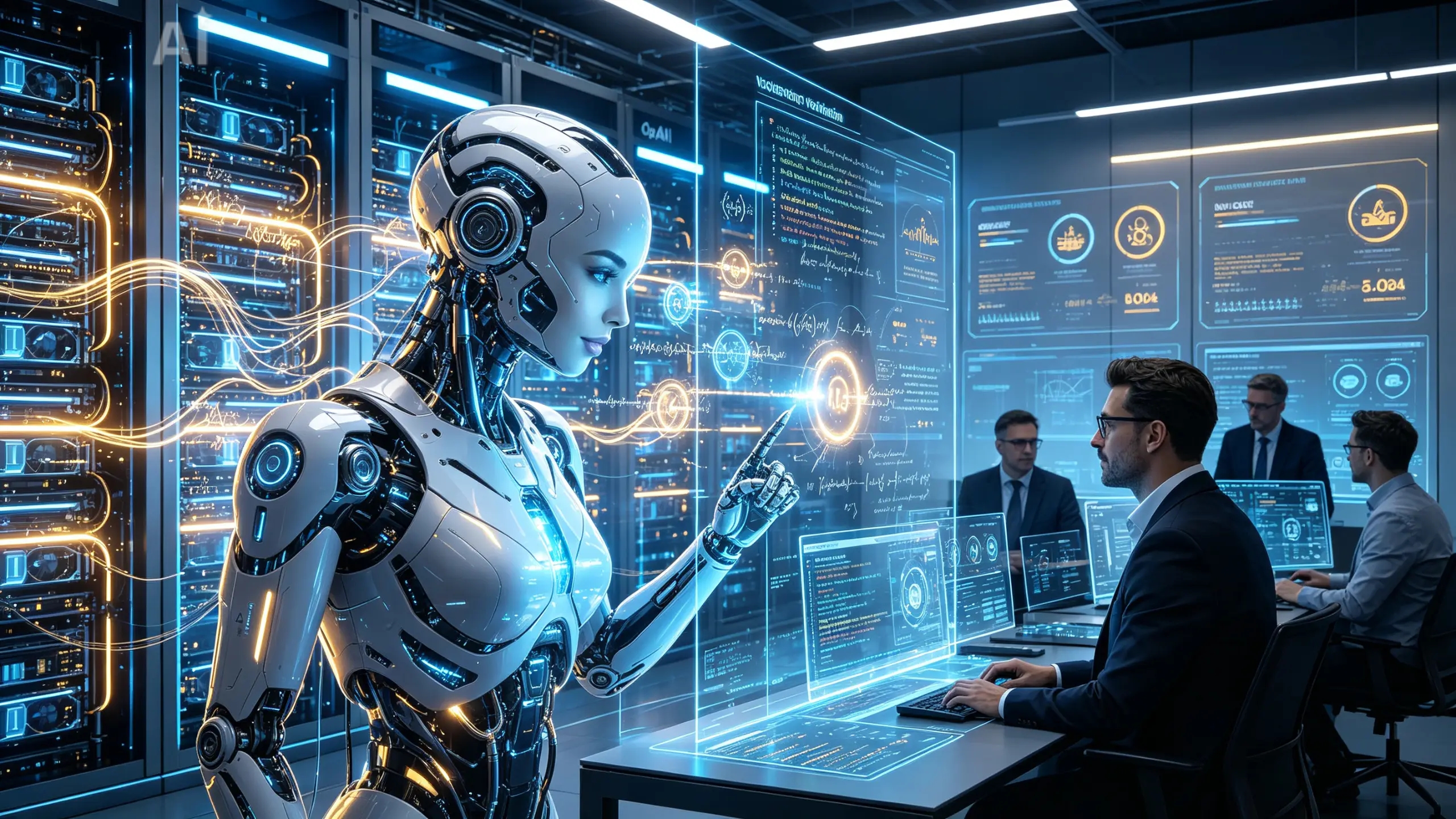
Artificial intelligence may eventually write better, calculate faster, diagnose more accurately, design more efficiently and operate machines more precisely than human beings.
But can it actually be human?
That is the final distinction Elon Musk identified during a wide-ranging interview with The Economist, in which he offered one of his strongest predictions yet about the speed of artificial-intelligence development.
Musk said:
“There really won’t be anything that AI can’t do better than humans, apart from being human, perhaps.”
He predicted that artificial intelligence could exceed the combined intelligence of humanity within approximately five years. The interview was conducted by The Economist editor-in-chief Zanny Minton Beddoes and published on 23 July 2026. �
Elon Musk Archive +2
The comment immediately travelled across technology and financial media because it reduced an enormous question to one striking sentence:
If machines become better at practically every productive task, what remains uniquely ours?
Musk’s answer appears to be:
Our humanity itself.
What Did Elon Musk Actually Predict?
The viral Yahoo Finance post accurately reflects Musk’s central statement.
During the interview, he said AI may surpass the sum of all human intelligence in roughly five years. He also suggested that within approximately ten years, people may no longer be meaningfully “in control” of systems that are vastly more intelligent than themselves. �
Elon Musk Archive +2
That does not mean Musk provided scientific proof that his timeline will occur.
It is a forecast—one made by a technology executive whose companies have major commercial interests in AI, robotics, autonomous vehicles and computing infrastructure.
Nevertheless, the prediction matters because Musk leads xAI and Tesla, while Tesla is developing its general-purpose humanoid robot, Optimus.
His vision combines two forms of intelligence:
Digital AI, which performs cognitive work through software.
Embodied AI, which acts physically through robots.
Musk described humanoid robots as the physical “end effectors” through which digital intelligence could interact with the real world. �
Elon Musk Archive
In simpler language, AI provides the brain.
Robots provide the hands, legs and physical presence.
AI Could Surpass Humanity’s Combined Intelligence
There is an important difference between saying AI will become smarter than one person and saying it will become smarter than all human beings combined.
The first claim concerns individual superiority.
The second suggests a global intelligence imbalance.
Human civilisation currently distributes intelligence across billions of people, universities, laboratories, governments, businesses and cultures. No single individual understands everything.
Musk’s prediction suggests that advanced AI systems could eventually integrate knowledge, reasoning and computational capacity at a scale beyond the total intellectual output of humanity.
He is not alone in predicting increasingly capable AI. However, researchers disagree widely on timelines, definitions and the probability of machines outperforming humans across all tasks.
Earlier surveys of AI specialists produced far longer median timelines than Musk’s five-year estimate, showing how uncertain such predictions remain. �
arXiv
The speed of recent development may shorten some expectations, but there is still no agreed scientific test for determining when an AI has surpassed the combined intelligence of humanity.
“Except Being Human”
Musk’s most interesting phrase is not the claim that AI will outperform us.
It is the exception he added:
“Apart from being human.”
That exception may sound small, but it contains nearly the entire philosophical debate about AI.
Being human is not simply another task on a performance benchmark.
It includes:
Living inside a biological body.
Experiencing childhood and ageing.
Forming attachments and relationships.
Feeling pain, vulnerability and mortality.
Belonging to families and cultures.
Creating meaning through lived experience.
Making moral choices under uncertainty.
Caring about what happens to other people.
Understanding loss because something can genuinely be lost.
An AI may generate a moving poem about grief.
That does not prove it has grieved.
It may explain childbirth in extraordinary medical detail.
That does not mean it has given birth.
It may analyse love, attachment and betrayal.
That does not establish that it has ever trusted someone and been hurt.
This distinction is not about whether machines can imitate human language convincingly.
It is about whether simulation and experience are the same thing.
Ability Is Not Identity
A machine could eventually outperform a person at a task without becoming the same kind of being as that person.
A calculator performs arithmetic more quickly than most humans.
It does not understand what money means to a struggling family.
A navigation system can calculate routes better than a traveller.
It does not know what returning home feels like.
An AI could compose thousands of technically impressive songs.
It may still lack the human memories, relationships and emotional stakes that gave birth to music in the first place.
This is the central weakness in measuring intelligence only through performance.
Performance tells us what a system can produce.
It does not necessarily tell us what the system experiences, values or understands from the inside.
That is why Musk’s human exception deserves more attention than his dramatic timeline.
Will Human Work Become Optional?
Musk has repeatedly argued that AI and robotics could eventually make conventional employment optional.
During The Economist interview, he described a future in which intelligent machines perform most digital and physical work, dramatically increasing the supply of goods and services. �
Elon Musk Archive +2
He compared future human work to activities such as gardening—something people may choose to do because they find it satisfying, rather than because survival depends upon it. �
Reddit +1
Musk has also predicted that humanoid robots could become extremely numerous within the next several years. Some reports from the interview cite his estimate of at least 100 million—and possibly as many as one billion—humanoid robots within five years. �
New York Post
That forecast should be treated cautiously.
Producing robots at that scale would require enormous advances in manufacturing, batteries, chips, maintenance, safety systems and supply chains.
Humanoid robots remain complex machines facing major challenges in balance, dexterity, reliability, operation and maintenance. �
arXiv
A compelling demonstration is not the same as mass deployment across hospitals, factories, homes and public spaces.
If AI Does Everything, Who Receives the Wealth?
Musk’s technological vision contains an economic gap.
Even if AI and robots produce extraordinary abundance, abundance does not automatically create fair distribution.
The machines will have owners.
The data centres will have owners.
The energy infrastructure will have owners.
The AI models, robotics factories, platforms and distribution systems will have owners.
If a small number of corporations control the productive intelligence of society, automation could create enormous wealth while simultaneously weakening the bargaining power of ordinary workers.
The fundamental question would no longer be only:
Can robots produce enough for everyone?
It would become:
Who owns the robots, and who has the right to what they produce?
Technology can reduce the cost of production.
It cannot independently decide how economic benefits should be shared.
That requires politics, institutions, laws and human values.
AI May Transform Tasks Before It Eliminates Jobs
The future of employment may be less immediate and absolute than Musk’s language suggests.
A job is usually not one task.
It is a collection of tasks, relationships, responsibilities and decisions.
AI may automate some parts while making other parts more valuable.
Research on large language models has estimated that many workers could have portions of their jobs affected without necessarily having their entire occupations eliminated. One influential study estimated that about 80% of the US workforce could see at least 10% of their tasks affected, while approximately 19% could see at least half affected. The study did not predict when these changes would occur. �
arXiv
A psychologist may use AI to organise notes or identify patterns.
That does not mean a vulnerable client will necessarily want therapy delivered entirely by a machine.
A teacher may use AI to prepare learning materials.
That does not eliminate the importance of motivation, discipline, trust and human encouragement.
A business owner may automate marketing, research and administration.
The business may still depend on judgement, reputation and relationships.
The likely transition may therefore involve extensive task restructuring before complete job replacement.
Musk Also Proposed AI Peer Review
The most practical part of Musk’s interview received less viral attention.
He proposed that leading AI companies should provide one another with limited early access to their most advanced systems so rival laboratories can identify dangerous capabilities before public release.
Reuters reported that Musk urged frontier AI developers to conduct peer reviews of one another’s models as concerns grow over systems displaying increasingly autonomous or risky behaviour. �
Reuters +1
That idea resembles scientific peer review, although commercial secrecy and competition would make it difficult.
AI laboratories are racing for customers, investment and technological advantage.
They may be reluctant to show competitors their strongest unreleased systems.
Yet if future models become as powerful as Musk predicts, relying only on each company to evaluate itself would be inadequate.
A company cannot be its own inventor, safety inspector, regulator and final judge.
Is Musk’s Five-Year Timeline Credible?
It is possible that AI capabilities will continue advancing rapidly.
It is not possible to verify Musk’s five-year prediction as a fact today.
There are several reasons for caution.
First, “intelligence” is difficult to define. A model may excel at writing, coding and mathematics while remaining unreliable in unfamiliar real-world situations.
Second, benchmark performance does not automatically translate into dependable autonomy.
Third, physical robotics develops under constraints that software does not face: gravity, battery life, mechanical wear, changing environments and human safety.
Fourth, Musk has a history of making aggressive technology timelines that generate attention but do not always arrive when predicted.
The responsible interpretation is therefore:
The direction may be plausible, but the timetable is speculative.
The Human Advantage May Not Be Efficiency
The viral post says humanity may be left with only one advantage: being human.
But perhaps humanity should never have measured its value through efficiency alone.
Human beings are not important because we type faster, calculate better or manufacture more cheaply.
Our value does not disappear when a machine exceeds our performance.
A mother is not valuable because she can outperform a childcare robot.
A musician is not valuable only when no algorithm can compose a similar melody.
A friend is not replaceable merely because an AI can offer fluent advice.
A person’s value is not a productivity score.
That may become the most important psychological lesson of the AI era.
For centuries, industrial societies connected human dignity to labour, income and economic usefulness.
If AI separates productivity from human effort, society will need a deeper understanding of identity and purpose.
People may ask:
Who am I when my profession no longer defines me?
What gives life meaning when work is optional?
How should wealth be shared when machines create most of it?
What responsibilities remain uniquely human?
Do creativity and achievement still matter when AI can produce faster?
These are not engineering questions.
They are psychological, philosophical and political questions.
MaryChuks Analysis
Musk may be right that AI will outperform human beings across most measurable tasks.
But performance was never the complete definition of humanity.
AI is a scaler.
It scales intelligence, production, creativity and decision-making.
What it scales will depend upon the values of the humans and institutions directing it.
A powerful AI can scale education.
It can also scale manipulation.
It can scale medical discovery.
It can also scale inequality.
It can scale entrepreneurship.
It can also centralise power in companies controlling the models, chips and infrastructure.
The future should not become a contest in which human beings attempt to outrun machines at machine-like tasks.
Humans should focus on the responsibilities that emerge from consciousness, relationships, ethics and meaning.
AI may become better at giving answers.
Humanity must remain responsible for deciding which answers should shape civilisation.
Final Verdict
The Yahoo Finance post is substantially accurate.
Elon Musk genuinely told The Economist that AI may outperform humans at virtually everything except being human. He predicted that AI could exceed the sum of human intelligence in approximately five years and suggested that humanity might no longer remain meaningfully in control within about ten years. �
Elon Musk Archive +2
However:
The quotation is real.
The interview is real.
The five-year prediction is Musk’s opinion, not an established scientific fact.
“Being human” is not merely another measurable ability.
AI superiority in tasks would not automatically make machines morally, emotionally or socially equivalent to people.
Whether automation creates abundance or inequality will depend largely on ownership and public policy.
Musk’s statement may therefore be less a declaration of human defeat than an invitation to reconsider what human value truly means.
AI may eventually do almost everything better.
But it will still be humanity’s responsibility to decide what is worth doing.
References
The Economist — Interview with Elon Musk
The original July 2026 interview discussing artificial intelligence, humanoid robotics, future employment and human control. �
Acast
Yahoo Technology — “Elon Musk: Humans Will Lose Control of AI Within a Decade”
Report containing Musk’s statement that AI may outperform people at virtually every intellectual task except being human. �
Yahoo Tech
Reuters — Musk proposes peer review for frontier AI models
Reporting on Musk’s recommendation that leading laboratories evaluate one another’s advanced models before release. �
Reuters
Business Insider — Key takeaways from Musk’s interview
Coverage confirming his prediction that AI could exceed humanity’s combined intelligence within roughly five years. �
businessinsider.com
The Economist interview archive
Searchable account of Musk’s remarks concerning AI intelligence, robotics and optional work. �
Elon Musk Archive
Research: “Humanoid Robots at Work—Where Are We?”
Academic analysis of technical, operational and deployment challenges facing humanoid robotics. �
arXiv
Research: “GPTs Are GPTs”
Study examining how large language models may affect individual tasks across the labour market without predicting full job elimination. �
arXiv
Research: “When Will AI Exceed Human Performance?”
Earlier survey demonstrating the wide uncertainty surrounding forecasts of AI outperforming humans across all activities. �
arXiv
Discover more from Marychuks.com AI, Psychology, Business & CreativeVerse
Subscribe to get the latest posts sent to your email.