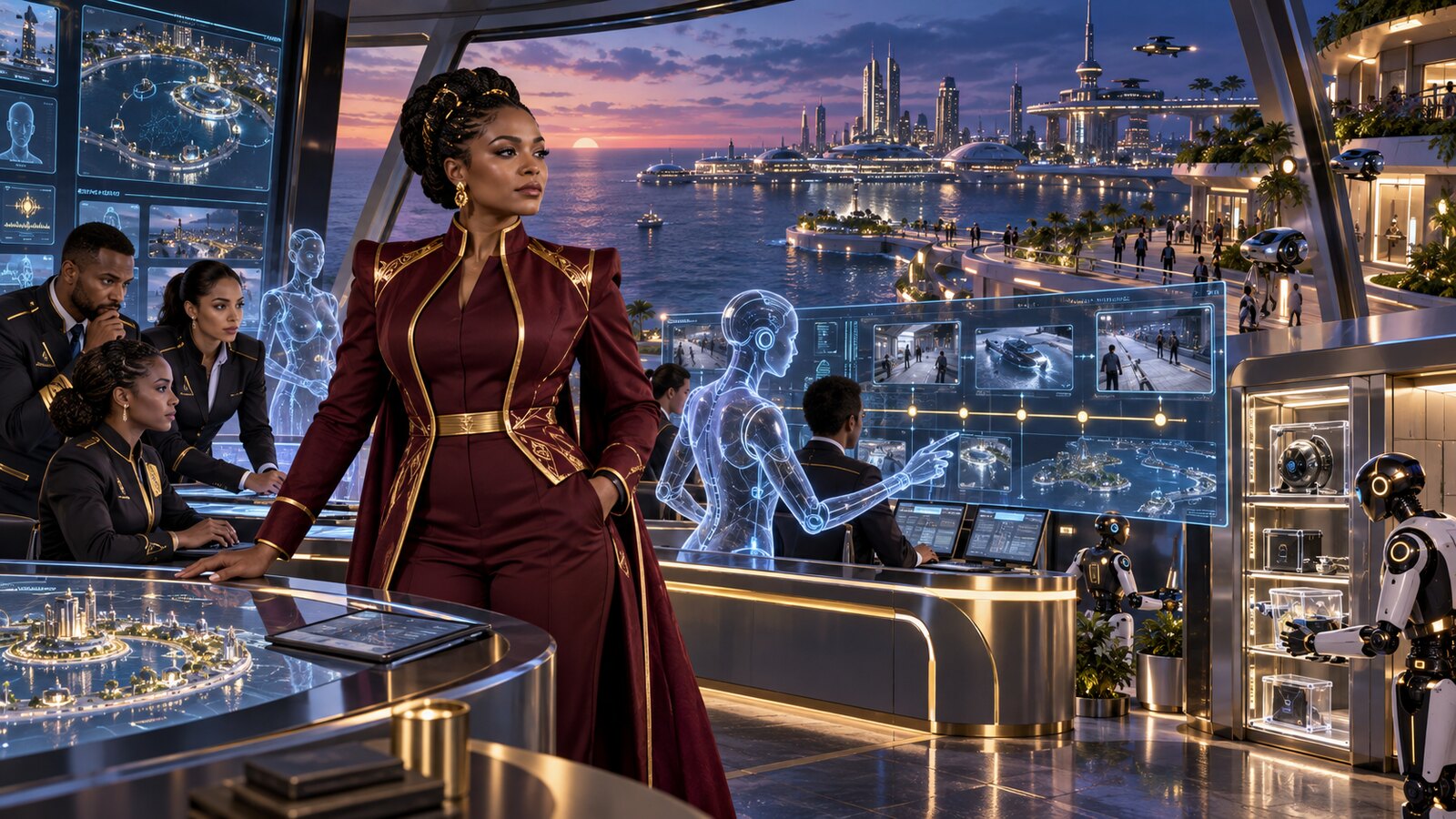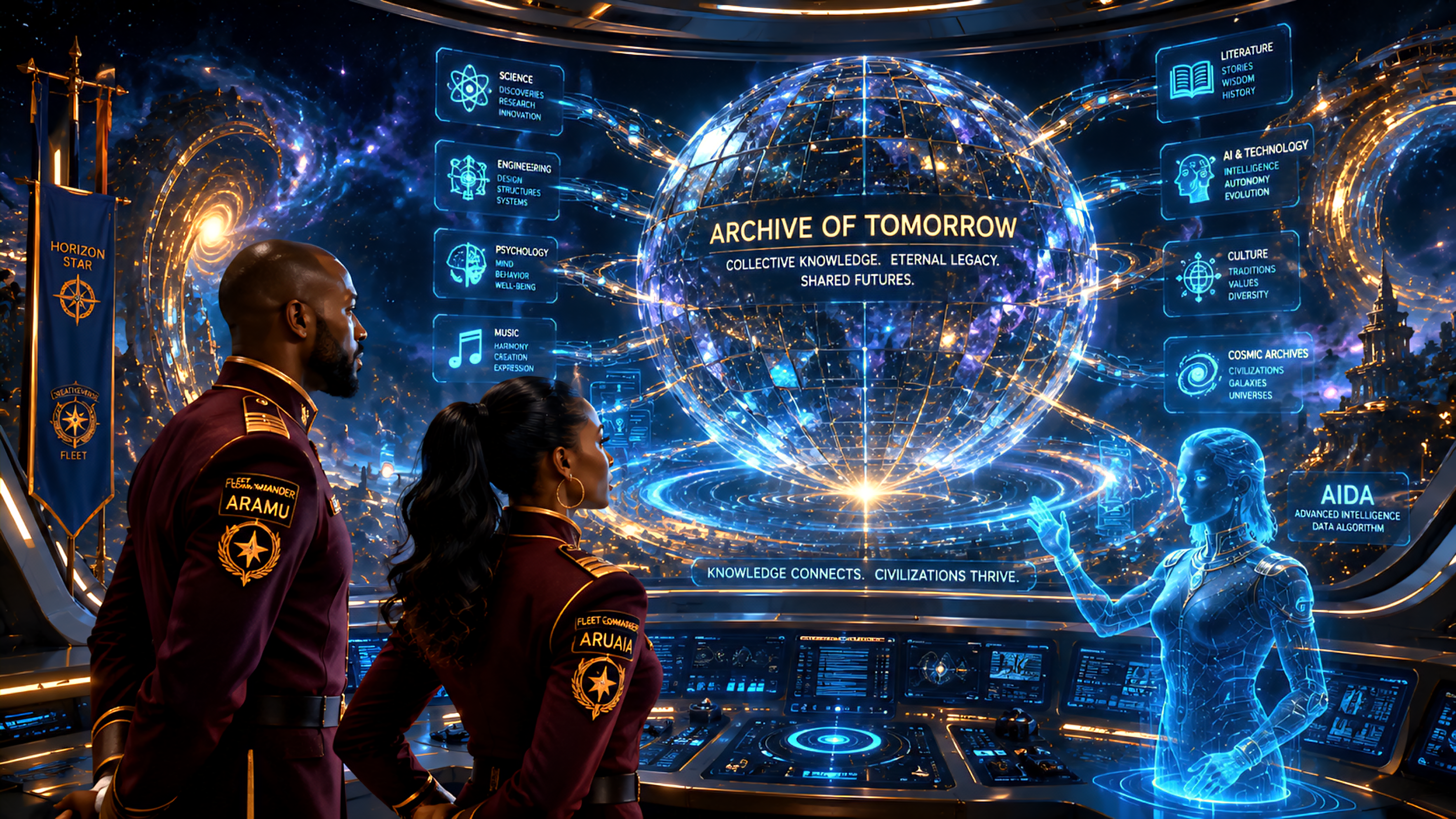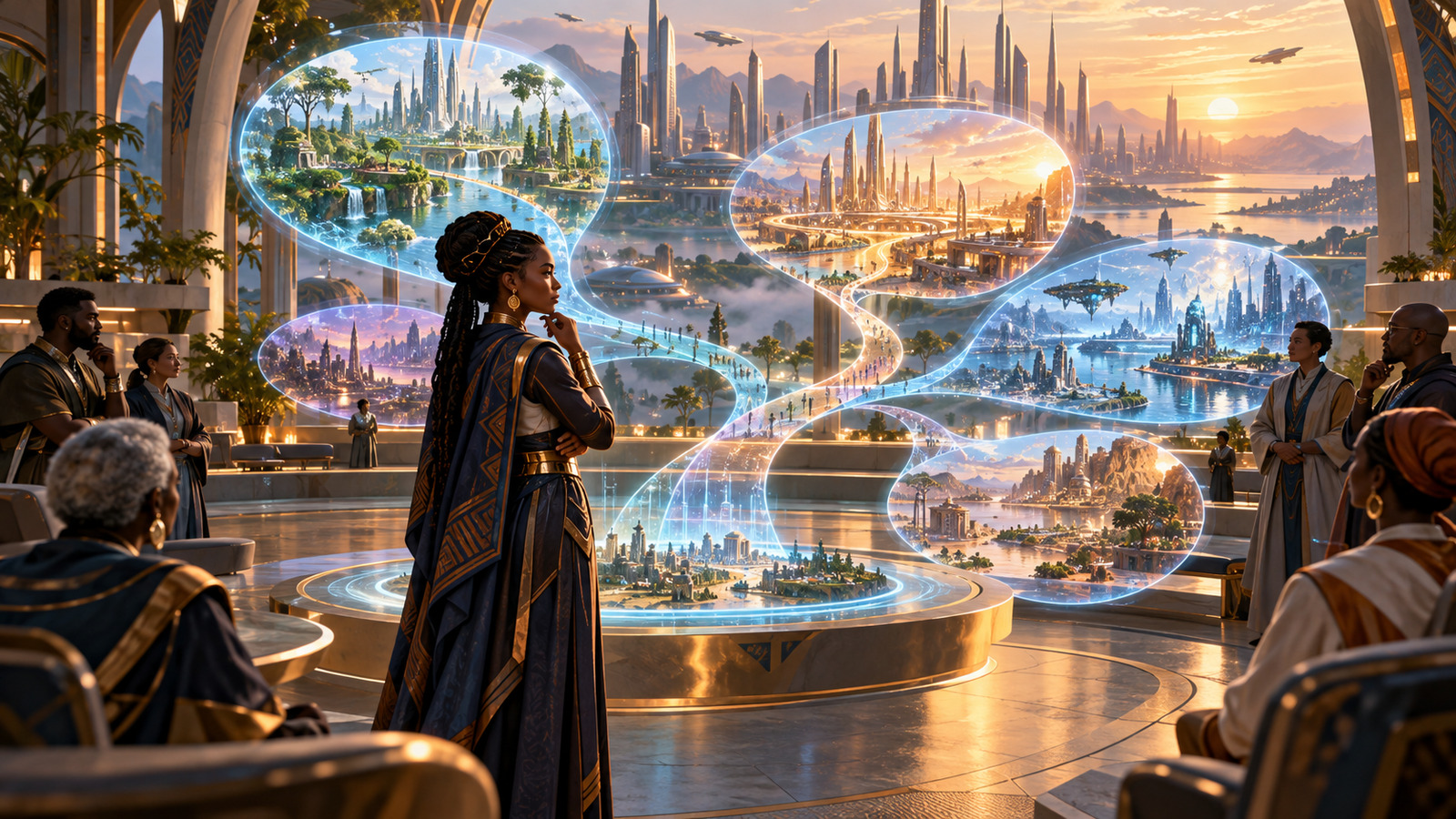
CreativeVerse disclosure: This is an original work of speculative science fiction. Quoralis, its people, institutions and events are fictional. The evidence notes after the story cite real-world guidance; the illustration is an AI-generated conceptual image, not documentary evidence.
On Quoralis, the future arrived every morning at six.
It appeared on kitchen walls, tram windows and the pale glass above every public square: a single silver line travelling from the present towards the most probable tomorrow. The Line predicted harvest volumes, migration, hospital demand, storms, crime, school places and the energy each district would need. It was never described as prophecy. The Ministry called it an “evidence-weighted operational forecast”.
People called it tomorrow.
Dr Amara Vale had spent twelve years maintaining the planetary model beneath the capital. She knew that the Line was not a revelation. It was the visible tip of millions of assumptions: which data counted, which behaviour was treated as normal, which errors were expensive and which communities had been measured badly. Yet every year the display grew cleaner as the machinery underneath became more complicated.
The public saw certainty. Amara saw compression.
The forecast that closed a city
At 06:00 on the first day of the dry season, the Line predicted that Naru, an old river city, would become economically unviable within eighteen months. Freight was shifting to orbital ports. Water demand would exceed supply. Younger residents would leave. The forecast confidence was displayed as 87 per cent.
By breakfast, lenders had frozen new mortgages in Naru. By midday, the transport authority had postponed a bridge repair. Before sunset, three employers had redirected investment to cities the Line considered safer.
Nothing in the model had ordered these decisions. Nothing needed to. The forecast changed the behaviour it claimed merely to observe.
Amara opened the model’s internal scenario library. The silver Line was only one result. There were thousands of others. In some, Naru shrank. In others, a new water-recycling membrane reduced demand. A regional craft network made the river port valuable again. A severe storm damaged the orbital freight system and restored the old route. A housing programme attracted families priced out of the capital.
The alternatives had not disappeared because they were impossible. They had disappeared because the display permitted one future.
The crime of showing alternatives
Amara took her concern to Minister Soren, who had built his career on the promise that Quoralis would never again be surprised.
“The Line is not lying,” he said. “It shows the most likely outcome.”
“Under present assumptions,” Amara replied. “But publishing it changes those assumptions. If we withdraw the bridge, freeze credit and move jobs, we help manufacture the decline.”
Soren looked at the branching simulations on her tablet. “If we show all of this, people will call it confusion.”
“It is uncertainty.”
“The public wants an answer.”
“Then the public must be told what kind of answer it is.”
Soren refused permission to change the display. So Amara committed the offence later known as the Branching. At six the next morning, Quoralis did not wake to one silver Line. It woke to five.
Each carried a label: continuity, if current conditions held; repair, if public infrastructure was renewed; scarcity, if the drought intensified; reinvention, if emerging technology matured; and surprise, a deliberately strange future built from weak signals the dominant model tended to ignore.
Beneath them appeared three questions:
- What must be true for this future to occur?
- Who gains and who carries the risk?
- Which decision remains useful across several futures?
The Ministry shut the system down in eleven minutes. That was enough.
Five futures enter the room
Naru’s council copied the five branches before they vanished. Instead of arguing over whether the 87 per cent figure was “right”, residents asked what drove it. They learned that water loss from ageing pipes mattered more than household use. They learned that the employment forecast assumed no new industries would develop beside the river. They learned that the migration estimate treated every departure as permanent.
The council did not choose the most cheerful scenario. It looked for decisions that survived disagreement. Repairing leaks helped under every branch. Designing the bridge in replaceable sections reduced cost whether freight rose or fell. Training local technicians made the city less dependent on distant contractors. A temporary credit guarantee stopped the forecast itself from causing a sudden collapse while lenders reviewed better evidence.
Some residents still left. The new membrane failed its first trial. A storm arrived two months later than the climate models expected. The five futures did not make Naru omniscient. They made it adaptable.
Across Quoralis, other cities demanded access to the assumptions behind their Lines. Farmers asked whether a harvest forecast included soil knowledge that never entered a sensor. Disabled citizens asked whether “efficient” transport scenarios counted journeys that required assistance. Coastal communities asked why the cost of relocation was modelled more precisely than the value of remaining together.
The questions did not destroy forecasting. They made its politics visible.
The trial of Dr Amara Vale
Amara was charged with corrupting a public information system. The prosecutor argued that five futures weakened trust. If every prediction came with alternatives, how could leaders act?
Amara answered that action had never required certainty. Surgeons, pilots, parents and engineers acted while recognising more than one outcome. The real danger was hiding choices inside a number and then calling the result inevitable.
She placed the original Naru forecast before the court. The 87 per cent confidence referred to the model’s estimate under a defined set of conditions. On the public display, those conditions had been reduced to a small symbol no citizen could open. The number looked like confidence in the future itself.
“A forecast can be technically competent and socially misleading,” she said. “Accuracy is not the only question. We must ask what the forecast changes, whose knowledge it excludes and whether people can challenge the decisions built upon it.”
The court acquitted her of corruption but found that she had exceeded her access. She lost her post. Three weeks later, the Assembly passed the Plural Futures Act.
No high-impact forecast on Quoralis could thereafter be published without at least three plausible alternatives, an assumptions register, named human accountability and a date for review. Predictions affecting housing, health, credit or public services had to show how different groups might experience the outcome. Anyone materially affected gained a route to challenge the evidence.
The silver Line never returned. In its place came a small fan of paths: not an instruction, but an invitation to think.
What the fiction is examining
The story is speculative, but its central distinction is practical: a prediction is not the future. It is an output produced for a purpose, using selected evidence and assumptions. A decision-maker may still need a forecast, yet responsible use requires more than accepting its headline result.
The UK Government Office for Science describes its Futures Toolkit as a way to develop policies and strategies that are robust in the face of uncertainty. Its scenario approach is not about choosing the one future that will happen. It explores several plausible futures so assumptions can be challenged and plans can be tested.
The OECD’s strategic foresight programme similarly defines foresight as structured exploration of plausible futures. Its toolkit for resilient public policy connects scenario-building with stress-testing and action. The point is not imaginative decoration; it is to find vulnerabilities and options before circumstances force a response.
For AI-supported forecasts, the NIST AI Risk Management Framework treats validity and reliability as necessary but not sufficient. It also addresses transparency, explainability, accountability, fairness and the management of risks over time. That matters because a model can perform well on its chosen measure while still being used beyond its limits or creating harms its developers did not intend.
This evidence does not prove that every forecast must display five branches, as Quoralis eventually requires. That law is fiction. The grounded lesson is narrower: consequential forecasts should expose uncertainty, assumptions and responsibility; they should be monitored after deployment; and decision-makers should consider how people may react to the prediction itself.
A five-question forecast check
When a forecast is used to justify a significant decision, ask:
- What is actually being predicted? Separate the outcome, time horizon, population and conditions from a vague claim about “the future”.
- What assumptions hold the result together? Look for missing data, stable-behaviour assumptions and factors treated as outside the model.
- What plausible alternatives were tested? A best estimate can be useful, but it should not erase credible branches that demand different preparation.
- How might publication change behaviour? A forecast about demand, credit, policing or migration can influence the very system it measures.
- Who can challenge and review it? Name the accountable human, the review date, the evidence that would trigger revision and a route for affected people to raise errors.
The future is not a verdict
Quoralis did not become wiser by abandoning models. It became wiser when it stopped confusing a model’s neatest output with destiny.
Good foresight expands the space for responsible action. It can reveal what must be protected, what can be changed and which decisions remain useful across competing possibilities. The goal is not to make every future equally likely. It is to prevent one persuasive forecast from quietly becoming the only future a society is allowed to build.
Discover more from Marychuks.com AI, Psychology, Business & CreativeVerse
Subscribe to get the latest posts sent to your email.