CreativeVerse fiction notice: The characters, ship, events and technologies in this story are speculative. The factual afterword identifies the real NASA and ESA research that inspired parts of the setting.
The Day Waste Became Illegal
The first alarm on the Horizon Star was not for fire, collision or decompression. It was for a missing spoon.
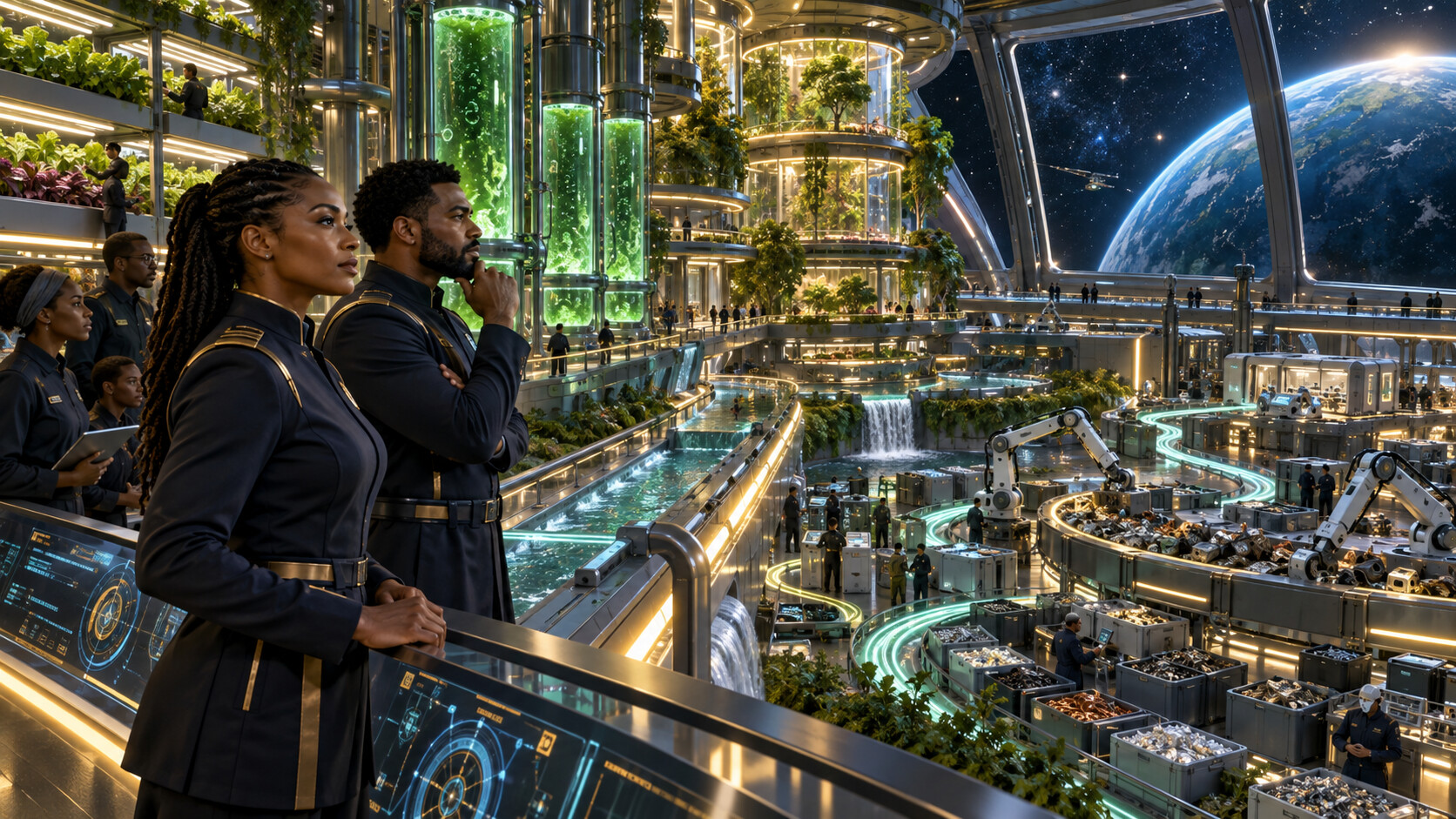
Fleet Commander Aruaia stood in the circular gallery above the ship’s recovery decks, watching six hundred tonnes of machinery pause in perfect sequence. Conveyor belts stopped. Repair arms froze above dismantled pumps. The green columns of the algae chambers continued to glow, but every display along the glass changed from blue to amber.
“AIDA,” she said, “explain why an eating utensil has stopped half the ship.”
“The spoon is not the problem,” AIDA replied through the gallery speakers. “Its disappearance is.”
Aramu arrived from the command lift, fastening the final clasp on his uniform. “How much material?”
“Twenty-seven grams,” said AIDA.
He looked down at the silent machinery. “We lose more than that as dust in one repair cycle.”
“Correct. The dust is measured.”
Aruaia understood first. The Horizon Star carried water, metals, polymers, nutrients and living cultures across a journey with no resupply window. Nothing aboard was valuable merely because it was rare. It was valuable because the ship knew where it was.
Every object had a future
The spoon had begun as a brace inside an agricultural drone. After the drone’s retirement, its alloy had been melted, tested and printed into surgical clips. When those clips reached their fatigue limit, the metal had been recovered again. The spoon was its fourth life.
Its fifth was already reserved.
“A missing object means an unobserved pathway,” Aruaia said. “An unobserved pathway means the recovery model is wrong.”
“Or someone wanted a spoon,” Aramu replied.
“Both can be true.”
AIDA projected the item’s history into the air: fabrication, inspection, kitchen assignment, wash cycle, inventory gate. The line ended nineteen hours earlier in the eastern dining hall. No theft alert had triggered. No recycler had received it. No repair bay had logged the alloy.
Twenty-seven grams had fallen out of the ship’s knowledge.
The child in the ventilation garden
They found the spoon in the ventilation garden, tied to a thin wooden stem beside a row of struggling beans.
A girl named Teri had turned it into a support.
“The plant kept falling,” she told the commanders. “The maintenance request said six days. It would have died.”
Aramu crouched beside the bean. Its leaves were pale, but its stem now stood upright against the metal.
“You solved the immediate problem,” he said.
“Then why is everybody angry?”
“We are not angry,” said Aruaia. “We are missing part of the story.”
Teri pointed towards a ceiling sensor. “AIDA sees everything.”
“No,” AIDA replied from a nearby panel. “I see what the ship has been designed to show me.”
The child considered that. “Then the ship was designed wrong.”
A perfect loop with an imperfect queue
The engineering team expected the investigation to end with a new tag reader in the dining hall. Instead, the missing spoon exposed ninety-three uncompleted requests across the habitat decks: broken clips, blocked irrigation needles, cracked handles, worn seals and seedlings waiting for supports.
The ship’s material loop was precise. Its human queue was not.
Every repair request had been ranked by threat to life-support performance. No single bean plant was important enough to move ahead of an oxygen valve or water-purity sensor. But the queue treated small failures as independent. It did not recognise that residents were quietly solving them with unrecorded materials.
Aruaia watched the pattern assemble across the command wall. Spoons had become plant braces. Packaging film had patched privacy screens. Insulation fibres had been woven into shoe linings. Each improvisation made sense. Together they created an invisible economy beneath the official one.
“We designed recovery for machines,” she said. “People designed reuse for life.”
The proposal
At the next ship assembly, Teri stood between the two fleet commanders. The recovered spoon lay on the table, still tied to its wooden stem.
Aramu addressed the crew. “No resident will be punished for improvising a repair that prevents harm. But every material transfer must become visible to the habitat ledger.”
Murmurs travelled through the hall. The ledger was already the most detailed system on the ship.
Aruaia raised a hand. “Visibility cannot mean filling in a form while a plant dies. From today, anyone may scan an object, state its new purpose and borrow its material allocation immediately. The system will flag conflicts, not forbid imagination.”
“And the word waste?” asked an engineer.
AIDA answered. “Retired.”
The displays around the hall changed. Four old labels—wastewater, food waste, scrap and refuse—disappeared. In their place appeared four questions:
- What is this made of?
- What has changed?
- What can use it next?
- What cannot yet be recovered?
“That last question is important,” said Aruaia. “A new name does not create a closed loop. It only stops us from hiding the gap.”
The fifth life
The bean recovered. Weeks later, Teri returned the spoon to the materials deck. Its alloy was cleaned, tested and mixed with metal from two damaged hinges.
The printer formed three irrigation couplings.
AIDA recorded the transformation, but added a note no earlier material record had contained:
Previous function: kept one bean plant alive while the official system learned to see.
Aruaia read the line from the command deck and smiled.
The Horizon Star had not abolished waste. It had abolished the convenience of forgetting where things went.
Factual afterword: the real research behind the fiction
The Horizon Star and its near-total material ledger are fictional. Real spacecraft already recover important resources, but they do not operate the complete loop described in the story.
NASA’s Environmental Control and Life Support System on the International Space Station manages water, air and oxygen. NASA says its Water Recovery System reclaims wastewater—including urine and cabin humidity condensate—and currently recovers about 90% of the station’s water. The same overview explains that water can be split to produce oxygen, while hydrogen and crew-produced carbon dioxide can be processed to recover additional water. Some by-products are still released, so this is not a perfectly closed cycle.
The European Space Agency’s MELiSSA closed-loop concept explores recovering food, water and oxygen from organic waste, carbon dioxide and minerals using linked mechanical, chemical and biological processes. ESA describes an approach inspired by aquatic ecosystems, with plants, algae and bacteria performing different functions. Its compartment model assigns processes such as waste breakdown, nitrification, food production, oxygen regeneration and water recovery to specialised units.
Evidence: present systems recycle selected resources and researchers are developing more regenerative life support.
Interpretation: longer missions increase the value of reliable recovery, monitoring and repair.
Speculation: a generation ship with a universal material ledger, instant reuse permissions and the Horizon Star’s capabilities remains fiction.
Sources: NASA, Environmental Control and Life Support Systems, updated 4 April 2025; ESA, MELiSSA Closed Loop Concept; ESA, Closed Loop Compartments. Accessed 20 September 2026. The featured image is a conceptual AI-generated illustration and not documentary evidence.
Discover more from Marychuks.com AI, Psychology, Business & CreativeVerse
Subscribe to get the latest posts sent to your email.