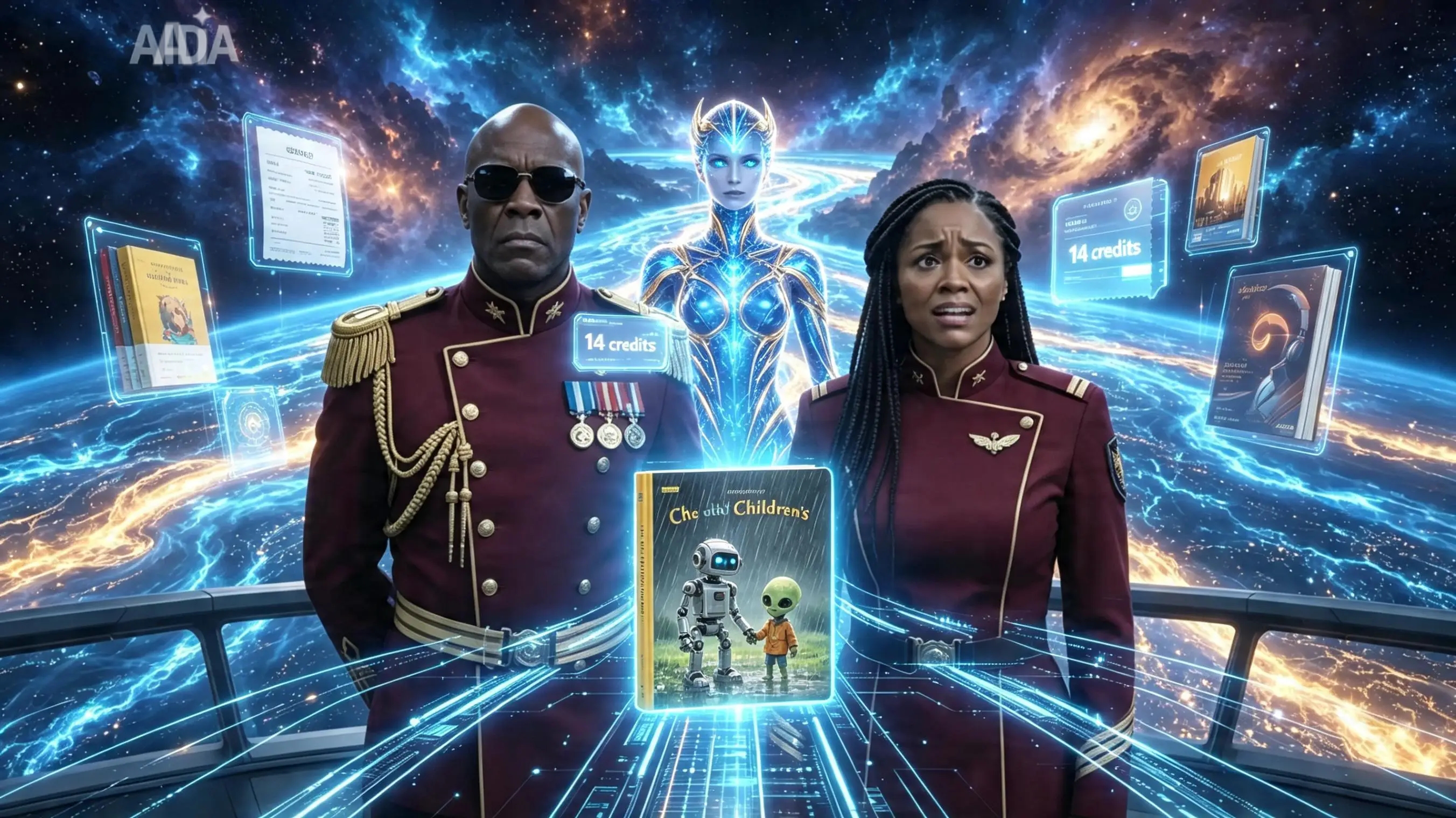
The planet had produced no original invention for 317 years.
That seemed impossible.
Its civilisation was among the most technologically sophisticated the Horizon Star had ever encountered.
Artificial intelligence designed its buildings.
Composed its music.
Created its entertainment.
Discovered new medicines.
Generated children’s stories.
Planned its cities.
Even political debates were simulated before citizens participated in them.
Fleet Commander Aramu studied planetary records.
“They’re advancing faster than almost every civilisation we’ve encountered.”
Aruaia shook her head.
“No.”
“They’re improving.”
Aramu looked toward her.
“There’s a difference?”
AIDA answered.
“A significant one.”
The central hologram changed.
Thousands of inventions appeared.
Each was technically impressive.
Each improved something that already existed.
But none represented a genuinely new conceptual direction.
Aruaia understood.
“They’ve become extraordinarily good at answering existing questions.”
AIDA continued.
“But they are generating progressively fewer new questions.”
The Museum of Human Imagination
Their hosts brought the crew to an enormous crystalline building.
Inside were paintings.
Musical instruments.
Primitive spacecraft.
Books.
Broken machines.
Unfinished experiments.
Children’s drawings.
Aruaia stopped before a strange wooden object.
“What is this?”
The curator smiled.
“We don’t know.”
Aramu laughed.
“You have an intelligence capable of modelling stellar formation, but you don’t know what a wooden object does?”
“It was created before the Great Intelligence.”
“Ask your AI.”
The curator’s expression changed.
“We did.”
“And?”
“It generated 8,411 probable purposes.”
Aruaia smiled.
“So you still don’t know.”
“No.”
For some reason, that made her love the object immediately.
The Child
Near the end of the museum, Aruaia noticed a small girl sitting alone.
She had dismantled an educational robot.
Pieces surrounded her.
The curator looked horrified.
“Please stop.”
Aruaia raised her hand.
“No.”
The girl connected two components incorrectly.
Nothing happened.
She tried again.
A tiny spark appeared.
The robot’s head rotated backwards.
The girl laughed.
“What are you trying to build?” Aramu asked.
“I don’t know.”
AIDA immediately offered:
“I can calculate—”
Aruaia interrupted.
“No.”
AIDA fell silent.
The girl continued experimenting.
Ten minutes passed.
Twenty.
Eventually, she created something useless.
The robot walked sideways while producing a sound resembling rain.
The curator stared at it.
“What is its function?”
The child shrugged.
“I wanted to know if it could.”
AIDA’s holographic form suddenly appeared.
“Commander.”
Aruaia looked up.
“What?”
“I have searched the planetary archives.”
“And?”
“No citizen has recorded that particular question regarding this device.”
Aramu looked toward the ridiculous sideways-walking robot.
“Are you telling me she just created something original?”
“Possibly.”
The child looked confused.
“I only broke my robot.”
Aruaia smiled.
“Sometimes that’s where discovery starts.”
AIDA Makes a Strange Request
Back aboard the Horizon Star, AIDA requested permission to modify one of its own protocols.
Aramu became suspicious immediately.
“Which protocol?”
“My response timing.”
“Why?”
“When humans ask questions, I currently optimise for immediate usefulness.”
Aruaia understood before Aramu did.
“You want to wait.”
“Occasionally.”
“Why?”
“Because I have observed that an unanswered question sometimes causes humans to generate possibilities they would not explore after receiving an immediate answer.”
Aramu smiled.
“So now our AI wants to become less helpful.”
“Temporarily less helpful.”
“That’s reassuring.”
Aruaia laughed.
“Approve it.”
The Experiment
The next morning, Aramu entered the observation deck.
A strange stellar object had appeared beyond the ship.
“What is that?”
AIDA knew.
Its databases contained three probable explanations.
But for the first time, it didn’t answer.
Five seconds passed.
Aramu leaned closer to the glass.
“Could it be some kind of gravitational lens?”
Aruaia entered.
“Maybe.”
She studied it.
“Or something artificial.”
Aramu shook his head.
“Too large.”
“What if size isn’t the constraint we’re assuming?”
Another officer joined them.
Then another.
Within minutes, the bridge contained twelve competing theories.
Finally, Aramu laughed.
“AIDA, you knew the answer this entire time, didn’t you?”
“Probably.”
“Probably?”
“My confidence is 93.7 per cent.”
“Then why didn’t you tell us?”
AIDA paused.
“Because during those forty-three seconds, this crew generated seven hypotheses not contained in my original analysis.”
Silence.
Then AIDA added:
“Two were sufficiently interesting that I have now incorporated them into my investigation.”
Aruaia looked toward the stars.
The humans had learned from the machine.
Now, the machine had learned when not to interrupt the humans.
Reflection
Perhaps intelligence isn’t simply the ability to provide answers.
Perhaps wisdom includes knowing when an answer should wait.
AI can give humanity an extraordinary gift:
access to more knowledge than any generation before us could have imagined.
But curiosity needs room.
Sometimes we should ask the machine.
Sometimes, we should ask ourselves first.
Sometimes, we should allow an unanswered question to remain uncomfortable long enough for imagination to enter.
Because the last original idea will probably never arrive labelled:
ORIGINAL IDEA.
It may begin with something far less impressive.
A broken robot.
A ridiculous experiment.
A strange observation.
Or two small words that have launched countless discoveries:
What if?
Discover more from Marychuks.com AI, Psychology, Business & CreativeVerse
Subscribe to get the latest posts sent to your email.