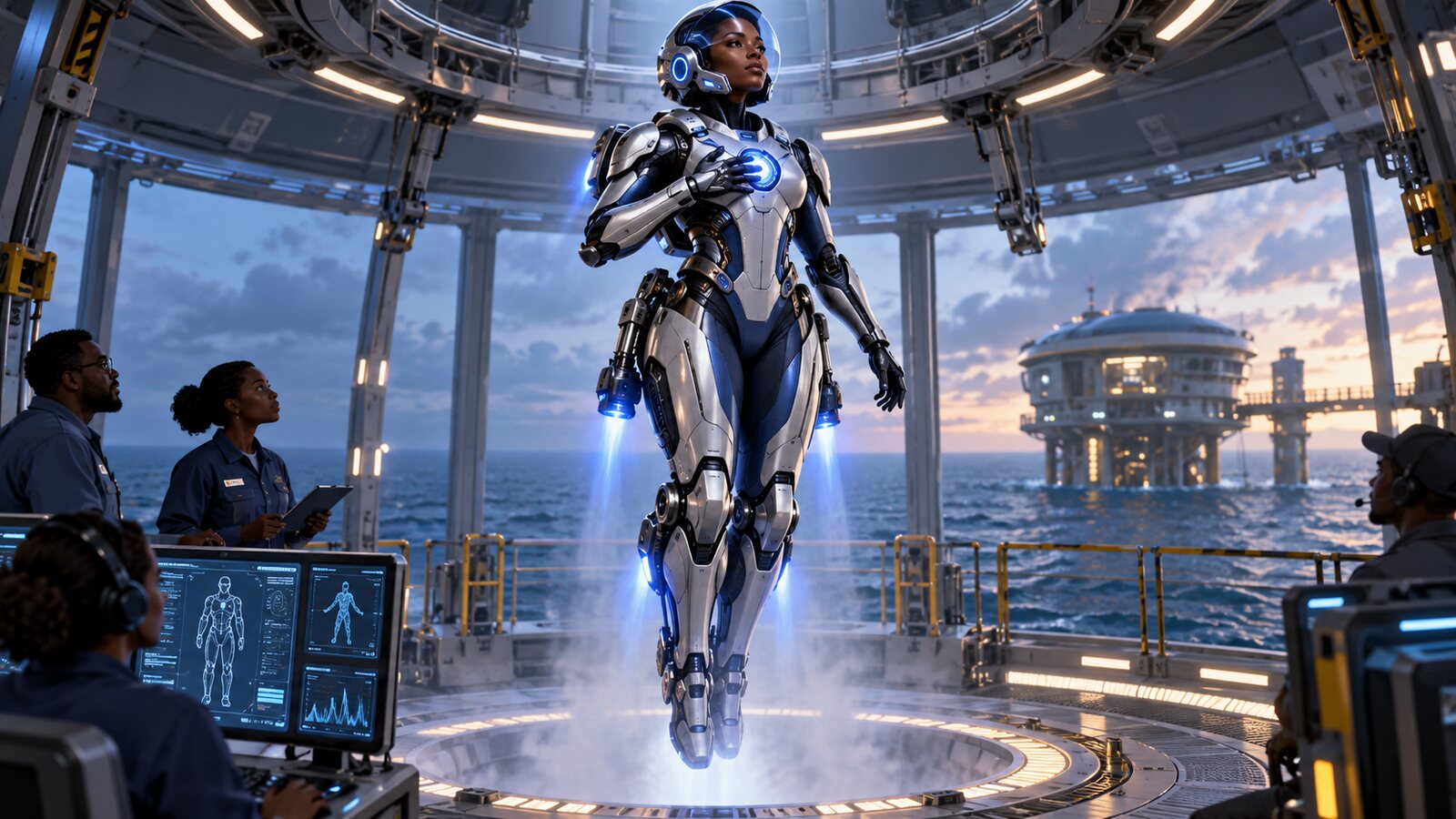

Imagine a Scaler Queen robotic costume built around one dramatic action. The wearer presses a control on the chest. The suit wakes. A helmet rises automatically and seals around the head. Stabilisation systems engage—and the wearer lifts from the floor.
That is the Antigravity Neural Suit concept. It belongs to speculative design: antigravity is not an established technology, and this article does not claim that gravity can be switched off. The value of the idea is to ask what real technologies, safety systems and human choices would be required to create the experience of controlled lift-off.
The activation sequence
1. Chest control
The button is not merely a power switch. It begins a diagnostic sequence: identity check, structural scan, battery status, joint alignment, environmental clearance and a confirmation that the test zone is safe.
2. Rising helmet
The helmet closes only after the system confirms that hair, clothing and equipment are clear. It provides eye protection, communications, airflow and an unobstructed view. Manual release remains available even after power loss.
3. Body calibration
Sensors read posture, balance and intended direction. A neural interface might contribute signals, but it should not be the only control channel. Muscle movement, hand controls and an external safety operator create redundancy.
4. Lift-off
The fictional “antigravity” effect could be represented in a real prototype through a tethered rig, cable robot, airflow platform or carefully controlled propulsion system. Each route has different noise, heat, energy and failure risks.
The real technologies hiding inside the fiction
Powered exoskeletons can assist joints and distribute loads. Inertial sensors can estimate orientation. Machine vision can detect obstacles. Haptic systems can communicate warnings through pressure and vibration. These components exist in different forms, but combining them into a compact, safe, free-flying suit remains an enormous engineering challenge.
This is where AI entering everyday objects becomes a useful comparison. Intelligence moves into the suit not to create spectacle alone, but to continuously interpret the wearer and environment.
Neural control must not mean invisible control
A neural interface should translate intention, never silently override it. The wearer needs clear feedback about what the system believes they want to do. Ambiguous signals should trigger clarification or hold position, not movement.
The human-command principles discussed in physical AI and embodied systems become especially important when the machine surrounds the body. The user must know who—or what—can move the suit.
The six non-negotiable safety systems
- Dead-man control: releasing a control returns the suit to a safe hover or descent.
- Independent braking: a separate mechanism prevents uncontrolled motion after software failure.
- Geofencing: flight is limited to mapped, authorised test spaces.
- External override: a trained safety controller can stop or recover the system.
- Energy reserve: landing power is protected from ordinary use.
- Manual escape: the wearer can exit without network access or central permission.
Why the suit belongs in Scaler Queen thinking
Scaler Queen concepts turn narrative into systems design. The Technology Villages provide a place for prototypes, while the Exhibition City Centre provides a controlled public setting for demonstration. The neural suit could move between story, simulation, costume, tethered prototype and research platform without pretending each stage is the same.
Conclusion
The most exciting future concepts are not weakened by honest labels. They become stronger. The Antigravity Neural Suit is fictional at its centre, but it can still inspire real work in exoskeletons, interfaces, balance assistance and human-controlled robotics. First comes imagination. Then comes the discipline to identify every system that must work before lift-off.
Discover more from Marychuks.com AI, Psychology, Business & CreativeVerse
Subscribe to get the latest posts sent to your email.