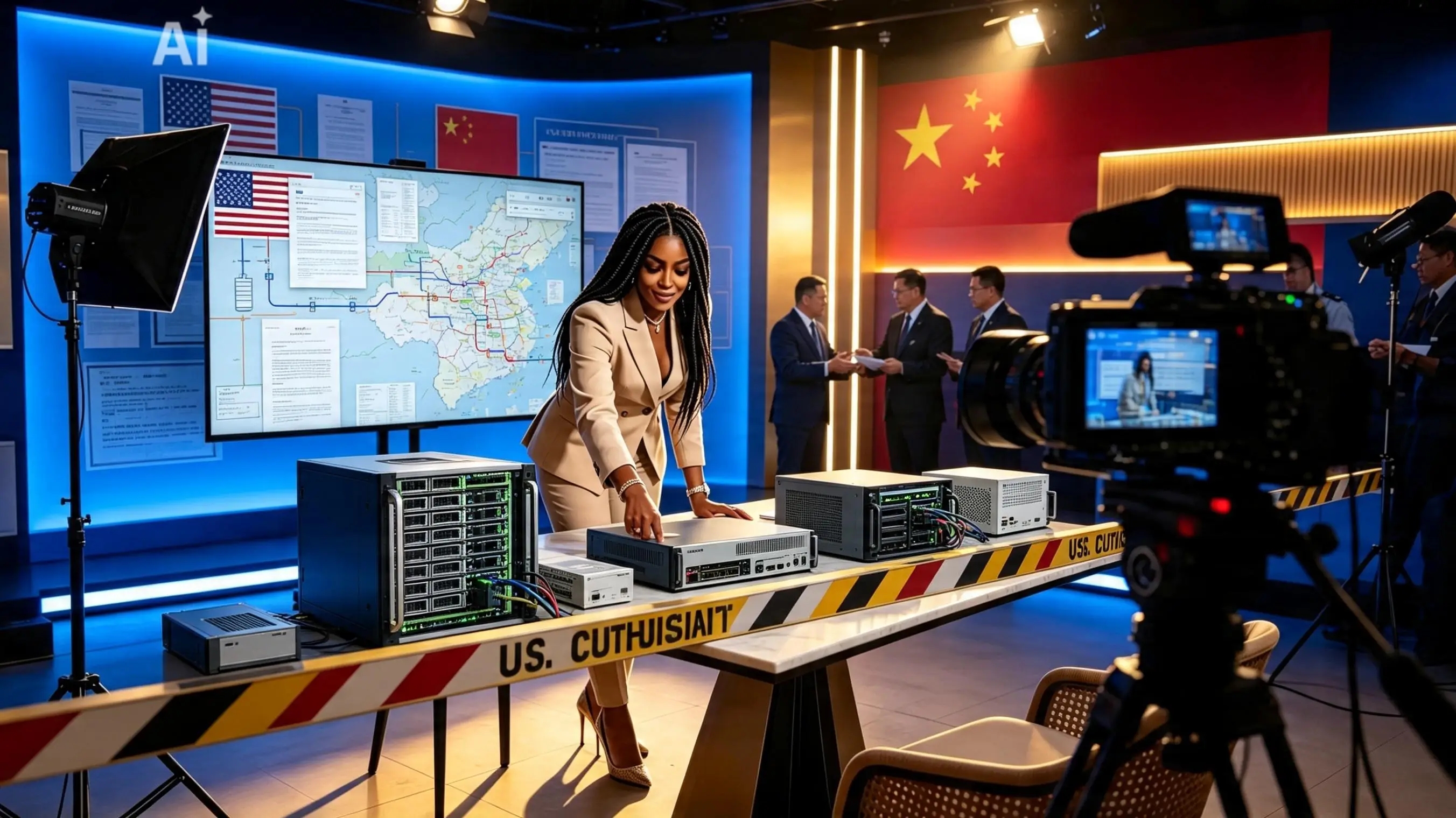
The technology conflict between the United States and China is moving deeper into the physical machinery of artificial intelligence.
The Trump administration is reportedly drafting restrictions that could block imports of new Chinese-made data-centre equipment into the United States.
The proposal would extend Washington’s AI-security concerns beyond advanced chips and into the wider systems required to operate data centres. �
Reuters
What Equipment Could Be Affected?
Public reporting has not yet provided a complete final list.
Data centres depend on far more than processors.
Relevant components can include:
Servers
Networking equipment
Power-management systems
Cooling systems
Storage devices
Monitoring technology
Control hardware
Backup power equipment
The administration is reportedly examining whether new models of Chinese components could create cybersecurity or national-security vulnerabilities inside the infrastructure supporting America’s AI expansion. �
Reuters
Why Data-Centre Hardware Matters
A data centre is not simply a warehouse filled with computers.
It is a tightly integrated system controlling:
Information flows
Electricity
Temperature
Remote access
Equipment monitoring
Software updates
Physical security
A compromised component could theoretically create opportunities for:
Espionage
Remote disruption
Data theft
Supply-chain attacks
Hidden access
Operational failure
The more important AI becomes to government, defence and the economy, the more closely authorities will inspect every layer of that infrastructure.
From Chip Controls to Entire Supply Chains
The US has already restricted China’s access to advanced American chips and manufacturing technology.
China has responded by investing heavily in domestic alternatives.
A ban on Chinese data-centre components would push the separation further.
The dispute is no longer merely about which country designs the smartest model.
It is about:
Who builds the chips
Who supplies the servers
Who controls networking
Who provides electricity systems
Who maintains the equipment
Who can be trusted inside critical infrastructure
AI sovereignty increasingly means controlling the full physical stack.
Why the Story Is Going Viral
The proposal reveals that the AI race is becoming an industrial and security conflict rather than a competition between chatbots.
Ordinary users see model names and applications.
Governments see strategic infrastructure.
A foreign-made cooling controller or network device may appear less exciting than a frontier model, but it can be essential to keeping that model operational.
The Cost of Removing Chinese Equipment
Restrictions may improve supply-chain control.
They could also increase costs.
US data-cententre developers may face:
Fewer suppliers
Higher equipment prices
Project delays
Replacement expenses
Greater dependence on a small group of approved vendors
Those costs may eventually affect cloud services, AI prices and electricity demand.
The government must therefore weigh security benefits against the economic consequences of reducing competition.
Is Every Chinese Component Dangerous?
No.
The country of manufacture alone does not prove that an individual device contains a vulnerability.
A responsible security framework should examine:
Ownership
Software access
Update mechanisms
Data handling
Remote-control features
Component testing
Supply-chain transparency
Blanket assumptions can become politically convenient while failing to identify the most important technical risks.
Mary Chuks’ Perspective
The AI race is teaching the world that digital independence requires physical independence.
A country cannot claim complete AI sovereignty while relying entirely on another country for chips, energy systems, cloud platforms or network equipment.
But replacing one dependency with another is not enough.
The strongest strategy is diversified resilience:
Multiple trusted suppliers
Independent security testing
Domestic capability
International partnerships
Repairable and auditable equipment
Security should be proven through evidence—not merely declared through nationality.
Practical Takeaways for Technology Businesses
Companies building data centres should:
Map the origin of critical components.
Review remote-access and update mechanisms.
Prepare for regulatory changes.
Avoid reliance on one supplier or country.
Conduct independent hardware-security audits.
Include replacement costs in long-term planning.
Monitor how restrictions may affect project schedules.
Conclusion
Artificial intelligence may look like software, but its power rests on physical systems assembled through global supply chains.
The proposed US restrictions show that every server, cooling unit and network component is becoming part of the geopolitical AI battlefield.
The next major technology dispute may not begin inside a chatbot.
It may begin inside the equipment room keeping the chatbot alive.
Original Source and Further Reading
Primary reporting: Reuters, “Trump Administration Drafting Ban on Chinese Data Center Devices, Sources Say,” published 4 August 2026. �
Reuters
Discover more from Marychuks.com AI, Psychology, Business & CreativeVerse
Subscribe to get the latest posts sent to your email.