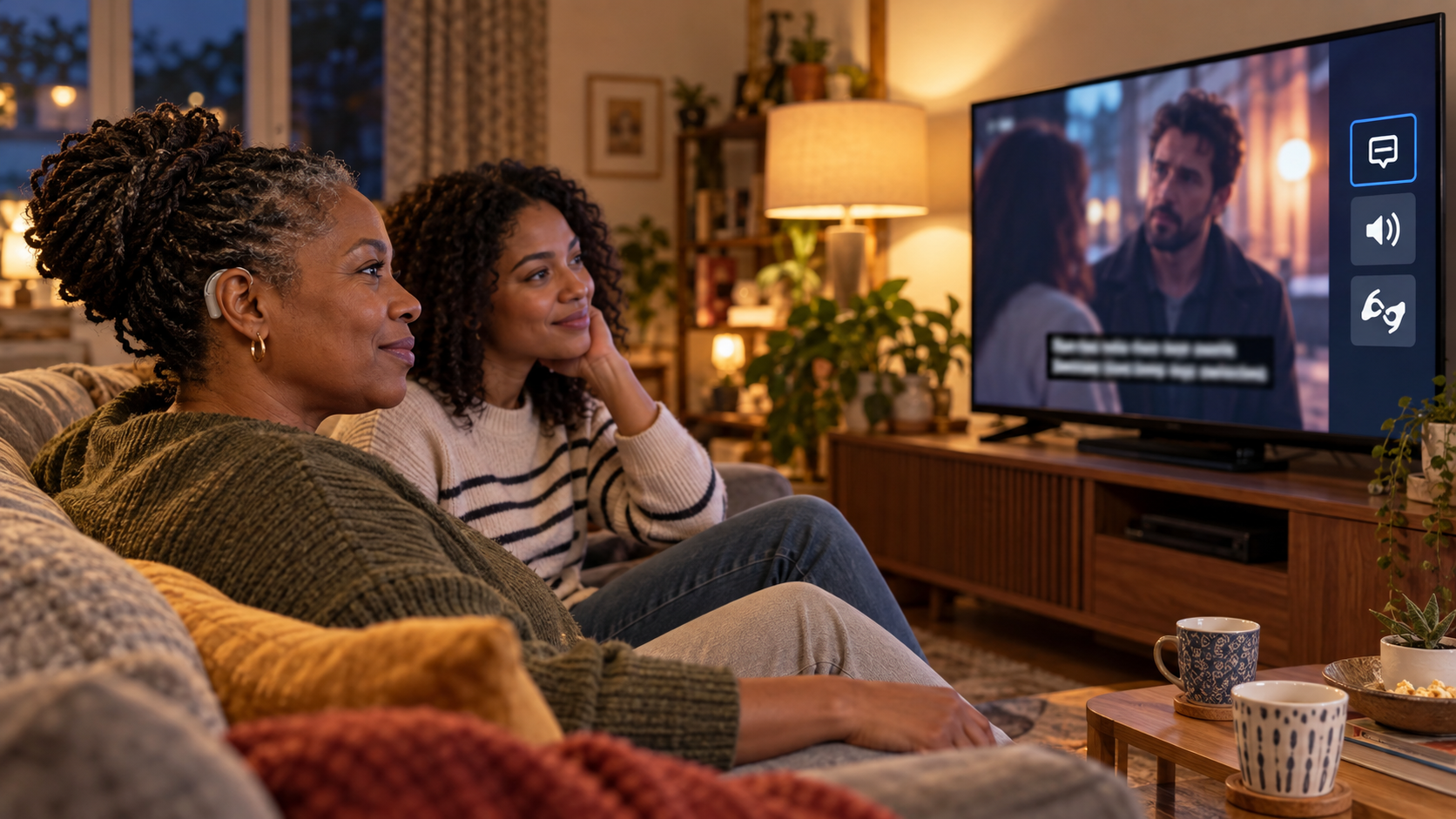
A television programme does not become accessible simply because a subtitle button exists. The words may arrive late, cover a speaker’s face, omit the sound that explains a reaction or disappear when the viewer switches devices. Audio description may be listed on one platform but absent on another. Signing may exist only for selected episodes. An accessible file is valuable; a usable viewing journey is the real standard.
This distinction matters as television moves between broadcast channels, catch-up players, subscription services, smart televisions, phones, games consoles and set-top boxes. The programme is the same, but the route to its access services may not be. A viewer should not need technical expertise, repeated trial and error or help from another person before the story becomes available to them.
Access services carry parts of the story
Ofcom groups subtitles, signing and audio description as television access services. They serve different needs rather than acting as interchangeable add-ons. Subtitles turn relevant audio into synchronised text. Signing presents content in sign language. Audio description adds spoken information about important visual action, expression, setting and on-screen detail, usually in gaps between dialogue.
The World Wide Web Consortium’s caption guidance explains that accessible captions include speech and the non-speech audio required to understand the content. That can include speaker identification, music and sound effects—not every noise, but the sounds that carry meaning. Dialogue-only text can therefore be accurate word for word and still leave out part of the scene.
Terminology varies. In Britain, “subtitles” commonly covers same-language text for accessibility as well as translated text. Some international guidance uses “captions” for same-language speech plus significant non-speech audio and “subtitles” for translation. The label is less important than what the service actually provides.
Availability is only the first test
Ask four questions. Does the access service exist? Can the viewer discover it before pressing play? Can they switch it on independently? Does it remain accurate and usable through the programme? A “yes” to the first question does not cancel a “no” to the others.
Ofcom’s access-services review found that users wanted more choice and customisation, greater consistency in interface layouts and an easier way to find accessible content. Its guidance focuses on outcomes: services should be good enough to count, and viewers should be told when something goes wrong.
This turns interface design into part of programme access. A tiny unlabeled icon, a setting buried three menus deep or a catalogue with no accessibility filter can block a feature that technically exists. The same is true when an episode page advertises subtitles but does not identify the language or whether meaningful sounds are included.
Audit subtitle quality, not just presence
Good subtitles preserve meaning while remaining readable at the pace of the scene. They should appear close enough to the corresponding audio that the viewer can connect text with action. They should identify an off-screen or unclear speaker where that knowledge matters. They should represent meaningful sound—such as a phone vibrating, a door locking or ominous music—when the image alone does not communicate it.
Position also matters. The W3C notes that captions should not obscure relevant visual information. A subtitle placed across a name card, sign-language interpreter, score, clue or speaker’s mouth can solve one barrier by creating another. Contrast should survive both bright and dark scenes, and line breaks should support understanding rather than splitting a phrase arbitrarily.
For live television, a short delay may be unavoidable because words are being produced in real time. That does not make every error acceptable. Names, numbers and urgent information require particular care, and recordings should be corrected where practicable rather than preserving preventable live-caption mistakes indefinitely.
Automation needs editorial responsibility
Speech recognition can accelerate transcription, but speed is not the same as quality. Accents, overlapping dialogue, invented names, code-switching, background music and poor sound mixing can all produce errors. An automated transcript may also miss who is speaking and which non-speech sounds matter.
Ofcom’s May 2026 report on access-service provision said providers were increasingly exploring automated and AI-assisted subtitling to address cost and capacity pressures, but that these tools require careful assessment and continuing human oversight. That is a sensible division of labour: automation can propose timing and text; accountable editors must verify meaning, context and presentation.
Viewers can spot warning signs: a character’s name changing from scene to scene, homophones that do not fit the sentence, missing punctuation that reverses meaning or music described merely as “[music]” when its mood is narratively important. One error does not prove an entirely automated process, but repeated patterns justify a quality report.
Audio description is not an audio plot summary
Audio description needs to fit around existing speech and sound without narrating what dialogue already makes clear. Its task is to convey visually available information needed to follow the programme: who entered, what expression changed, which object was revealed, where the scene moved or what silent action altered the plot.
Quality therefore depends on selection and timing as much as on voice. Too little description leaves gaps; too much competes with the programme. A viewer audit should ask whether crucial silent action is conveyed, whether characters are identified consistently and whether the description avoids unnecessary interpretation of motives that sighted viewers would also have to infer.
Signing needs visibility and informed choice
Sign-presented or sign-interpreted programming cannot help viewers who cannot find it. Programme information should state clearly which sign language is used and whether signing is integrated, interpreted or available as a separate version. The interpreter must remain visible at a useful size and should not be hidden by menus, captions or platform overlays.
Signing is not a substitute for subtitles, and subtitles are not a substitute for signing. Viewers have different first languages, literacy preferences and access requirements. Choice is a feature of accessibility, not duplication.
Check the whole device journey
A streaming service may possess the correct file and still fail to deliver it on every supported device. Ofcom’s 2025 access-services report, published in May 2026, recorded provider concerns about inconsistent technical support across platforms, particularly older and third-party devices. Availability figures also varied by platform.
Test the route that real viewers use: search for a programme, inspect its accessibility information, begin playback, switch the service on, pause, rewind, move to the next episode and return later. Does the preference persist? Are trailers and adverts accessible? Can the controls be used with a screen reader or remote without fine pointer movement? Does casting from a phone to a television preserve the chosen service?
A viewer’s ten-point access audit
- Before play: can you see which access services and languages are available?
- Discovery: can you filter or search the catalogue by subtitle, description or signing availability?
- Control: can the feature be switched on without leaving the programme or requiring assistance?
- Accuracy: do the words, names and numbers match the programme?
- Meaning: are relevant sounds, speakers and visual events represented?
- Timing: does text or description connect clearly with the corresponding moment?
- Presentation: is it readable or audible without covering or competing with essential content?
- Continuity: does the service remain available across episodes, adverts, pauses and restarts?
- Devices: does it work on the television, app or console the household actually uses?
- Recovery: is there an accessible way to report faults and receive an update?
Evidence, policy and the viewer’s reality
Ofcom reported that all regulated broadcast channels met or exceeded their access-service requirements in 2025. Its voluntary on-demand survey, however, also showed uneven provision and technical barriers; because the participating providers varied, Ofcom correctly described those trends as indicative. Meanwhile, the Media Act 2024 created a new accessibility regime for the most-watched Tier 1 on-demand services, with implementation work continuing through 2026.
Those are important system-level developments. They do not tell an individual viewer whether tonight’s episode works on tonight’s device. That is why regulation, provider quality assurance and lived-experience testing must meet. Quotas measure supply; usability determines access.
The practical standard is straightforward: people should be able to find, activate, understand and trust the service that carries the story to them. Anything less is not a completed accessibility feature. It is a file waiting to become one.
Featured image disclosure: conceptual AI-generated editorial illustration created for this article. It does not depict a specific broadcaster, streaming service or television programme.
Discover more from Marychuks.com AI, Psychology, Business & CreativeVerse
Subscribe to get the latest posts sent to your email.


