For the first phase of generative AI, creators learned a new instruction:
Prompt the machine.
Write this.
Generate that.
Make image.
Create video.
Summarise article.
Now the next phase is beginning to look different.
Instead of asking AI to produce one asset, we may increasingly ask it to:
operate the workflow.
Reuters announced on 12 September 2026 that it has integrated its Model Context Protocol server with CuttingRoom’s browser-based AI-assisted video editing platform, ShortCut.
The practical result is striking.
A newsroom editor can now use ordinary language to request verified Reuters video by:
story;
topic;
region;
language;
event.
The system can bring that footage directly into an editing timeline and assist with:
cutting;
audio mixing;
colour correction;
captioning;
graphics;
reframing for vertical, square and broadcast formats.
All without the editor repeatedly moving between separate tools. �
Reuters
That sounds like a media-industry announcement.
I think it points to something much larger.
The interface between humans and professional software is changing.
Traditional Creative Software Makes the Human Learn the Machine
Think about professional editing.
You learn:
timeline.
Menus.
Keyboard shortcuts.
Panels.
Export settings.
Effects.
Aspect ratios.
The software says, essentially:
Learn how I work.
Generative AI introduces another model.
Human:
“Find the clip where the prime minister enters the building, trim the first three seconds, add captions, make a vertical version and keep the newsroom’s lower-third style.”
Machine:
does the mechanical translation.
Now the interface says:
Tell me what you want.
That is a profound shift.
Natural Language Is Becoming a Control Layer
The old software stack looked like:
HUMAN INTENT
↓
BUTTONS
↓
MENUS
↓
TOOLS
↓
OUTPUT.
Conversational software can potentially compress that into:
HUMAN INTENT
↓
LANGUAGE
↓
TOOLS + DATA + WORKFLOW
↓
OUTPUT.
That reduces interface friction.
This Does Not Mean Professional Skill Disappears
Quite the opposite.
If software becomes easier to operate, value shifts upward.
The scarce skill becomes less:
Where is the caption button?
and more:
Which clip tells the story accurately?
That is editorial judgement.
AI may know how to:
trim.
But deciding:
what deserves to remain
is a different competence.
Reuters’ Implementation Makes This Especially Interesting
Reuters says newsroom customers retain control over their own editorial rules and data.
The customer writes editorial instructions in plain language, and the material remains inside the customer’s infrastructure. �
Reuters
That is important.
Because professional AI does not only need:
capability.
It needs:
constraints.
“Make a Great Video” Is Not Enough
A newsroom needs:
verification;
attribution;
editorial standards;
formatting rules;
brand consistency.
A bank needs:
compliance.
A hospital needs:
clinical safeguards.
A creator business needs:
brand voice.
So the future AI workflow may be:
capability + institutional rules.
This Is Where MCP Becomes Interesting
Model Context Protocol, or MCP, is part of a larger movement toward allowing AI systems to connect to:
tools;
data;
applications.
The important idea is not the acronym.
It is that AI can increasingly move beyond:
talking about the work
toward:
working across the systems where the work happens.
Chat Was the First Interface
Now comes:
action.
The AI can potentially:
find the file;
load the footage;
edit the asset;
format versions.
That is much closer to:
digital labour.
This Changes the Creator Economy Too
Imagine a solo creator.
Today:
record video.
Download.
Open editor.
Trim.
Generate captions.
Resize for Instagram.
Resize for YouTube Shorts.
Create thumbnail.
Write description.
Schedule.
Many steps.
Tomorrow the creator might say:
“Turn this 12-minute video into one 90-second version, three 30-second clips, caption all of them, keep my intro branding, and prepare vertical versions.”
The point is not that AI becomes the creator.
The point is that one creator can command:
a much larger production system.
The Production Team Becomes Software
Historically, scale often meant hiring:
video editor;
captioner;
social producer;
designer.
Some of those functions may increasingly become:
agentic services.
That makes small creative businesses more operationally powerful.
But It Also Raises the Bar
When everyone can produce:
ten formats
instead of:
one,
the internet gets:
more content.
Much more.
So production advantage quickly becomes:
normal.
Then the scarce resource moves again.
Toward:
ideas.
Credibility.
Taste.
Distribution.
Trust.
Cheap Production Makes Original Thinking More Valuable
This pattern keeps repeating.
AI lowers the cost of:
execution.
Therefore value migrates toward:
decision.
If fifty creators can produce technically perfect videos instantly, the audience still asks:
Who is saying something worth hearing?
That is good news for people with:
real expertise;
distinctive perspective;
original concepts.
This Is Especially Relevant to News
Speed matters enormously.
Reuters and CuttingRoom explicitly frame the integration around faster production while maintaining editorial control. �
Reuters
News organisations constantly face:
breaking story;
multiple platforms;
different video dimensions;
language versions.
Automation can help.
But journalism has an additional problem:
accuracy.
The Fastest Wrong Video Is Still Wrong
🤣
This is why newsroom AI should not simply optimise:
speed.
The workflow needs:
provenance;
verification;
human review.
Reuters’ system is interesting partly because it begins from:
licensed, verified Reuters material
rather than asking a generative system to invent visuals around a news event.
That difference matters.
AI-Assisted and AI-Generated Are Not the Same Thing
This distinction deserves more attention.
AI-generated media
The machine creates:
new pixels;
new audio;
new text.
AI-assisted media
The machine helps humans:
find;
edit;
organise;
transform
existing material.
Different risk profile.
Sometimes the Safest AI Is the AI That Does Not Invent
For factual media, this may become a critical design principle.
Ask AI to:
locate verified footage.
Trim it.
Caption it.
Translate it.
Do not necessarily ask it to:
fabricate a photorealistic scene of an event that never had cameras.
Creators Need Provenance Too
A creator’s workflow may eventually combine:
original footage;
licensed media;
AI-generated assets.
The audience increasingly needs to know:
which is which.
That creates an opportunity for:
metadata;
content credentials;
clear labelling.
Conversational Editing Also Changes Accessibility
Professional editing software can have:
steep learning curves.
Natural-language interaction can lower the barrier for:
small businesses;
educators;
journalists;
people with disabilities;
new creators.
You may no longer need to memorise:
which submenu contains the exact function.
You describe the outcome.
This Could Expand Who Becomes a Creator
Much like smartphones lowered the technical barrier to:
photography,
conversational creative software may lower the barrier to:
professional post-production.
That does not make everyone:
good.
It makes the tools:
available.
Those are different.
One-Person Media Companies Become More Plausible
This matters enormously for the creator economy.
A single person may increasingly control:
writing;
video;
audio;
graphics;
distribution
through an AI orchestration layer.
Not because the human physically performs every mechanical step.
Because they direct:
the system.
The Job Changes From Operator to Director
That might be the deepest shift.
Old creator:
I make every component.
New creator:
I define the concept, standards and final judgement while machines execute many components.
That resembles:
directing.
Taste Becomes a Professional Skill
AI can generate:
ten edits.
Which one works?
That is taste.
AI can offer:
twenty hooks.
Which one accurately reflects the story?
Judgement.
AI can resize:
everything.
Should this story even become a 15-second clip?
Editorial intelligence.
We Should Stop Calling All of This “Prompt Engineering”
The phrase is becoming too small.
What professionals increasingly need is:
workflow design.
What should happen first?
What sources may the AI access?
What should it never invent?
What requires approval?
Which steps may execute autonomously?
That is operational architecture.
MaryChuks.com Has the Same Opportunity
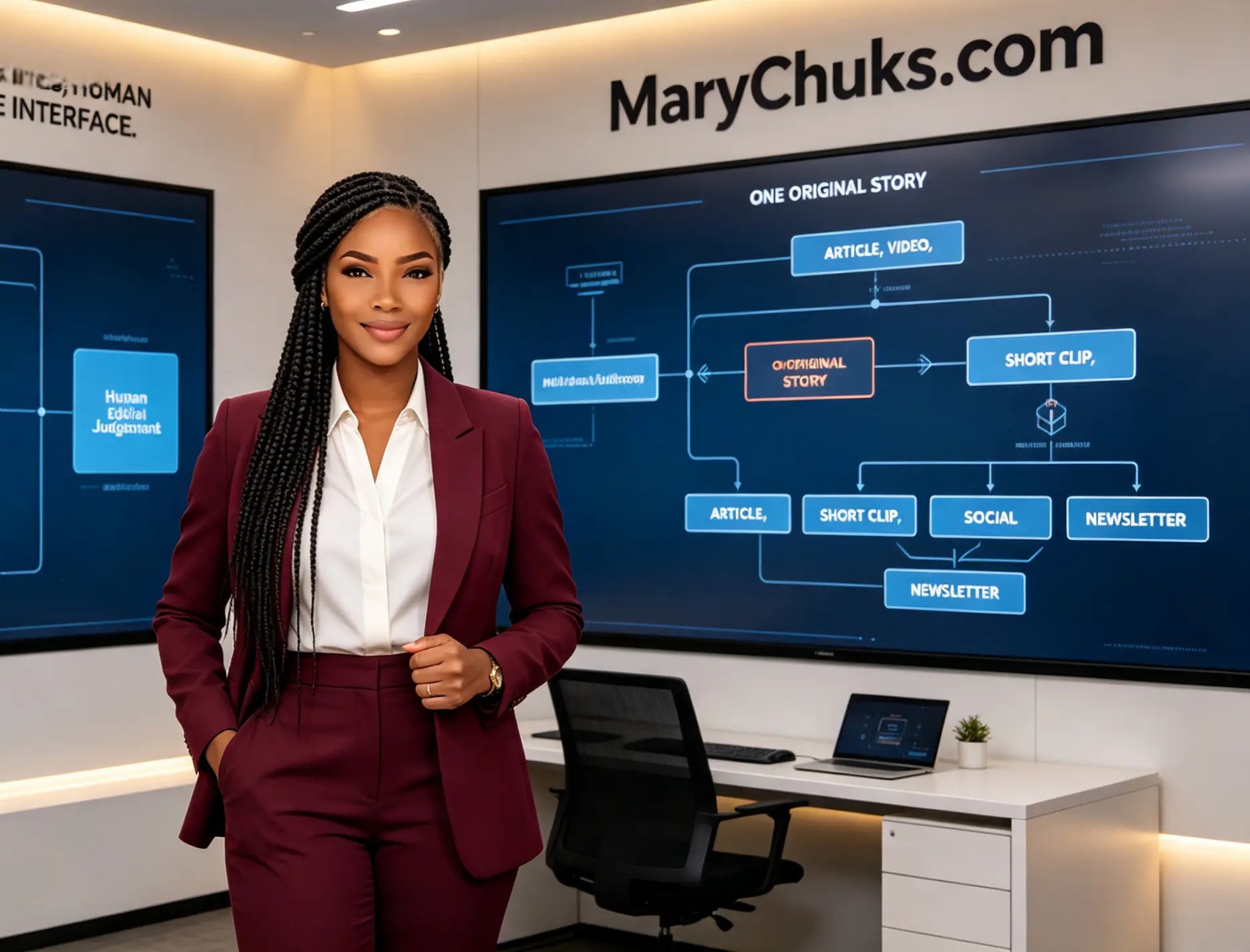
One original MaryChuks.com article can become:
website article;
newsletter;
Facebook post;
Threads post;
30-second video;
60-second commentary;
podcast segment.
The goal is not to make six unrelated pieces.
It is to create:
one intellectual property source
with:
multiple distribution forms.
AI can help operate the conversion layer.
That Is More Powerful Than “Create More Content”
The better creator strategy may be:
Create fewer original ideas. Extract more value from each one.
Because the difficult part is:
the insight.
Distribution formats are increasingly cheap.
Do Not Automate the Wrong Layer
This matters.
If AI invents your entire:
idea;
angle;
opinion;
voice,
your content risks becoming:
generic.
Better architecture:
HUMAN ORIGINAL CONCEPT
↓
AI RESEARCH + PRODUCTION SUPPORT
↓
HUMAN JUDGEMENT
↓
MULTI-FORMAT DISTRIBUTION.
The human remains upstream.
Newsrooms Face the Same Principle
Journalist:
determines story.
Verified footage:
provides evidence.
AI:
speeds the assembly.
Editor:
owns final judgement.
That architecture is healthier than:
AI invents event.
The Browser May Become the Studio
CuttingRoom’s ShortCut operates in the browser, and Reuters footage can sit alongside the newsroom’s existing media systems in the same editing environment. �
Reuters
That illustrates another transition.
Professional workflows are increasingly:
cloud-based;
connected;
conversational.
The workstation becomes less:
one giant application
and more:
a network of services.
This Creates New Security Questions
When AI can access:
archives;
licensed media;
production systems,
permissions matter.
Who can retrieve which footage?
Who can publish?
Can AI merely prepare?
Or execute?
Agentic creative tools require:
role-based authority.
The Future Creative Stack May Look Like
SOURCE
Verified or original material.
↓
AI ORCHESTRATOR
Finds and transforms.
↓
RULES
Brand, editorial and legal constraints.
↓
HUMAN REVIEW
Accuracy and judgement.
↓
DISTRIBUTION
Multiple platforms.
That is significantly more powerful than:
“type prompt, get video.”
Final Thoughts
Reuters and CuttingRoom’s announcement is interesting because it shows a mature direction for generative AI.
AI does not always need to:
create something from nothing.
Sometimes the more valuable system is the one that understands:
your existing assets;
your rules;
your tools;
your intended outcome—
and removes the mechanical friction between them.
That is where the creator economy may be heading.
From:
AI as generator
to:
AI as production operator.
And that shift changes what humans need to become good at.
Less time spent asking:
Where is the button?
More time asking:
What should we make?
What is true?
What should remain?
Who is this for?
Those are not software-interface questions.
They are:
human judgement.
And as AI becomes increasingly capable of operating the studio, human judgement may become the most important tool left inside it.
Verification note: Reuters announced the CuttingRoom integration on 12 September 2026. Reuters says ShortCut can use plain-language instructions to find Reuters footage, bring it into the edit, assist with cutting, audio mixing, colour correction, captions, graphics and platform reframing. Reuters also says customers define their own editorial rules and retain their material inside their infrastructure. This is a Reuters corporate announcement rather than independent product evaluation. �
Reuters
Reuters announcement: AI-assisted video editing with CuttingRoom�
Discover more from Marychuks.com AI, Psychology, Business & CreativeVerse
Subscribe to get the latest posts sent to your email.