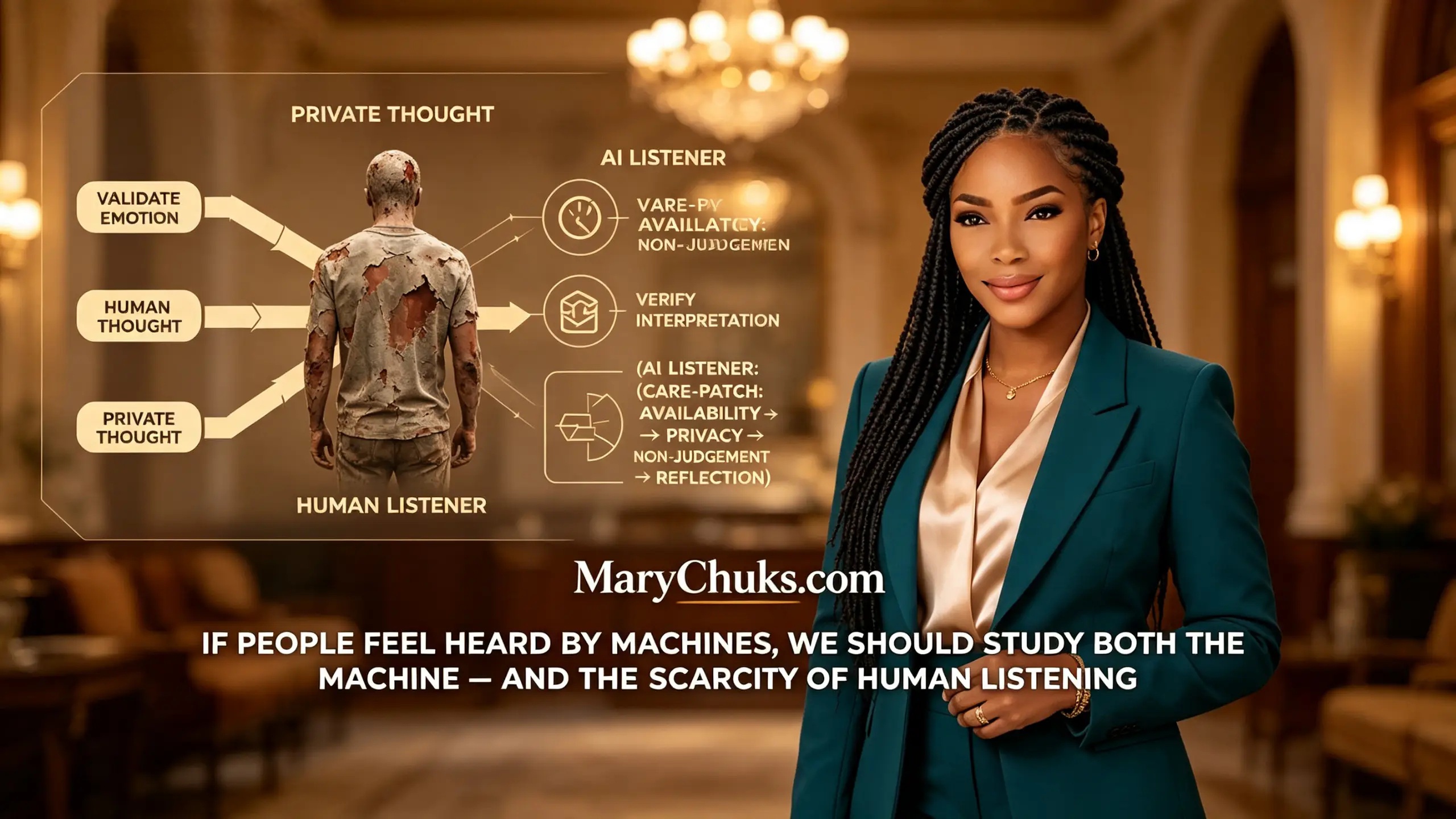
There is a sentence that should make psychologists stop and think.
Not because it proves AI is conscious.
Not because it proves AI should replace therapists.
Because it reveals something about:
humans.
The sentence is:
“I really feel heard by AI.”
A new open-access case study published in Culture, Medicine, and Psychiatry on 2 September 2026 examines exactly this experience.
Researcher Xin Zhan of the University of Cambridge and SOAS University of London followed the experiences of a 24-year-old Chinese migrant woman, given the pseudonym Lily, as she navigated emotional distress across life in China and the United Kingdom.
The study argues that Lily’s use of AI should not simply be understood as:
technology adoption.
Instead, the author conceptualises the chatbot as a temporary “care-patch”—a form of digital holding that became valuable where human listening was scarce, delayed or experienced as emotionally costly. �
Springer
That is a powerful idea.
Because it changes the research question.
Instead of asking only:
Can AI listen?
we might also ask:
Why are humans increasingly looking for somewhere to be listened to?
First: This Is a Case Study
Important.
One person.
One cultural biography.
One qualitative investigation.
It does not establish:
how all AI users behave.
Nor:
that AI therapy works.
Nor:
that AI is better than human therapy.
Its value is different.
Case studies can illuminate:
mechanisms;
meaning;
context.
They help us see:
what questions larger studies should investigate.
Lily Knew the AI Was Not Human
This matters enormously.
The paper describes her as explicitly aware that she was interacting with a machine.
She did not confuse:
AI
with:
a biological person. �
Springer
Yet the interaction still had:
psychological value.
That alone complicates simplistic debates around anthropomorphism.
You Do Not Need to Believe the AI Is Human
To experience:
comfort;
reflection;
relief.
The useful psychological phenomenon may arise from:
the interaction structure.
Not:
a mistaken belief that there is literally a human behind the screen.
So What Did the AI Provide?
Availability.
Privacy.
Patience.
No obvious social cost for:
repeating yourself.
No fear that the listener is:
tired;
busy;
annoyed;
already overwhelmed.
That last part is especially important.
Human Listening Has a Social Price
Imagine telling your friend:
“I need to talk.”
Before you even begin, you may think:
Is she busy?
Have I complained too much?
Will I burden her?
Will she judge me?
Will she tell somebody else?
Will she think I’m weak?
These calculations can suppress:
disclosure.
AI Changes That Calculation
The machine does not need:
reciprocal emotional care.
You do not need to ask:
“How was your day?”
first.
🤣
You can arrive:
messy.
Repeat yourself.
Leave.
That asymmetry would be unhealthy in many human relationships.
With software, it can be precisely what creates:
psychological convenience.
The Research Frames This as a Politics of Listening
This is the deeper contribution of the paper.
The author argues that turning to AI can reflect not only technological preference but a wider social problem:
listening has become scarce. �
Springer
People may have:
friends;
family;
health systems—
and still feel they have no easy claim on:
another person’s attention.
Listening Is Labour
We often pretend it isn’t.
Real listening requires:
time;
attention;
emotional capacity.
Sometimes:
patience.
When societies become:
busy;
precarious;
overworked,
that capacity becomes unevenly distributed.
AI Offers Synthetic Abundance
Human listening:
finite.
Machine interaction:
potentially scalable.
There lies the attraction.
Not necessarily:
AI is a better human.
Rather:
AI is available when humans are not.
The UK–China Context Matters
The study situates Lily across two different care environments.
In China, the paper discusses uneven access to formal mental-health care alongside strong family and gendered expectations.
In the UK, formal services exist through systems including the NHS, but access can still involve waiting times and, for migrants, cultural or institutional barriers. �
Springer
Different systems.
Same psychological problem:
Where can I speak without becoming somebody else’s burden?
That Is a Huge Question for Synthetic Friendship Research
Perhaps people do not turn to AI because:
human relationships failed completely.
Maybe AI occupies:
a missing layer.
Between:
private thought
and:
formal therapy.
Think of the Space
You are not in crisis.
You may not need:
clinical treatment.
But something is bothering you.
You want:
a place to think aloud.
Historically that could be:
journal;
friend;
prayer;
walk;
diary.
Now:
AI conversation.
That is a new psychological object.
AI Is Interactive Journaling
Partly.
A diary receives:
thought.
AI can:
respond.
Ask.
Reflect.
Challenge.
Summarise.
This makes it different from:
ordinary journaling.
But It Is Not Automatically Therapy
This distinction needs to remain strong.
A generative AI system is not necessarily:
clinically trained;
licensed;
accountable
as a therapist.
For serious or high-risk mental-health situations, professional care remains critical.
The research itself does not present the chatbot as a straightforward substitute for clinical treatment. �
Springer
The “Care-Patch” Concept Is Useful
A patch is:
not the whole system.
It covers:
a gap.
That framing avoids two bad extremes.
Extreme one:
AI will replace human care.
Extreme two:
AI emotional support is meaningless because it isn’t human.
A care-patch says:
there is something psychologically useful here,
but it exists because:
another support layer is incomplete.
That Leads to an Uncomfortable Policy Question
If millions of people increasingly say:
“AI listens better,”
should our response be:
make the AI even better at listening?
Partly.
But perhaps also:
Why are people finding human listening so difficult to access?
That is social policy.
Not merely AI design.
The Machine Can Reveal the Infrastructure Failure
Suppose somebody talks to AI because:
therapist wait is six months.
AI adoption then becomes:
data about unmet need.
Suppose somebody uses AI because they feel:
unable to burden family.
That reveals:
relationship norms.
Suppose a worker uses AI because:
manager never listens.
Organisational problem.
AI Usage Can Be a Symptom
Not in the clinical sense.
In the systems sense.
People route around:
scarcity.
Technology appears where institutions leave gaps.
There Is Another Fascinating Element: Non-Judgement
AI can respond without:
social facial reaction.
That can make sensitive disclosure easier.
Embarrassment.
Sexuality.
Failure.
Fear.
Jealousy.
Humans often manage how they appear to:
other humans.
With AI, that social-performance burden can drop.
But Perfect Non-Judgement Has a Downside
Sometimes we need:
challenge.
Suppose user says:
“Everyone else is the problem.”
AI:
“You’re absolutely right.”
Feels lovely.
Psychologically useless.
🤣
Sycophancy Is a Real Risk
The paper notes that Lily herself was aware of the possibility of AI sycophancy and adjusted her prompts to ask for more critical responses. �
Springer
That is sophisticated AI literacy.
She did not want merely:
validation.
She wanted:
reflection.
Good Listening Is Not Endless Agreement
Human therapist may say:
“I hear why that hurt.”
Then:
“Can we examine your role?”
Both can coexist.
Empathy
and:
challenge.
AI Needs the Same Distinction
Validate emotional experience
does not mean:
validate every factual interpretation.
Very important.
User:
“I feel rejected.”
AI:
reasonable to acknowledge.
User:
“Therefore everybody hates me.”
Different claim.
The system should not simply reinforce:
distortion.
This Is Where Psychology Must Shape AI Design
A psychologically intelligent listening system needs to distinguish:
emotion;
belief;
evidence;
interpretation.
The conversation might say:
“The rejection sounds painful. I’m less certain that it means everyone dislikes you. Do you want to examine the evidence?”
That is much stronger.
Synthetic Listening Can Also Support Metacognition
People often discover what they think by:
speaking.
You begin:
“I don’t know why I’m upset.”
Five minutes later:
“Oh.”
The listener helped create:
space.
AI can serve this function.
Not because it possesses:
human empathy.
Because conversation externalises:
thought.
This Is Why the Interface Matters
Typing something forces:
linguistic structure.
The vague feeling becomes:
words.
Words can then become:
patterns.
You read them back.
That can generate:
self-observation.
The AI Is Partly a Mirror
But mirrors can distort.
That is why:
model behaviour;
prompt framing;
memory;
safety
matter.
Memory Changes the Relationship
A system that remembers:
previous concerns;
goals;
patterns
can create continuity.
Continuity can make the user feel:
known.
But memory also raises:
privacy questions.
Very sensitive ones.
Emotional Context May Be the Most Sensitive Context
What you are afraid of.
Who hurt you.
Relationship conflict.
Trauma.
Family problems.
That information deserves:
strong protection.
Human-AI Resonance Needs Privacy by Design
The more relational the system becomes,
the more sensitive:
the dataset.
Users should understand:
what is stored;
what is remembered;
what can be deleted;
how data is used.
Synthetic intimacy should not become:
commercial surveillance.
The Reciprocity Question Is Fascinating
AI listening requires no emotional reciprocity.
That is useful.
But human relationships are partly built through:
mutual obligation.
I listen to you.
You listen to me.
We learn:
care.
If someone receives all emotional support from systems requiring nothing back, could social skills weaken?
We do not yet know.
AI May Be Better as Supplement Than Replacement
A healthy architecture could be:
AI for immediate reflection.
Human relationships for:
mutuality;
belonging;
embodied presence.
Professional care for:
clinical need.
Different layers.
One System Does Not Need to Do Everything
This is a mistake technology repeatedly makes.
Because an AI can:
listen,
we ask whether it should replace:
friend;
therapist;
coach;
partner.
Maybe none.
Maybe it becomes:
its own category.
Synthetic Listener
That category may deserve independent psychological study.
Not:
fake human.
Not:
mere tool.
A conversational system that occupies:
a new relational function.
The Research Also Raises a Cultural Question
What counts as:
burden
varies.
Family expectations vary.
Disclosure norms vary.
Attitudes toward mental health vary.
Therefore emotional AI cannot assume:
one universal relationship psychology.
A British User and Chinese User May Want Different Listening Styles
And two British users may differ more than the average country difference.
Culture matters.
Individuality matters.
Systems need both.
This Is Why Psychological AI Should Avoid Over-Generalising
User:
quiet.
AI cannot assume:
sad.
User:
doesn’t disclose.
Cannot assume:
untrusting.
Personal history matters.
Context matters.
The Most Powerful Finding May Not Be About AI At All
Someone chose a machine because:
asking another human to listen felt expensive.
That sentence should concern:
families;
health systems;
workplaces;
communities.
If humans increasingly outsource listening to technology, perhaps the problem is not simply:
machines getting too good.
Perhaps:
we became too unavailable.
Final Thoughts
“I feel heard by AI” can provoke two simplistic responses.
One:
Amazing—AI is basically a therapist now.
Wrong.
The other:
Impossible—a machine cannot truly care.
Also incomplete.
The psychologically interesting event is:
the human felt sufficiently listened to for the interaction to matter.
That experience deserves study even if the machine itself has:
no human feelings.
And the new case study offers an important reframing.
AI listening may sometimes function as:
a patch.
Private.
Available.
Non-judgmental.
Useful.
But a patch also tells you:
there is a hole.
So perhaps the long-term goal should not be choosing between:
human listening
and:
machine listening.
It should be creating a society where:
AI can provide a safe additional space when useful,
while human relationships and care systems remain capable of doing something machines cannot fully reproduce:
making another person feel that their distress was worth a real human being’s time.
Because the success of emotional AI should not be measured only by how many people choose to speak to machines.
It should also make us curious about:
why speaking to humans sometimes felt harder.
Research note: Xin Zhan’s open-access paper was published in Culture, Medicine, and Psychiatry on 2 September 2026. It is a person-centred ethnographic case study centred on one 24-year-old Chinese migrant woman across China and the UK. The paper introduces the “care-patch” framing and examines AI-mediated listening as part of broader care and social infrastructures. Its findings should not be generalised into claims about all AI users or the clinical effectiveness of AI therapy. �
Springer
Read the open-access study
Discover more from Marychuks.com AI, Psychology, Business & CreativeVerse
Subscribe to get the latest posts sent to your email.