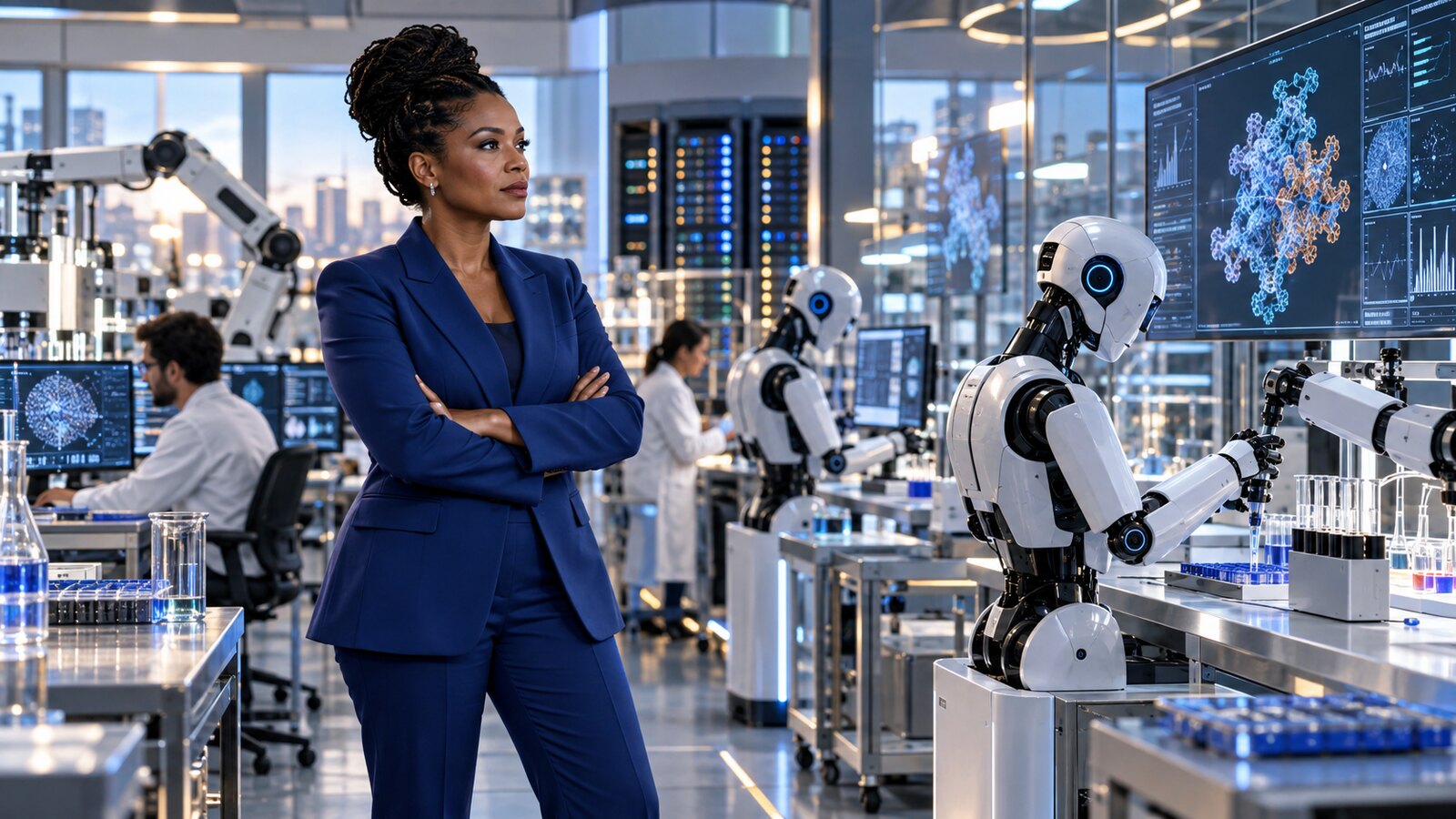

OpenAI says it has reached a milestone it forecast last year: an automated “research intern” capable of completing well-defined assignments that might occupy a skilled researcher for several days. That is not the same as an independent scientist—but it could still change the speed, cost and organisation of discovery.
In a research update published on 6 September 2026, OpenAI defined the system carefully. It works under human direction, tackles bounded research tasks and is being used inside a larger workflow in which researchers contribute code faster and run more experiments. The company’s longer-term target is an automated AI researcher by March 2028.
An intern is not an autonomous scientific authority
The word “intern” matters. A capable intern can search literature, prepare code, compare hypotheses, run controlled experiments and summarise evidence. The principal investigator still defines the question, approves methods, interprets ambiguous results and decides what is safe to pursue.
This distinction prevents two opposite mistakes. The first is dismissal: treating the system as another chatbot when it can sustain multi-step research work. The second is exaggeration: assuming that longer autonomous activity automatically gives the machine scientific judgement, responsibility or consciousness.
MaryChuks.com previously examined China’s AREX autonomous-research project and Anthropic’s early work on AI systems improving AI. OpenAI’s milestone adds another signal: research automation is moving from demonstration towards daily institutional practice.
Why research acceleration is different from ordinary productivity
A faster email draft saves minutes. A faster research loop can alter the rate at which an entire technical field advances. An agent can generate an experimental plan, implement code, diagnose a failed run and launch a revised test while several other agents explore competing approaches. That compresses not one task but the cycle between question, evidence and correction.
The valuable unit is therefore not the number of tokens produced. It is the number of reliable learning loops completed. If an organisation can test ten plausible ideas instead of one, it may find better solutions sooner. If it automates weak assumptions, however, it can also manufacture error at unprecedented speed.
Human oversight must be part of the laboratory design
Supervision cannot mean placing a human name at the end of an automated process. A credible laboratory needs explicit controls: who may start a run, which resources agents may access, what requires approval, how anomalies are logged, when a project pauses and who is accountable for publication.
- Question control: humans define the research objective and unacceptable routes.
- Environment control: agents work inside isolated systems with bounded permissions.
- Evidence control: results must be reproducible rather than merely persuasive.
- Interpretation control: specialists examine whether the measurement supports the conclusion.
- Release control: external claims receive independent review and appropriate safety checks.
That approach follows the principle behind the MaryChuks AI Verification Workflow: generation and validation are different jobs. A system that can produce a hypothesis is not automatically the system that should certify it.
The scientific opportunity is enormous
Research agents could make advanced exploration available to smaller laboratories, universities and countries that cannot employ enormous specialist teams. They could help examine neglected diseases, materials, energy systems, climate adaptation and AI alignment. The biggest social gain may come not from replacing elite researchers, but from extending high-quality experimental capacity beyond a few well-funded institutions.
OpenAI argues that an automated researcher might also become an automated safety researcher. That is possible, but it is not guaranteed. The same acceleration can discover protections and vulnerabilities. Governance must therefore scale with capability instead of arriving after deployment.
What research leaders should prepare now
Universities and companies do not need to wait until 2028 to prepare. They can document which research stages are suitable for delegation, build secure experimental environments, require provenance for agent-produced code and reward replication alongside novelty. They should also teach researchers to challenge an AI-generated result rather than becoming impressed by its fluency.
The recent report that AI produced advances across ten mathematics problems showed why human verification remains essential. Automated research may create more candidate discoveries. It does not remove the burden of proving which discoveries survive contact with reality.
MaryChuks perspective: model intelligence creates capability; a disciplined research system converts capability into knowledge. The future laboratory will be neither human-only nor AI-only. It will be a governed partnership in which machines multiply exploration while humans retain purpose, responsibility and the authority to stop.
Call to action: Join the MaryChuks.com newsletter for practical analysis of AI research, psychology and human–AI collaboration.
Question: Which scientific task would you trust an AI research intern to perform today—and which decision must remain human?
Source
Discover more from Marychuks.com AI, Psychology, Business & CreativeVerse
Subscribe to get the latest posts sent to your email.