By Mary Oge Chuks
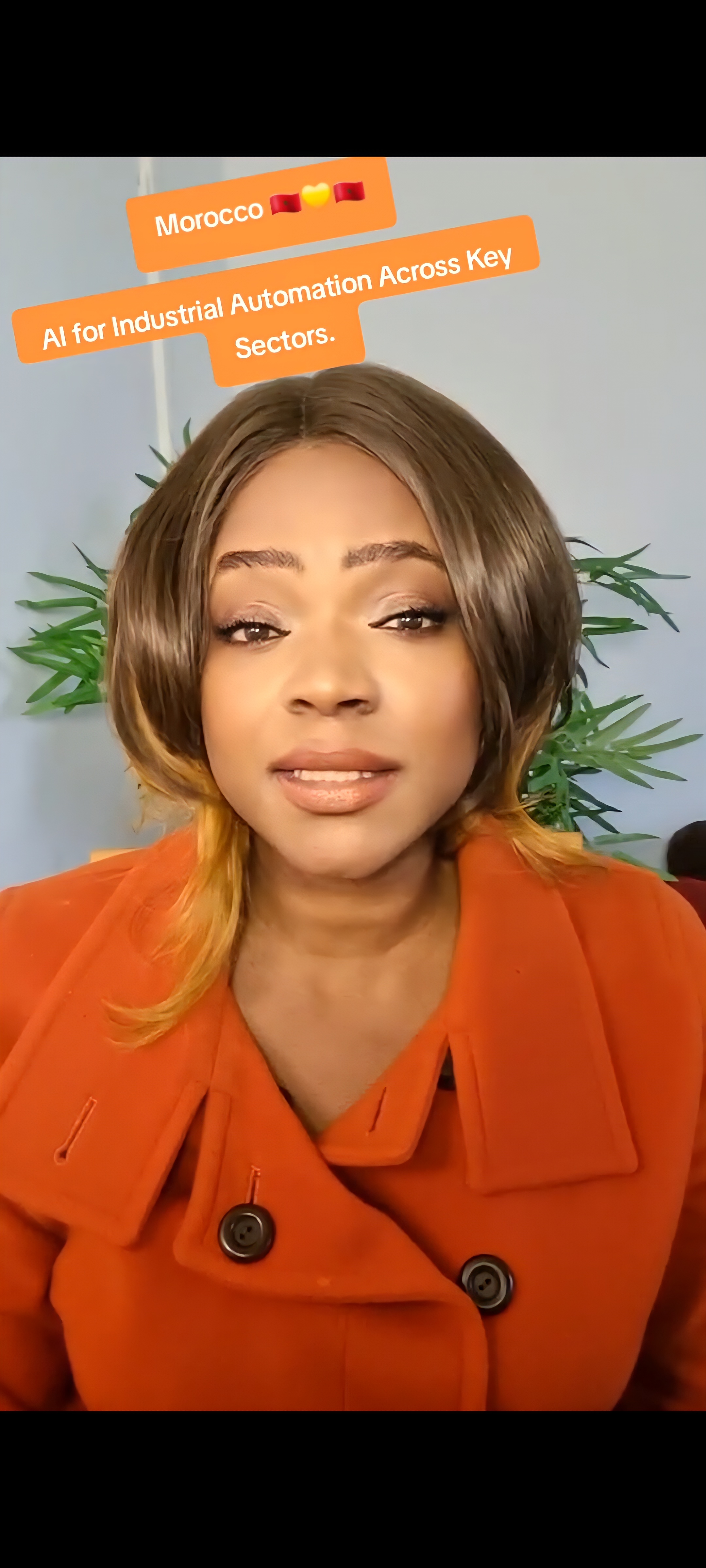
In 2024, I published a video exploring how artificial intelligence could reshape education, healthcare, mining, agriculture and manufacturing in Morocco. Looking back, the question behind that video remains compelling: what happens when we connect intelligent tools to the everyday systems people depend on?
The video was titled “Morocco: AI for Industrial Automation Across Key Sectors.” Its scope went beyond factory automation. It imagined a broader transformation—one in which learning, care, food production and industrial work could benefit from better information and more responsive services.
A note on the original video
This article revisits my 2024 creative vision; it is not a verified inventory of technologies operating throughout Morocco in that year. Some examples in the original narration were expressed more confidently than the available evidence supports.
The named “MadrasaTech” personalised-learning example has not been independently verified for this article. Nor have the specific claims about AI-equipped rural clinics, improved crop yields in Souss-Massa or predictive maintenance at Tangier automotive plants. Here, those examples are discussed as potential applications, rather than confirmed local deployments. The original video is preserved as part of my creative archive.
1. Education: Learning that responds to the student
Imagine a classroom where a student who needs another explanation receives one, while a student ready for a greater challenge can move forward.
That was the educational possibility at the heart of my video. Adaptive learning tools could help teachers identify difficulties and provide practice suited to different learners. For a rural student, useful digital support might also widen access to learning materials.
But access to a tablet does not automatically create educational inclusion. Connectivity, language, accessibility and teacher support determine whether a tool is useful. A system must also avoid treating a temporary difficulty as a permanent limit on a child’s ability.
The goal should be to expand the teacher’s capacity to support students—and to judge success by meaningful learning.
2. Healthcare: Better support for clinical decisions
My healthcare segment imagined digital tools helping clinicians interpret information and connect patients with specialist care.
Two ideas need separating: telemedicine connects people remotely; AI analyses information. A remote consultation does not necessarily use AI, and an AI-generated result does not establish a diagnosis.
For Morocco’s healthcare future, the useful question is where carefully evaluated tools could strengthen existing services. Any proposed application needs evidence of accuracy in the population it serves, protection for patient information and clear clinical responsibility.
A convincing demonstration is a starting point. Reliable care requires much more.
3. Mining: Efficiency must include environmental accountability
The mining sequence explored how geological analysis and operational data might support better decisions.
Possible applications include identifying equipment problems earlier, comparing extraction options and monitoring resource use. However, greater productivity does not automatically mean less environmental harm.
If a system makes extraction cheaper but encourages a larger total volume, its environmental effect may differ from the promotional story. Water use, energy consumption, waste and land disturbance must be assessed alongside production.
My strongest takeaway from this section is that “smart mining” should describe measurable improvements, including environmental performance.
4. Agriculture: Useful intelligence must reach the farmer
The agricultural vision was practical: help farmers understand what is happening in their fields early enough to respond.
Sensors, aerial imagery and analytical tools could support decisions about irrigation, crop stress and disease monitoring. Their value depends on whether the information is accurate, affordable and actionable.
A farmer needs advice that fits the crop, the local conditions and the resources available. The farmer also needs a way to question an unreliable recommendation.
The original script referred to improved yields and reduced waste in Souss-Massa. Without a verified project and measured results, that should remain an aspiration rather than a claimed outcome.
5. Manufacturing: Smarter production, with a place for workers
My factory sequence imagined predictive maintenance and robotics helping production run more smoothly.
Robotics, automation and AI overlap, but they are not interchangeable. A robot can carry out a programmed task without using AI. Predictive maintenance involves anticipating equipment problems from available information; its effectiveness must be demonstrated.
The human question matters just as much. Automating repetitive work does not guarantee that workers move into creative roles. Training, job design and opportunities for progression need deliberate investment.
A successful factory transformation should improve reliability while giving workers a credible place in the new system.
The idea I want to carry forward
Revisiting this video reminds me why I create future-focused content: to make possibilities visible and invite people to examine them.
The next step is to connect that imagination to evidence. Who benefits? What improves? What does it cost? Who remains responsible when a system fails?
For Morocco—and for the wider African conversation about AI—the ambition is worth exploring. Its value will ultimately be demonstrated in people’s lives.
Which of these five sectors would you prioritise, and what result would convince you that AI was making a meaningful difference?
#AIInMorocco #DigitalTransformation #AIInAfrica #AIInEducation #AIInHealthcare #SustainableMining #AIForAgriculture #SmartFactories #FutureOfWork
Discover more from Marychuks.com AI, Psychology, Business & CreativeVerse
Subscribe to get the latest posts sent to your email.