Every 2 October, the United Nations marks the International Day of Non-Violence on the birthday of Mahatma Gandhi. The date matters, but the harder question is what non-violence demands after the commemorative post has disappeared from the timeline.
Non-violence is often misread as politeness, silence or an obligation to endure harm without resistance. That is too shallow. In public life, it can be a disciplined method of opposing injustice while refusing to make physical harm the instrument of change. In families, workplaces and communities, it can mean reducing danger, protecting dignity and creating a route from accusation to accountable action.
The United Nations says the observance exists to spread the message of non-violence through education and public awareness. General Assembly resolution A/RES/61/271, adopted in 2007, affirmed the principle’s universal relevance and linked it to a culture of peace, tolerance and understanding. Those are official commitments. Whether institutions and leaders embody them is an evidence question, not something a slogan can settle.
Begin with a crucial distinction
Conflict is not the same as violence. People can disagree intensely about power, money, rights, history or responsibility without threatening bodies or treating opponents as less than human. Indeed, suppressing every disagreement may preserve the appearance of calm while allowing the underlying harm to grow.
A serious non-violent approach therefore asks two questions at once: How do we prevent harm? and How do we confront the issue rather than bury it? If a process answers only the first by silencing the weaker party, it is not a credible peace process. If it answers only the second by escalating humiliation and retaliation, it may reproduce the very domination it claims to oppose.
The six-part practical test
1. Is the objective concrete?
“We want justice” expresses a moral direction, but a campaign also needs an actionable demand: publish the records, change the rule, release the funds, investigate the allegation, protect the threatened group, or create an independent review. A precise objective lets supporters coordinate and gives decision-makers something they can accept, reject or negotiate.
Precision also limits opportunism. When no one can state the desired change, charismatic figures can continuously redefine victory, prolong mobilisation or claim success without delivering anything measurable.
2. Are people treated as participants rather than instruments?
Non-violent organising still carries risks: arrest, retaliation, online harassment, lost income, trauma and exposure. Leaders should explain foreseeable risks, avoid pressuring vulnerable people into front-line roles and provide meaningful ways to participate at different levels. Consent matters in activism as much as it matters elsewhere.
This is especially important when adults mobilise children, employees, migrants, disabled people or anyone dependent on the organisers. Moral urgency does not cancel a duty of care.
3. Is the method matched to the objective?
A petition can demonstrate breadth but may not change a closed institution. A boycott can create economic pressure but may also affect workers who did not make the contested decision. A march can build visibility, while negotiation can convert visibility into terms. Documentation can preserve truth even when immediate reform is blocked.
No tactic is automatically virtuous or effective. The relevant test is whether it moves the defined objective forward while keeping the likely harm proportionate and visible. This is analysis, not romanticism.
4. Are de-escalation and safety designed in advance?
“Stay peaceful” is not a safety plan. Organisers need roles, routes, communication channels, accessibility arrangements, emergency contacts, legal information and clear responses to provocation. Participants should know who can pause an action and how verified instructions will be distinguished from rumours.
The right of peaceful assembly is protected under international human-rights law. The UN Human Rights Committee’s General Comment No. 37 explains that peaceful assemblies can take many forms and that isolated violence by some participants should not automatically be attributed to others. That legal principle does not remove real-world risk; it shows why authorities, journalists and organisers should avoid treating a diverse crowd as one undifferentiated actor.
5. Does the language leave a route back to shared life?
Strong criticism is compatible with non-violence. Dehumanisation is not. Language that describes a harmful decision, identifies responsibility and demands repair is different from language that portrays whole populations as vermin, traitors or legitimate targets.
This is not a request to soften facts. It is a strategy for keeping accountability attached to evidence. Once a movement treats identity as proof of guilt, it becomes easier to punish bystanders and harder to build the coalition needed for durable change.
6. Is there an accountable pathway after the confrontation?
A powerful demonstration may open a door; it does not implement a settlement. Someone must record commitments, define deadlines, verify compliance and report breaches. If representatives negotiate, participants should know their mandate. If an institution promises reform, the public should be able to inspect what changed.
This is where non-violence becomes institutional rather than merely symbolic. The UN’s broader Declaration and Programme of Action on a Culture of Peace connects peace with education, human rights, equality, democratic participation, development, tolerance and the free flow of information. The implication is important: peace is not simply the absence of a visible clash. It depends on systems that allow people to participate, know what is happening and challenge power without being destroyed by it.
Non-violence does not require remaining in danger
Personal safety must not be confused with public symbolism. Someone facing domestic abuse, stalking, credible threats or an escalating confrontation does not have to stay and reason with the aggressor. Leaving, seeking emergency help, using safeguarding services and following professional advice can be the most responsible action.
Likewise, bystanders should not improvise interventions that create additional victims. De-escalation depends on context, capability and a safe exit. The ethical aim is to reduce harm—not to perform bravery for an audience.
How to read a “peaceful” claim critically
Governments, organisations and movements all use the language of peace. Readers should examine conduct, not branding. Ask:
- Who is permitted to speak, assemble and report?
- Who bears the cost of keeping order?
- Are independent records available?
- Are grievances answered or merely managed?
- Are allegations investigated under a fair process?
- Can participants leave, dissent or change their minds?
- What happens when commitments are broken?
These questions distinguish evidence from interpretation. A calm photograph is evidence only of what appeared inside one frame. It does not prove the absence of coercion outside it. Conversely, one disruptive incident does not necessarily describe an entire movement. Responsible judgement requires time, multiple sources and attention to incentives.
A seven-line non-violence plan
Before a difficult meeting, campaign or public action, write seven lines:
- Problem: What specific harm is occurring?
- Objective: What observable change is required?
- People: Who is affected, who decides and who may be placed at risk?
- Method: Why is this tactic suitable?
- Limits: What will participants not do?
- Safety: How will risk, accessibility, provocation and emergencies be handled?
- Follow-through: Who records commitments and verifies results?
This small discipline will not solve every conflict. It will expose empty rhetoric, unclear demands and unmanaged risk before they become somebody else’s burden.
The useful takeaway
Non-violence is not the refusal to cause discomfort. Accountability often is uncomfortable. It is the refusal to use physical harm, dehumanisation and uncontrolled retaliation as shortcuts to change—combined with the courage to organise, document, negotiate and persist.
On 2 October, the most meaningful tribute is not simply to praise peace. It is to design a process in which truth can be spoken, people can remain safe, power can be challenged and agreements can be checked.
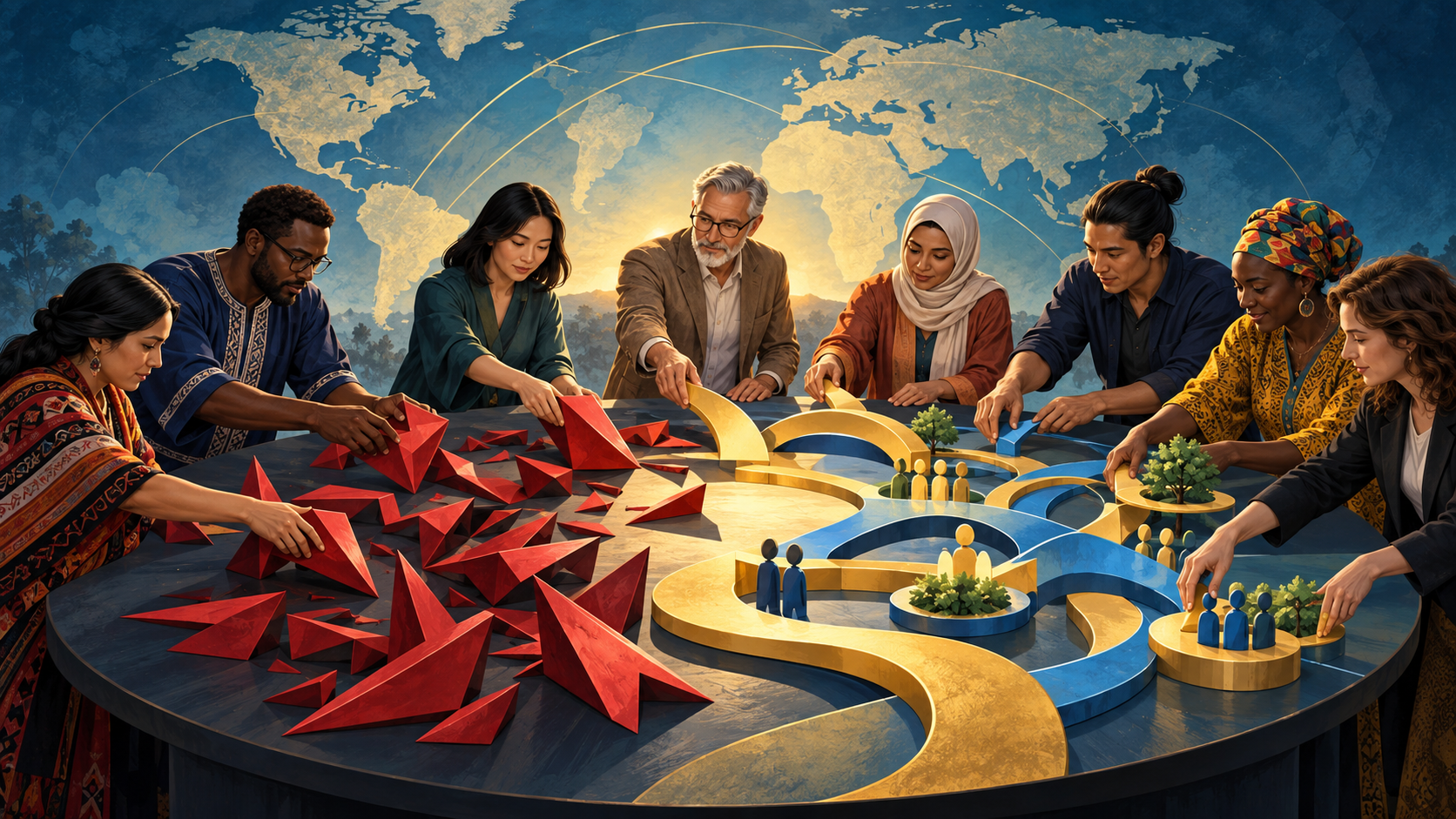
Featured image disclosure: the featured image is an original conceptual AI illustration. It does not depict a real meeting, protest or historical event.
Sources
- United Nations: International Day of Non-Violence
- UN General Assembly resolution A/RES/61/271
- OHCHR: General Comment No. 37 on peaceful assembly
- UN Declaration and Programme of Action on a Culture of Peace
Discover more from Marychuks.com AI, Psychology, Business & CreativeVerse
Subscribe to get the latest posts sent to your email.