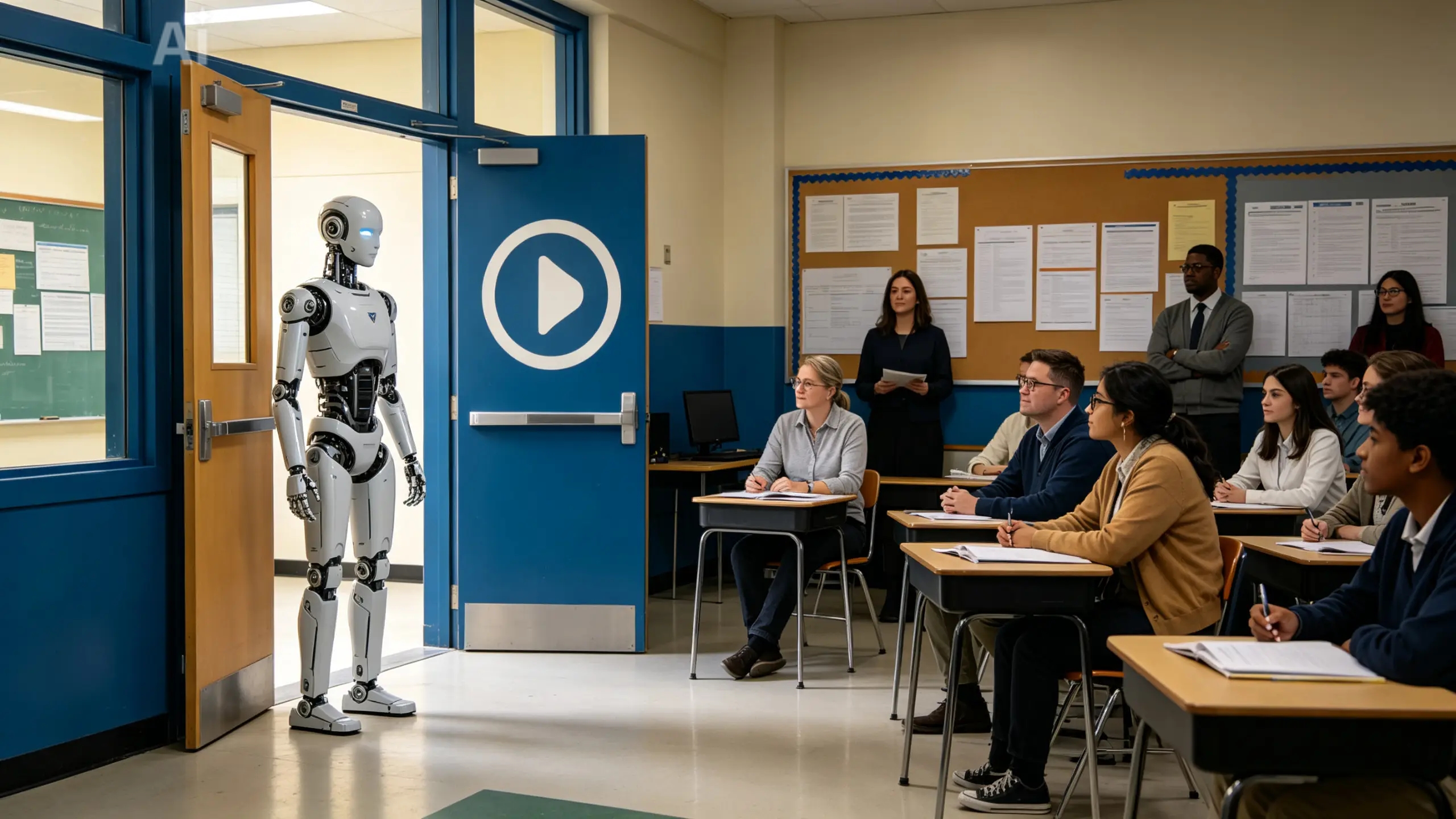
A New York school district’s plan to place a lifelike humanoid robot in a classroom has been paused following objections from teachers, education officials and local residents.
Salamanca City Central School District intended to introduce an AI-powered Realbotix humanoid as a teaching assistant during the 2026 school year. The approximately $58,000 to $60,000 project was promoted as an opportunity for students in a rural area to experience emerging technology without travelling long distances. �
AP News +1
The proposal instead produced a national argument about consent, student privacy, educational priorities and whether a human-looking robot belongs in a classroom.
What Was the Robot Supposed to Do?
District leaders described the machine as an educational assistant rather than a replacement teacher.
It could reportedly present approved material, demonstrate AI and robotics, and allow students to learn how such systems are maintained, updated and repaired. �
The Guardian +1
Supporters argued that students should not be excluded from advanced technology simply because they live far from major technology centres.
That educational goal is reasonable.
The controversy arose from how the project was selected, communicated and governed.
Why Teachers and Residents Objected
Educators questioned whether the money would be better spent on human staff, conventional classroom resources or proven educational technology.
Others raised concerns about:
Student-data collection
Camera and microphone access
Parental consent
The robot’s physical appearance
The lack of clear statewide rules
Community consultation
The manufacturer’s wider commercial history
The state teachers’ union argued that the district needed stronger safeguards and clearer oversight before placing the technology around children. �
The Guardian +1
The district subsequently paused the pilot while working through enhanced student-data privacy arrangements and consulting the community. �
New York Focus +1
Why the Story Went Viral
The phrase “robot teacher” activates a powerful fear: that schools will respond to staffing and funding problems by replacing human educators with machines.
The robot’s humanlike appearance made the proposal more emotionally charged than an ordinary educational application running on a laptop.
People do not react to a humanoid simply as software. They interpret its face, voice and movement socially.
That can produce curiosity, discomfort or misplaced trust—especially among children.
Can Robots Help in Education?
Yes, but usefulness depends on the role.
Robots may help demonstrate programming, language interaction, engineering and assistive technology. They could support controlled simulations or allow students to explore how embodied AI works.
But teaching is not only information delivery.
Human teachers notice:
A child becoming withdrawn
Confusion hidden behind silence
Conflict between pupils
Changes in behaviour
Family and cultural context
When a lesson needs to stop
When encouragement matters more than another explanation
A robot may recognise patterns, but human education also involves duty, judgement and accountable relationships.
The Community Context
Salamanca serves a community with a significant Native American population, and some local educators argued that the district should have consulted more carefully before using its students as early participants in an unusual technology pilot. �
The Guardian +1
That concern goes beyond this one machine.
Communities that have historically been subjected to decisions from outside institutions may reasonably demand a stronger voice before experimental systems enter their schools.
Mary Chuks’ Perspective
Innovation should enter the classroom through trust, not surprise.
Schools should not ask merely, “Can this machine teach?”
They should ask:
What educational problem are we solving?
Why is this better than existing options?
What information does it collect?
Who is accountable for mistakes?
How were teachers, parents and students involved?
What happens when the technology fails?
A school can prepare children for an AI future without turning them into involuntary test subjects.
Practical Safeguards for School AI
Before deploying humanoid or agentic AI, schools should require:
Independent privacy and security assessments.
Clear parental and student consent.
Teacher control over every classroom interaction.
No facial or emotion recognition without strong legal justification.
A published description of data collection and retention.
Evidence that the technology solves a genuine educational need.
A limited pilot with independent evaluation.
A guaranteed right to withdraw.
Conclusion
The paused robot-teacher project is not proof that AI has no place in education.
It is proof that novelty is not a substitute for governance.
A machine may be able to walk into a classroom. Trust must be invited in more carefully.
Original Sources and Further Reading
Original local investigation: New York Focus, “NY School District Hits Pause on Robot Teacher Amid Scrutiny.” �
New York Focus
Independent reporting: Associated Press, “New York School Pauses Plan to Deploy Humanlike AI Robot Teacher After Backlash.” �
AP News
Educator perspective: The Guardian’s reporting on teachers’ concerns and community response. �
Discover more from Marychuks.com AI, Psychology, Business & CreativeVerse
Subscribe to get the latest posts sent to your email.