When astronaut John Glenn prepared to orbit Earth in 1962, NASA’s electronic computers had already produced the mission’s trajectory figures. Yet he wanted a human mathematician to check them. That mathematician was Katherine Johnson.
The episode is often retold as a comforting story about human genius defeating a machine. Its deeper lesson is more useful. Johnson’s value did not come from opposing technology. It came from understanding the mathematics well enough to test a new system, explain its outputs and make uncertainty manageable when the stakes were human life.
Her career also exposes a contradiction in twentieth-century American science: institutions could depend on the expertise of Black women while restricting their opportunities and recognition. Johnson’s biography is therefore not only a story of exceptional talent. It is a study of preparation, institutional barriers, authorship, trust and the conditions under which expertise becomes visible.
A child who moved faster than the curriculum
Katherine Coleman was born on 26 August 1918 in White Sulphur Springs, West Virginia. According to NASA’s official biography, her ability with numbers moved her ahead several grades. By 13 she was attending high school on the campus of West Virginia State College; at 18 she enrolled at the college itself.
She studied mathematics and French, graduated with highest honours in 1937 and became a teacher. Her education was not simply a sequence of individual triumphs. Mentorship mattered. NASA’s account identifies mathematician W. W. Schieffelin Claytor—only the third African American to earn a doctorate in mathematics—as an important mentor who recognised and extended her ability.
In 1939, she was selected as one of three Black students offered places when West Virginia began integrating its graduate schools. She entered the graduate mathematics programme at West Virginia University, then left after the first session to begin a family. That decision complicates the tidy myth that important careers always follow a straight line. Johnson returned to teaching before a new opportunity redirected her life.
From teacher to human computer
In 1952, a relative told Johnson about openings at the National Advisory Committee for Aeronautics, or NACA, the organisation that preceded NASA. She joined Langley’s West Area Computing section in 1953. The unit was staffed by Black women who performed demanding calculations in a segregated workplace.
Within weeks, Dorothy Vaughan assigned Johnson to the Maneuver Loads Branch of the Flight Research Division. Her temporary placement became permanent. She analysed flight-test data and contributed to an investigation of a crash caused by wake turbulence. This early work matters because it shows that her spaceflight achievements were built on years of applied aeronautical analysis, not a sudden moment of inspiration.
Sputnik’s launch in 1957 accelerated the American space programme. Johnson moved with the engineers who formed the Space Task Group as NACA became NASA. Her work shifted from aircraft data towards the geometry and mechanics of putting people into space and bringing them home.
Turning a destination into equations
Orbital flight is not simply a matter of pointing a rocket upwards. Engineers must connect launch conditions, velocity, Earth’s rotation, trajectory, tracking and re-entry so that a spacecraft arrives where recovery teams expect it. Johnson helped make those relationships calculable.
She performed trajectory analysis for Alan Shepard’s Freedom 7 mission in May 1961, the first American human spaceflight. A year earlier, she and engineer Ted Skopinski had co-authored the technical report Determination of Azimuth Angle at Burnout for Placing a Satellite Over a Selected Earth Position. NASA records that this was the first time a woman in the Flight Research Division received author credit on a research report.
Authorship is not ceremonial. It attaches names to reasoning, makes contributions traceable and influences who is remembered as a producer of knowledge. Johnson’s credit signalled a shift from being treated as an anonymous calculating resource towards recognition as a research mathematician.
Why John Glenn asked for her check
For Glenn’s Friendship 7 mission, IBM computers calculated orbital equations across a network of tracking stations. Electronic computation promised speed and scale, but it was still new enough for failures and inconsistencies to worry the people whose lives depended on it.
NASA’s biography records that Glenn asked for Johnson to run the computer’s figures through the same equations by hand on her mechanical calculator. He was prepared to fly if her results agreed. The crucial point is not that hand calculation was inherently superior. It is that trust was created through an independent method operated by someone with deep domain knowledge.
Modern technical teams would call this verification, redundancy or human oversight. But those words can become empty if no one has the authority, time and expertise to challenge the automated result. Johnson was not a decorative “human in the loop”. Her judgement mattered because she could reproduce the logic and recognise whether an answer was plausible.
Beyond one famous orbit
Reducing Johnson’s career to Glenn’s request hides its breadth. She identified her work connecting Apollo’s lunar module with the command and service module in lunar orbit as her greatest contribution. She also worked on the Space Shuttle and the Earth Resources Technology Satellite, later renamed Landsat.
NASA credits her with authoring or co-authoring 26 research reports. She retired in 1986 after 33 years at Langley. Her work crossed a major technological transition: from teams of human computers using mechanical tools to increasingly powerful electronic computing. Rather than being displaced by that transition, she helped make the new systems dependable.
Recognition arrived, but history should remain precise
In 2015, President Barack Obama awarded Johnson the Presidential Medal of Freedom. The White House archive describes her as a pioneer whose computations influenced major American space programmes from Mercury through the Shuttle era. She died on 24 February 2020 at the age of 101.
Late recognition is valuable, but celebration can flatten the history it tries to repair. Johnson did not work alone, and NASA’s achievements depended on many mathematicians, engineers, technicians and administrators—including other Black women whose labour was long under-credited. Honouring her properly means seeing both her individual excellence and the wider system that made such excellence harder to exercise and easier to overlook.
Five lessons from Katherine Johnson’s career
- Foundations create flexibility. Deep mathematical understanding allowed Johnson to move across aeronautics, orbital mechanics and Earth observation.
- Mentorship changes trajectories. Talent develops faster when teachers recognise it and provide harder problems, access and expectation.
- Verification requires real competence. Oversight is meaningful only when the reviewer can interrogate the system rather than merely approve it.
- Credit is part of technical integrity. Naming authors preserves accountability and shapes who future generations believe can produce knowledge.
- Innovation is institutional as well as technical. A powerful computer does not remove bias, hierarchy or exclusion; organisations must redesign access and authority too.
The mathematics behind trust
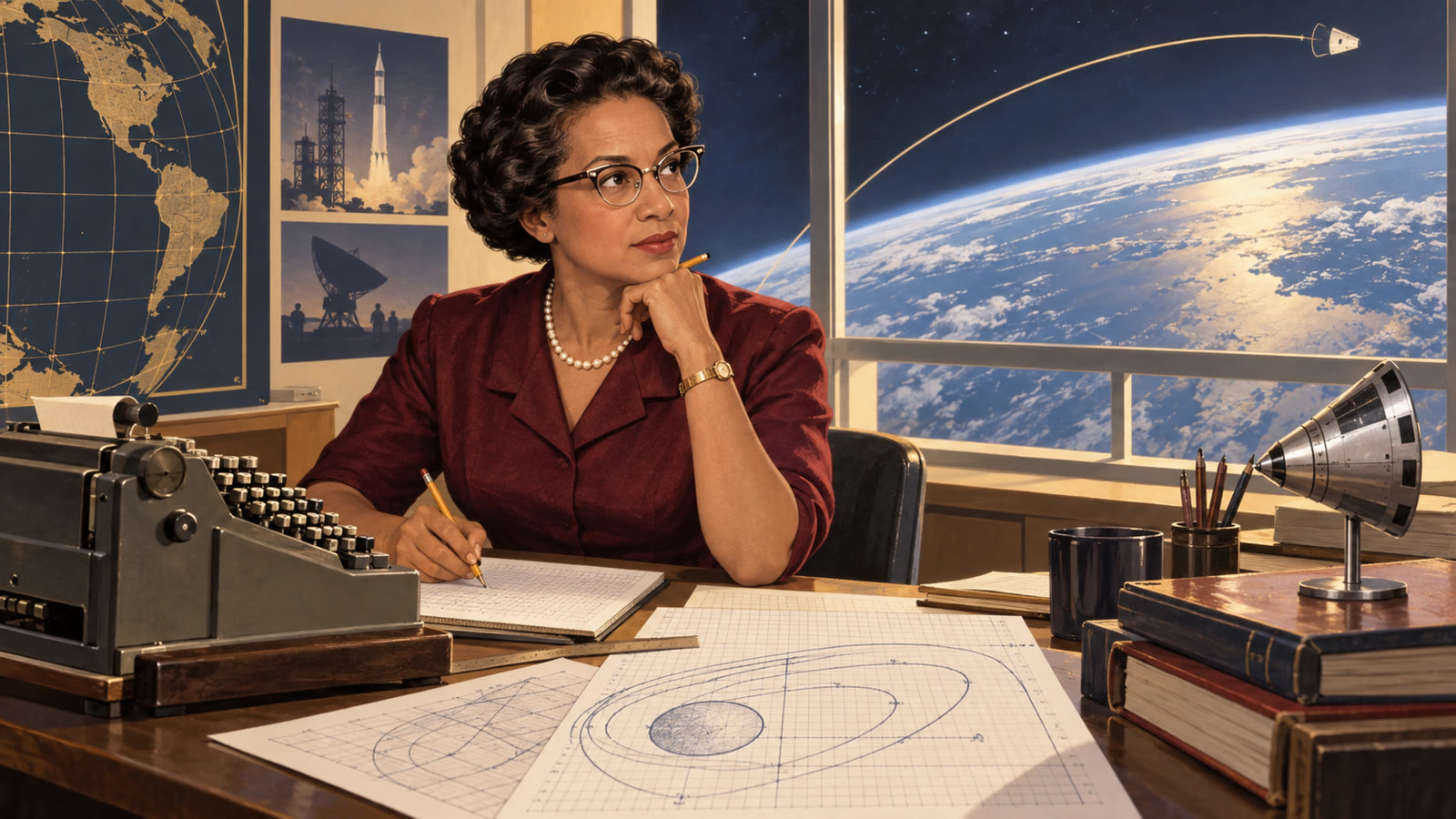
Katherine Johnson’s legacy is often symbolised by a spacecraft tracing a clean arc around Earth. The harder achievement occurred beneath that arc: years of study, repeated calculations, careful authorship and the confidence to stand behind an answer.
She helped NASA convert uncertainty into decisions that astronauts could act upon. In an age newly preoccupied with automated systems, that may be her most contemporary lesson. Trust should not be demanded because a machine is fast or a person is famous. It should be earned through transparent methods, independent checking and expertise with the authority to say when the numbers do—or do not—make sense.
Discover more from Marychuks.com AI, Psychology, Business & CreativeVerse
Subscribe to get the latest posts sent to your email.