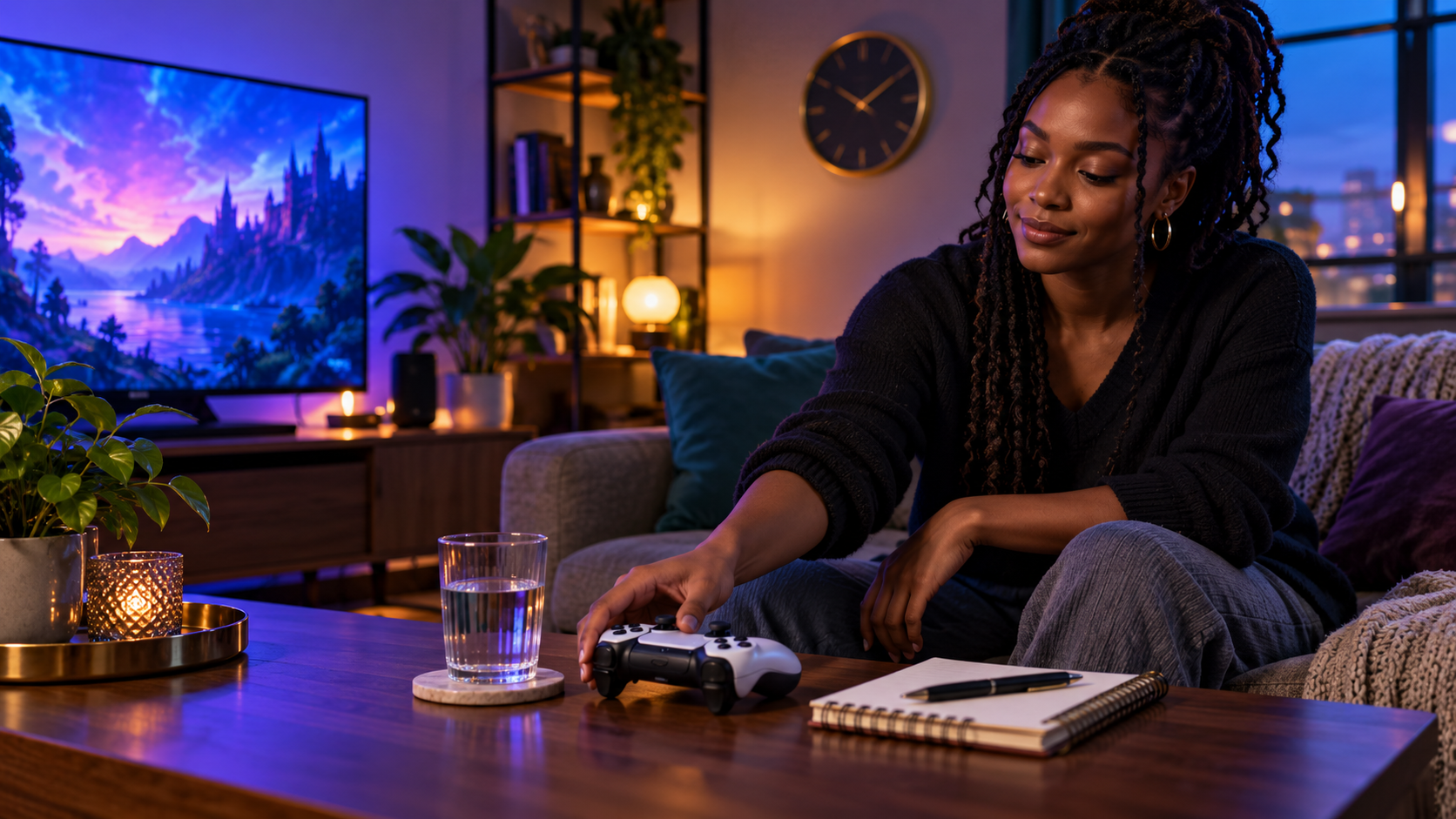
A gaming session can be restorative, social and absorbing. The problem begins when “one more match” repeatedly steals sleep, work, movement or relationships—and when stopping feels less like a choice than a negotiation you keep losing.
The answer is not to treat every long session as an illness or turn leisure into another productivity contest. A better goal is simpler: make gaming fit the life you want, rather than allowing the game’s reward loop, social pressure or endless structure to decide when your evening ends.
Start with the right question
“How many hours is too many?” sounds precise, but it is often the wrong first question. Ten hours played during a free weekend does not tell you the same story as two hours that repeatedly cause missed medication, abandoned coursework or conflict at home.
The World Health Organization’s ICD-11 explanation focuses on a pattern of impaired control, gaming taking increasing priority over other activities, continued play despite negative consequences and significant impairment in important areas of life. It also says the pattern would normally be evident for at least 12 months before a diagnosis. That is a high clinical threshold—not a label for enjoying games enthusiastically.
Research also cautions against assuming that play time alone determines wellbeing. A 2022 registered study using objectively logged play data found little evidence that time spent gaming, by itself, caused changes in wellbeing over three months. The authors found that motivational quality mattered: playing because you wanted to was different from feeling compelled to play. Read the Royal Society Open Science study.
So begin with function, not shame:
- Can I stop near the time I intended?
- Do I still sleep, eat, move and meet essential responsibilities?
- Does gaming leave me refreshed, connected or satisfied—or mainly irritated and depleted?
- Am I choosing to play, or using play to avoid a problem that becomes worse afterwards?
- Can I enjoy other activities without constantly thinking about returning to the game?
Why stopping can be harder than starting
Modern games often have no natural “finish”. Competitive matches lead into rankings; open worlds keep offering tasks; live-service games rotate events and rewards; multiplayer groups create social obligations. None of this proves a game is harmful. It does mean that “I will stop when I feel finished” may be a weak plan, because the experience is designed to keep generating unfinished business.
Psychologically, stopping also involves a state change. You move from focused stimulation and rapid feedback into a quieter environment where tomorrow’s work, washing-up or worries are waiting. The resistance may not be about the game alone. It may be about what becomes emotionally visible when the game is turned off.
Run a seven-day gaming audit
Do not begin with a dramatic ban. Collect a week of honest evidence. After each session, record five items:
- Planned stop: the time or event you intended to finish.
- Actual stop: when you really stopped.
- Trigger: what extended the session—another match, a friend, a reward, frustration, boredom or avoidance.
- Cost: what was displaced, if anything.
- After-effect: energised, calm, connected, neutral, restless, angry or exhausted.
This converts a vague feeling of “I game too much” into a visible pattern. You may discover that duration is not the main problem. Perhaps late-night competitive play damages sleep, while an equally long weekend co-operative session strengthens friendships and causes no meaningful disruption.
Use an event-based stopping cue
A clock alarm can interrupt you in the middle of a match, so it is easy to dismiss. Pair time with a concrete game event:
- “At 10 p.m., I will finish the current match and not join another queue.”
- “After this quest, I will save at the next safe point.”
- “When my friends begin a new round after 11 p.m., I will say goodnight rather than silently staying.”
- “If a session runs 20 minutes beyond plan, tomorrow’s session starts 20 minutes later—not as punishment, but to keep the weekly total honest.”
The crucial boundary is usually not “turn it off immediately”; it is “do not begin the next unit”. Make that decision before the emotional momentum of the session takes over.
Build a five-minute landing routine
Stopping becomes easier when the next state is already prepared. Create a short landing routine that requires almost no motivation:
- put the controller or headset in its charging place;
- drink water and stand or stretch;
- write one line about where to resume next time;
- reduce screen brightness and switch the room lighting;
- complete one tiny closing task, such as brushing your teeth or setting out tomorrow’s clothes.
This is not about “earning” gaming through chores. It gives your brain a bridge between a highly stimulating activity and the rest of your evening.
Protect the three recovery anchors
If you want one simple rule, protect sleep, movement and essential responsibilities first.
1. Sleep
Work backwards from the time you need to sleep, not merely the time you want to stop playing. Include the landing routine, washing and the time your mind needs to settle. If competitive play leaves you physiologically alert, place calmer games—or non-gaming activities—nearer bedtime.
2. Movement
Do not rely on a heroic workout to compensate for a long sedentary session. Use small interruptions: stand between matches, refill water, or take a short walk before starting. The aim is to prevent the whole day from collapsing into one posture.
3. Commitments
Identify the non-negotiable tasks that keep tomorrow stable: medication, childcare, coursework, a work handover, feeding a pet or paying a bill. Complete or schedule these before the session when possible. A leisure activity feels better when it is not surrounded by accumulating consequences.
Business + Psychology + AI: use tools without outsourcing control
For streamers, esports competitors and gaming creators, play may also be work. That changes the economics but not the need for boundaries. Track preparation, live performance, editing and community management separately; otherwise every hour can be justified as “content” even when it no longer serves the business.
Psychologically, build choice back into the environment. Disable unnecessary notifications, remove automatic launch at start-up, and tell regular teammates your stopping time before play begins. Social accountability works better when it is clear and respectful, not when friends are expected to guess.
AI can help you summarise a seven-day session log or identify repeated triggers, but do not let it diagnose you. A useful prompt is: “Group these session notes by trigger, displaced activity and after-effect. Do not make medical conclusions.” The decision remains yours, and health concerns belong with qualified professionals.
When a routine reset is not enough
Seek professional support if gaming is repeatedly linked with serious loss of control, significant distress, deteriorating relationships, missed education or work, financial harm, neglected health, or an inability to reduce play despite persistent consequences. If gaming is functioning as your main escape from depression, anxiety, loneliness or another difficulty, support for the underlying problem matters too.
Do not diagnose yourself—or someone else—from a checklist. The WHO criteria concern a persistent pattern with significant impairment, and assessment requires context. A GP or qualified mental-health professional can help distinguish enthusiastic play, a difficult habit, and a condition requiring clinical care.
A practical reset for tonight
- Choose a stop time and a stop event.
- Tell anyone you play with before the session begins.
- Protect one essential task and your intended sleep window.
- Place water and your five-minute landing cue nearby.
- Afterwards, record the actual stop time and how you felt.
Healthy gaming is not defined by performing leisure perfectly. It is defined by retaining meaningful choice. The best boundary is one you can repeat without resentment: strong enough to protect your life, flexible enough to preserve play, and honest enough to change when the evidence says it should.
Sources and further reading
- World Health Organization: Gaming disorder
- Royal Society Open Science: Time spent playing video games is unlikely to impact wellbeing
- Ofcom: Online Nation 2025
Discover more from Marychuks.com AI, Psychology, Business & CreativeVerse
Subscribe to get the latest posts sent to your email.


One thought on “Gaming Should Leave You Rested, Not Trapped: A Practical Routine Reset”