A player collides with an opponent, gets up and insists they are fine. There is no dramatic loss of consciousness, so the match carries on. That familiar scene is exactly why grassroots sport needs a simple rule: if in doubt, sit them out.
Concussion is a temporary brain injury, and it is not always obvious at the moment of impact. Symptoms can be subtle or appear later. Coaches, officials, volunteers and parents are not being asked to diagnose it at the touchline; their job is to notice a possible problem, stop further exposure and secure appropriate care.
The UK Government published the first UK-wide guidance for grassroots sport in April 2023 to create a common approach across activities and ages. The core safety principle remains straightforward: anyone with a suspected concussion should be removed from play immediately and should not return that day. The full official resource is available in the UK grassroots concussion guidance.
1. Stop the activity first
When concussion is suspected, stop the player taking part. Do not send them back for “a few minutes to see how they go”, even if the score matters or they say they feel better. A person with impaired judgement may underestimate their own symptoms, and another impact could create unnecessary risk.
Move the person away from the field of play only when it is safe to do so. If a serious neck or spinal injury is possible, avoid unnecessary movement and follow the emergency operator’s instructions unless there is an immediate danger.
2. Notice signs without pretending to diagnose
Possible signs include confusion, slow answers, an unsteady gait, poor balance, a blank expression, unusual irritability, a memory gap or behaviour that simply seems “not right”. The player may report headache, dizziness, nausea, blurred vision, fatigue, sensitivity to light or noise, or difficulty concentrating.
A knockout is not required. Nor does the absence of one symptom prove that everything is fine. Treat what you observe as evidence for a safety decision, not as a home-made medical diagnosis. The decision you can make is removal from play; diagnosis and medical clearance belong to qualified healthcare professionals.
3. Know when it is an emergency
Call 999 for urgent warning signs. The NHS head injury and concussion guidance includes a person who is unconscious and does not wake, cannot stay awake, has a seizure, develops weakness or numbness, has problems with walking, balance, understanding, speaking or writing, or has clear fluid from the ears or nose. Serious vision or hearing problems, bleeding from the ears, a penetrating injury, a dent in the head or a high-speed impact also require emergency help.
Contact NHS 111 when advice is needed for symptoms such as vomiting or dizziness, or when blood-thinning medicine, a clotting disorder, alcohol or drugs complicate the situation. Do not let the injured person drive themselves to A&E.
This list is not a substitute for professional assessment. If symptoms worsen, new warning signs appear or you remain concerned, escalate rather than waiting for certainty.
4. Make a clean handover
Once the player is off the field, place them with a responsible adult. Record the time of the incident, what happened, any visible signs, the symptoms reported and whether these changed. Note any relevant medical information that is already known, including blood-thinning medication, without turning the touchline into an interrogation.
For a child or young person, contact the parent or guardian and explain clearly that a possible concussion is suspected. For an adult, identify who will accompany them and help them follow the appropriate NHS advice. A concise written record helps the next adult or clinician understand what was seen rather than relying on fragmented memories after the match.
5. Treat the first 24 hours as an observation period
For a minor head injury managed at home, the NHS advises that a responsible adult should stay with the person for at least the first 24 hours. Rest is appropriate, while worsening or worrying symptoms require medical help. Alcohol and recreational drugs should be avoided, and the person should not drive until fully recovered.
Being allowed home does not mean being cleared for sport. Home observation, return to school or work, light exercise and return to contact competition are different decisions and may progress at different speeds.
6. Return gradually, not heroically
The NHS advises avoiding contact sport for at least three weeks after a head injury. UK grassroots guidance also sets a minimum 21-day period before returning to competitive sport where head impacts or collisions are possible after a confirmed concussion. A player should follow the official graduated return process and any sport-specific governing-body rules, with healthcare advice where required.
Time alone is not proof of recovery. If symptoms return as activity increases, the player should stop, step back and seek appropriate advice. The practical lesson is that a calendar date is a minimum boundary, not an automatic certificate of fitness.
7. Build a club system before the incident
A good response should not depend on which volunteer happens to be standing nearest. Every grassroots club can prepare a one-page protocol covering:
- who can stop participation and who takes charge of the response;
- the venue address, access point and location of first-aid equipment;
- how emergency services, parents or guardians will be contacted;
- where incident observations and handover details will be recorded;
- how the club checks that a graduated return has been completed; and
- how players learn that honest symptom reporting protects participation rather than betraying the team.
The rule should apply consistently to star players, substitutes, coaches and officials. A safety policy loses credibility the first time competitive pressure is allowed to overrule it.
A touchline checklist
- Stop: remove the person from play immediately when concussion is suspected.
- Check: observe signs, ask simple questions and look for emergency warning signs.
- Escalate: call 999 for red flags; use NHS 111 or other appropriate medical advice when needed.
- Supervise: do not leave the person alone or let them drive themselves for care.
- Record: write down the mechanism, time, signs, symptoms and changes.
- Protect: no same-day return, followed by the official graduated return process.
The critical distinction
Grassroots concussion safety is not about making every volunteer a neurologist. It is about designing a response that still works under pressure: uncertainty triggers removal, red flags trigger emergency help, observations travel with the player, and return is gradual.
The evidence available at the touchline may be incomplete. The safety decision does not have to wait for perfect evidence. Sitting someone out is reversible; exposing an injured brain to another impact is not.
Medical note: This article provides general safety information, not diagnosis or individual medical advice. Use current NHS, emergency-service and sport-governing-body guidance for the person and situation concerned.
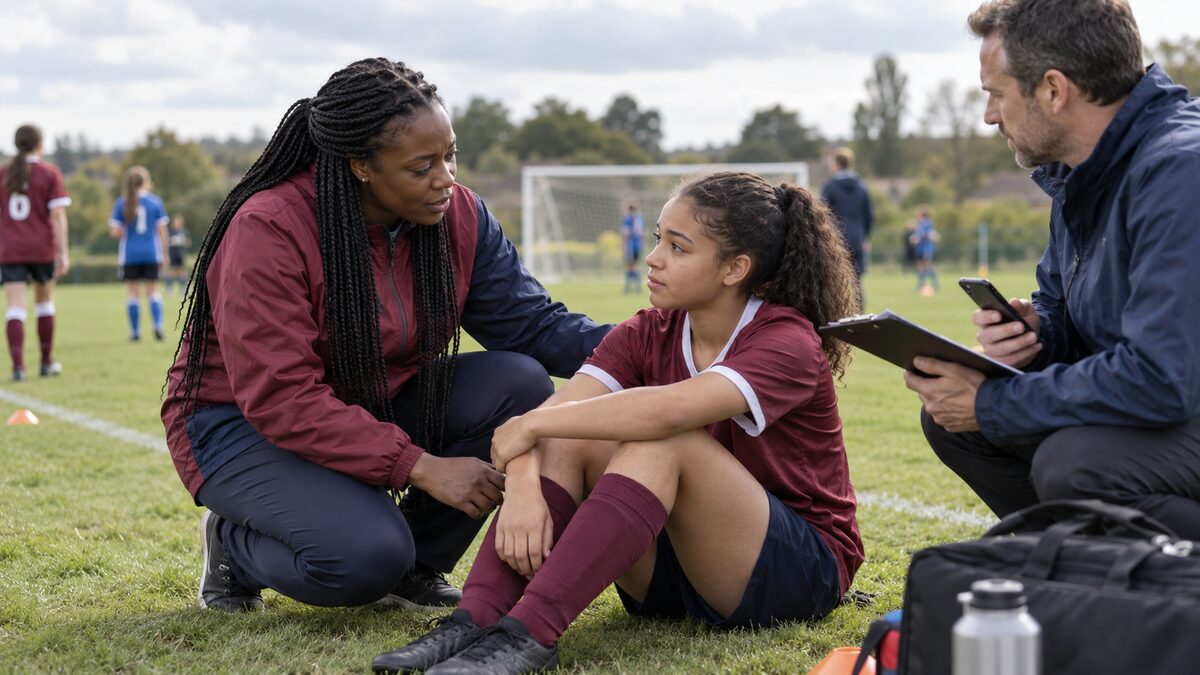
Image note: The featured image is an original conceptual AI-generated illustration. It is not documentary evidence of a real incident.
Sources
- Department for Culture, Media and Sport: landmark UK-wide grassroots concussion guidance (28 April 2023).
- UK Government: Concussion Guidelines for Grassroots Sport.
- NHS: Head injury and concussion (reviewed 29 May 2025).
- Sport England: new concussion guidelines for grassroots sport.
Discover more from Marychuks.com AI, Psychology, Business & CreativeVerse
Subscribe to get the latest posts sent to your email.