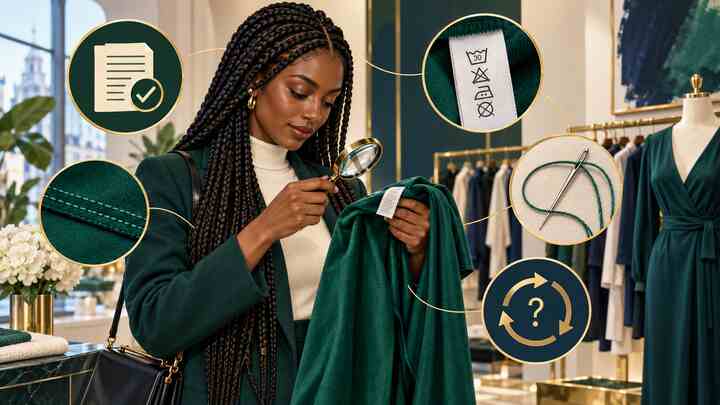
A green label can help you notice a garment. It cannot, by itself, tell you whether that garment is the better environmental choice. Words such as conscious, responsible and eco often sound precise while leaving the most important questions unanswered: which part of the product is being described, compared with what, and on the strength of which evidence?
The answer is not to dismiss every environmental claim. It is to read fashion marketing as carefully as you would read a price, size or care label. The following audit turns a vague impression into a practical buying decision.
Start by shrinking the claim
First, copy the claim into plain language. “Made with recycled fibres” is not the same statement as “the whole garment is recycled”, “this garment is recyclable” or “this garment has a lower overall impact”. A claim may apply to the outer fabric but not the lining, thread, zip, buttons, dyeing, packaging or delivery.
The UK Competition and Markets Authority’s Green Claims Code identifies six broad tests for environmental claims. They should be truthful and accurate; clear and unambiguous; should not omit important information; should make fair and meaningful comparisons; should consider the product’s full life cycle; and should be substantiated. Although the code is written for businesses, those principles make an excellent consumer checklist.
- What exactly is claimed? A fibre, a component, the finished garment, a collection or the whole brand?
- What is the comparison? The company’s previous version, an industry average, another material or no stated baseline at all?
- What important qualification sits nearby? Look for percentages, geography, dates, exclusions and conditions.
If the claim cannot survive those three questions, do not let an earthy colour palette or a leaf symbol do the evidential work.
Read the fibre label—but do not turn it into a moral scoreboard
In Great Britain, official textile-labelling guidance says a label must show fibre content, including fur and other animal parts. Where a product has two or more components with different fibre contents, each component’s content must be shown. This makes the sewn-in label one of the most useful pieces of verifiable information available in a shop.
Use it to test specificity. If the swing tag celebrates recycled polyester, what percentage appears on the composition label? Is that percentage for the shell, while the lining is different? If a garment is described as a “cotton blend”, what is the blend?
But avoid a simplistic natural-good, synthetic-bad hierarchy. Environmental performance depends on cultivation or extraction, processing, dyeing, manufacturing, transport, laundering, durability and disposal. Fibre composition is evidence about what an item contains; it is not a complete life-cycle verdict.
Look for evidence you can inspect
A credible claim should lead somewhere. The strongest supporting page will explain the method, boundary, date and responsible organisation. It may identify a recognised certification and let you verify the certificate. It may publish a product-level breakdown rather than a general corporate ambition.
By contrast, a paragraph about values, a photograph of a forest or a promise to “do better” may communicate intent without substantiating the claim on the garment in your hand. The Advertising Standards Authority’s updated July 2026 guidance on environmental claims emphasises how a claim is likely to be understood, the evidence needed to support it, and the importance of clear and responsible presentation.
Evidence is inspectable. Interpretation is the judgement you make after examining it. Keep the two separate.
Audit the garment, not only the slogan
A well-substantiated material claim can still sit on a poorly made garment. Longevity depends partly on design and construction, so spend two minutes checking the object itself.
- Seams: Are they straight, secure and free from loose loops? Gently pull the fabric across a seam and check whether the stitches gape.
- High-stress points: Examine pocket corners, underarms, crotch seams, buttonholes and strap attachments.
- Fastenings: Run the zip, test the press studs and check whether buttons feel firmly attached.
- Fabric behaviour: Does it recover after a gentle stretch? Does a dark or delicate surface already show abrasion, snagging or heavy pilling?
- Repairability: Is there enough seam allowance for a modest alteration? Are buttons and fastenings replaceable? Does the brand provide spare parts or repair information?
These observations do not produce a laboratory durability rating. They are practical indicators of whether the piece is likely to tolerate your real use.
Count the care burden
The care label reveals more than washing temperature. A garment that requires specialist cleaning, careful reshaping, frequent ironing or separation from every other colour may not fit your life. If those demands make you avoid wearing it, the environmental story on the hang tag becomes less relevant.
Ask four ordinary questions: Can I wash this with clothes I already own? Can I dry it without equipment I do not use? Can I remove likely stains? Can I maintain its shape? The best choice is often the garment you can wear repeatedly and care for competently, not the garment with the loudest claim.
Treat “circular” and take-back promises as questions
A collection bin proves that a company accepts returned items. It does not, on its own, prove that every item becomes new clothing. Ask what happens after collection: reuse, repair, fibre-to-fibre recycling, conversion into lower-grade material, energy recovery or disposal? Is the outcome measured and published? Are blended fabrics accepted? Does participation depend on a voucher that encourages another purchase?
Likewise, “recyclable” needs a realistic route, not merely a theoretical one. A technically recyclable garment offers little practical benefit if no accessible system can identify, separate and process it at scale. This is where the Green Claims Code’s full-life-cycle principle matters: a positive attribute should not obscure a larger limitation.
Use a personal wear test
Before buying, imagine three complete outfits, three occasions and the next twelve months. If the piece works with what you own, fits comfortably, survives your care routine and suits repeated use, it has a credible place in your wardrobe.
Some shoppers use a “30 wears” question: can I realistically see myself wearing this at least 30 times? Treat that number as a personal decision aid, not a universal scientific threshold. Evening wear, work uniforms, coats and everyday T-shirts serve different purposes. The useful part is forcing a forecast based on your behaviour rather than the excitement of the fitting room.
The five-minute fashion-claims audit
- Define: Restate the environmental claim precisely and identify its scope.
- Verify: Compare the marketing with the fibre label, percentages, methodology and certification.
- Inspect: Check seams, stress points, fabric behaviour, fastenings and repairability.
- Fit: Judge comfort, wardrobe compatibility and the care routine you will actually follow.
- Follow: Investigate what take-back, recyclable or circular means after the item leaves your hands.
A better question than “Is it sustainable?”
No garment is impact-free, and a single word cannot compress every trade-off into a trustworthy verdict. A more useful question is: What environmental advantage is being claimed, what evidence supports it, and is this a durable garment I will genuinely use?
That question leaves room for evidence, personal circumstances and uncertainty. It also shifts power back to the shopper. You do not need to solve the entire fashion system at the till. You need to recognise what is known, notice what is missing and choose without confusing a marketing mood for proof.
Editorial note: This article provides general consumer information, not a product endorsement or a life-cycle assessment. The featured image is an original conceptual AI-generated illustration and is not documentary evidence.
Discover more from Marychuks.com AI, Psychology, Business & CreativeVerse
Subscribe to get the latest posts sent to your email.